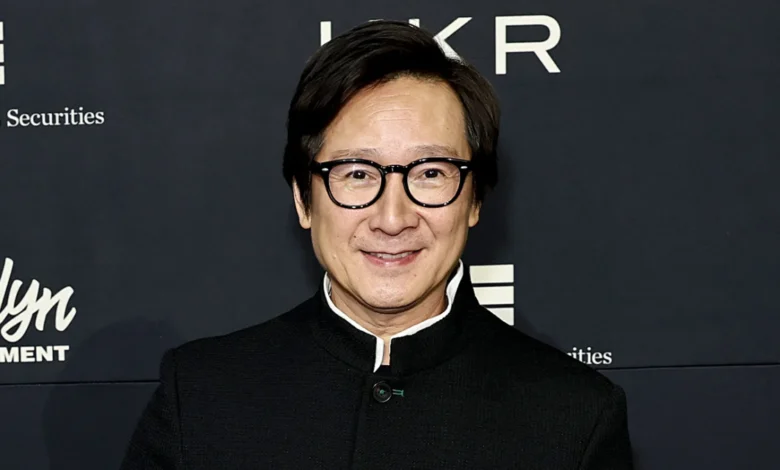
The intersection of child stardom, financial windfall, and the mentorship of Hollywood royalty is rarely as poignant as the story shared by Oscar winner Ke Huy Quan in his newly released memoir, Never Say Die. As the actor chronicles his journey from a young immigrant finding his footing in the American film industry to his triumphant return to the spotlight in recent years, one specific anecdote stands out: the moment he discovered that his work on Steven Spielberg’s 1984 blockbuster, Indiana Jones and the Temple of Doom, yielded a $100,000 residual check—an amount that, for a 12-year-old in the mid-1980s, was not only incomprehensible but transformative for his family’s economic stability.
The Genesis of a Career: From Short Round to Global Recognition
In 1984, Ke Huy Quan was a newcomer to the industry, cast as Short Round, the spirited sidekick to Harrison Ford’s iconic adventurer. The role was not merely a breakthrough; it was a cultural touchstone that introduced a generation to a character who was both a loyal companion and a source of comic relief. However, the reality of the business of filmmaking was far from the consciousness of the young actor.
As detailed in his memoir, Quan entered the industry with little understanding of the complex financial structures that govern the entertainment sector. At that time, the standard contractual arrangement for a child actor typically involved a base salary for the duration of production. The concept of residuals—payments made to actors for the reuse of their work in various media formats, such as television broadcasts or home video releases—was, for a child, a foreign abstraction.
The Kitchen Table Revelation: A Lesson in Generosity
The narrative provided in Never Say Die captures an intimate, domestic scene that serves as the backdrop for this financial milestone. Quan recalls walking into his family’s kitchen to find his parents, visibly stunned, clutching an envelope from Lucasfilm. The contents of that envelope, a check for approximately $100,000, represented a sum of money that significantly exceeded the typical compensation for a supporting performer of his age and experience level.
This unexpected influx of capital was not a standard occurrence in 1984. The film industry, particularly in the mid-80s, was transitioning from a studio-dominated era toward one where talent participation in back-end profits became more common for high-level stars, but remained virtually unheard of for supporting cast members, especially children. Quan explicitly attributes this to a “quiet gesture” by Steven Spielberg and George Lucas, the executive producer and creative force behind the Lucasfilm juggernaut. By including the young actor in a profit-sharing capacity, the filmmakers ensured that his contribution was valued beyond the initial production schedule.
The Mechanics of Residuals and Industry Standards
To understand the magnitude of this gesture, one must look at the historical context of residuals in the 1980s. The Screen Actors Guild (SAG) has long negotiated for residual payments, which serve as a critical secondary income stream for actors. However, receiving a large, lump-sum check of this nature in the early stages of a career is an anomaly.
In the 1980s, the home video market (VHS) was in its infancy, and television syndication was the primary driver of residuals. For a blockbuster film like Temple of Doom, the long-term revenue potential was immense. By ensuring that Quan received a share of the profits, Spielberg and Lucas effectively provided him with a form of financial security that would allow his family to navigate the uncertainties of immigrant life in America. For a family that had uprooted itself to start anew, this financial cushion was more than a paycheck; it was a cornerstone of their American success story.
A Career Interrupted and Resurrected
The trajectory of Quan’s career following his early success serves as a sobering reminder of the volatility of Hollywood. After starring in The Goonies (1985), Quan found himself facing a dearth of roles as he transitioned into adulthood. The industry’s failure to provide substantive, complex roles for Asian actors in the 1990s and 2000s led him to pivot away from acting, eventually working behind the scenes as a stunt coordinator and assistant director.
It was not until the 2022 release of Everything Everywhere All at Once that Quan reclaimed his position in the global cultural consciousness. His subsequent Academy Award for Best Supporting Actor was a culmination of decades of perseverance. Throughout his 2023 awards circuit run, including his Golden Globes victory, Quan was vocal about his gratitude toward those who gave him his start. His public acknowledgment of Spielberg—whom he thanked on stage during multiple ceremonies—highlights a lifelong professional and personal bond rooted in that initial act of kindness in the 1980s.
The Broader Implications of Mentorship and Fair Compensation
The financial history of the Indiana Jones production underscores a larger debate within the entertainment industry regarding the treatment of actors. While the current labor environment in Hollywood is defined by high-profile strikes and negotiations over streaming-era residuals, the story of Ke Huy Quan offers a historical perspective on how personal mentorship and ethical treatment of junior talent can shape the longevity of an actor’s career.
The “gesture” from Spielberg and Lucas was not just about the money; it was about acknowledging the humanity and the long-term welfare of a child on set. In an industry where young performers are often viewed as expendable assets, this approach stands as a case study in responsible leadership. When the creative heads of a production take an active interest in the financial well-being of their cast, the impact can be life-changing, as evidenced by the security this payment provided for the Quan family.
Historical Chronology of a Resilient Career
- 1984: Ke Huy Quan debuts as Short Round in Indiana Jones and the Temple of Doom. The film earns $333.1 million worldwide, cementing its place as one of the highest-grossing films of the decade.
- 1985: Quan stars in the cult classic The Goonies, furthering his profile as a young talent to watch.
- 1990s–2010s: Following a decline in suitable roles for Asian actors, Quan transitions to technical roles, working on films such as X-Men and Jet Li’s The One.
- 2022: The release of Everything Everywhere All at Once triggers a massive critical and commercial resurgence for Quan.
- 2023: Quan wins the Golden Globe, the SAG Award, and the Academy Award for Best Supporting Actor, marking one of the most celebrated comebacks in cinematic history.
- 2024: Publication of his memoir, Never Say Die, where he officially discloses the financial details of his early career with Lucasfilm.
Conclusion: A Legacy of Integrity
The disclosure of the $100,000 residual check is more than a footnote in Hollywood trivia; it is a testament to the enduring relationship between an icon of cinema and a young actor who never lost his passion for the craft. As Quan writes in his memoir, his initial fear was that his success as a child was merely a matter of luck, and that he would never reach those heights again. However, by sharing this story, he reinforces the idea that his success was built on a foundation of professional support and human kindness.
The narrative of his life—from a child actor receiving an unprecedented check from legends of the industry to an Oscar winner reflecting on the path that brought him there—serves as a reminder that the impact of a film goes beyond the screen. For Ke Huy Quan, that impact was measured in a check that arrived in a kitchen in the 1980s, providing the stability that allowed him to eventually return and claim his place in history.