In a significant political transition on Monday, July 20, 2026, Keir Starmer officially tendered his resignation as Prime Minister to His Majesty the King, marking the end of a six-and-a-half-year tenure that saw the Labour Party rise from a historic defeat to a landslide electoral victory. As Starmer departed Downing Street, his successor, Andy Burnham, prepared to be appointed the new Prime Minister, promising a departure from conventional politics and an immediate focus on the nation’s pressing economic challenges. The day unfolded with ceremonial gravity, personal reflections, and the palpable anticipation of a new political era.
Starmer’s Farewell: Reflecting on a Transformative Tenure
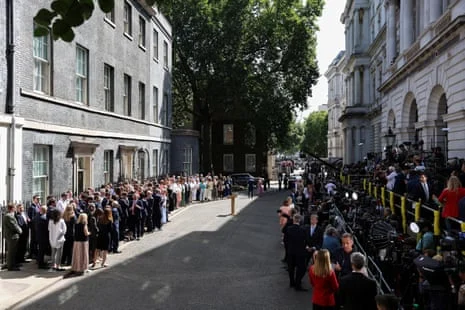
At 11:15 AM CEST, a solemn Keir Starmer emerged from 10 Downing Street to deliver his final address, a moment of transition witnessed by ministers, officials, and a throng of international journalists. "My work is done," Starmer declared, a statement that encapsulated the completion of a political journey beginning in the aftermath of Labour’s devastating 2019 general election loss. He reflected on his leadership, stating he had "changed [the] party so it was fit to face the country, and won a landslide general election victory in 2024."

Starmer underscored his government’s achievements over the preceding two years, expressing confidence that "Britain is now stronger and fairer than it was two years ago." He cited tangible improvements, including a stronger economy, a significant uplift in public services marked by "the biggest fall in waiting times for 17 years" – a crucial indicator given persistent concerns over the National Health Service (NHS) backlogs. His administration also claimed success in lifting children out of poverty daily, addressing a long-standing social inequality. Furthermore, Starmer highlighted a "significantly" reduced immigration rate and a strengthened defence and security posture, asserting that Britain’s international reputation had been "greatly enhanced."
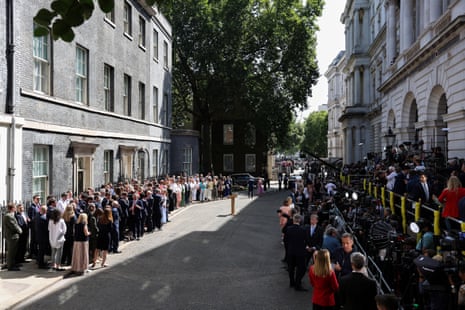
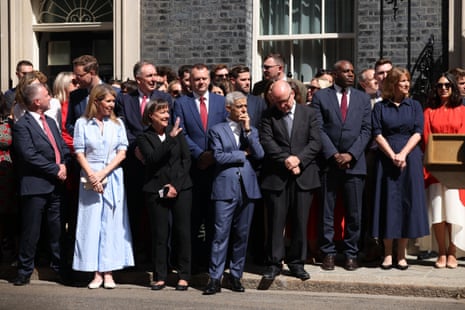
Among those gathered to witness Starmer’s departure were prominent figures like Rachel Reeves, David Lammy, and Sadiq Khan, testament to the broad support he once commanded within the party. Jenny Chapman, the development minister and a staunch ally, confirmed Starmer was "reconciled" to leaving office. She praised his perspective, suggesting his pre-politics experience grounded him, enabling a "smooth, respectful" transfer of power – a hallmark of British democratic tradition. The scene outside Downing Street, described by Guardian political correspondent Alexandra Topping as "pure theatre," was a blend of high-stakes political drama and meticulous logistical coordination, complete with the appearance of the venerable Downing Street cat, Larry, a constant presence through multiple premierships.
Burnham’s Ascent: A Promise of Change
Following Starmer’s resignation, attention swiftly turned to Andy Burnham, who was due to arrive at Downing Street around 12:40 PM CEST to deliver his inaugural speech as Prime Minister. Burnham’s appointment represents a strategic shift for Labour, replacing a leader who had, by the start of the year, become an "electoral millstone" with a politician widely admired across the country and, crucially, currently united behind by his party.
In a wide-ranging interview with Patrick Maguire of The Times, Burnham offered intriguing insights into his vision for governance, signaling a clear intention to break from established political norms. He vowed to govern "in a different way," challenging the conventional political approach that he believes "hasn’t been working" for the past decade. "Judge me in six, twelve months on whether I’ve lapsed back into that," he stated, emphasizing his commitment to a new methodology. This promise resonates deeply with a public often disillusioned by political infighting and perceived ineffectiveness.
Prioritising the Cost of Living and Economic Reform
A central plank of Burnham’s early agenda will be addressing the pervasive cost of living crisis that has impacted households across the UK. He confirmed plans for "early moves" to alleviate financial pressure, although specific measures are yet to be unveiled. Burnham indicated ongoing discussions with the Treasury regarding announcements expected within the week, reflecting the urgency of the issue. His focus stems from direct feedback heard on the doorsteps during campaigning, where frustrations over finances – the inability to afford simple pleasures like a pint, family outings, or holidays – were consistently voiced.
Burnham also articulated a "more sophisticated" economic critique, advocating for a shift towards "early investment, early intervention, setting people up for success, and much less paying for failure." This philosophy suggests a long-term, preventative approach to public spending, aiming to build resilience and foster growth from the ground up rather than reacting to crises. Crucially, he pushed back against the "tax raiser" label, highlighting public frustration with policies such as the frozen personal allowance, which has functioned as a stealth tax, eroding disposable income for many. While not committing to reversing the freeze, his acknowledgement signals a potential re-evaluation of current fiscal policies.
Policy Shifts and a "10-Year Plan"
One of the first tangible policy shifts under Burnham’s leadership is the announced scrapping of Keir Starmer’s digital ID scheme. Burnham defended this decision as an example of his administration’s different priorities, arguing it would free up resources from a project that "wouldn’t make a tangible difference to people’s lives anytime soon." This move not only marks a clear departure from his predecessor’s agenda but also signals a pragmatic approach to policy, prioritising immediate, perceptible benefits for citizens over potentially complex, long-term digital infrastructure projects.
Burnham revealed plans to outline a "10-year plan for the country" this week. He clarified that this ambitious timeframe reflects the scale of the structural changes he believes are necessary for Britain, rather than a personal declaration of how long he intends to remain in office. This vision suggests a desire for deep-seated reform, acknowledging that the country is "not in the right place structurally."
A New Political Style: Instinct, Listening, and Cross-Party Engagement

Burnham’s interview also offered glimpses into his personal approach to leadership. He emphasized trusting his "instincts," acknowledging that past political missteps occurred when he deviated from them. His commitment to listening to people, he stated, is paramount, and he intends to maintain this connection even as Prime Minister. In a symbolic move that starkly contrasts with his predecessor, Keir Starmer, who, as an Arsenal season ticket holder, was confined to the director’s box for security reasons, Burnham revealed he has persuaded the No 10 security team to allow him to continue attending Everton matches in his regular seat in the stands. This, he explained, is his "mega focus group," a vital channel for understanding public sentiment.
On the divisive nature of Westminster politics, Burnham expressed his shock at the extent of "negative briefing," calling for a collective reflection among politicians to avoid mimicking "the worst patterns of social media." He advocated for finding "common ground with anybody," even suggesting a willingness to engage with opposition figures like Kemi Badenoch, whom he deemed "much more capable than some of her predecessors," and Nigel Farage, whose "communication skills" he admired. This conciliatory stance could herald a less adversarial political climate.
Cabinet Formation and Immediate Challenges
The afternoon will see Burnham embark on the critical task of appointing his cabinet, a process that will define the ideological direction and administrative capacity of his new government. Already, James Timpson, the prison minister, has resigned, with speculation, notably from Sky News’ Beth Rigby, suggesting Sally Jameson, the MP for Doncaster Central and a former prison officer, as a potential successor. Timpson’s original appointment in 2024 was notable given his lack of traditional Labour political background, chosen for his liberal stance on penal policy and his company’s employment of ex-offenders. His departure highlights the immediate need for Burnham to consolidate his team and articulate a clear policy platform.
Burnham also touched upon personal details that shape his outlook, including his Catholic faith, which he hinted might lead to delegating Church of England-related decisions. He spoke movingly of his father, who suffers from dementia and is unable to fully grasp his son’s monumental achievement. A poignant detail was his father’s long-standing mission to persuade him to back proportional representation (PR), a policy Burnham has now embraced without his father’s full recognition.
Historical Context and Future Outlook
Burnham’s ascension marks the sixth change of Prime Minister in just over a decade, underscoring a period of significant political volatility in the UK. This frequent turnover, beginning with Theresa May replacing David Cameron in 2016, highlights an era where political leaders have struggled to maintain long-term public and party support. The unusual nature of this particular transition – replacing an incumbent Prime Minister with a popular regional politician who enjoys broad public appeal – signals Labour’s determination to present a fresh face and a unified front.
As Andy Burnham prepares to step into the highest office, the nation awaits not only his inaugural address but also the composition of his first cabinet and the concrete details of his "early moves" to address the cost of living. His promises of a "different way" of governance, a "10-year plan," and a more collaborative political style set a distinct tone for what promises to be a transformative, albeit challenging, period in British politics. The coming days and weeks will be crucial in defining the trajectory of this new administration and its ability to deliver on its ambitious promises to the British people.