a Cosmic Maverick: New Research Reveals the Milky Way is Forging Stars Where It Shouldn’t
Recent astrophysical investigations have upended long-held assumptions about the architecture of our home galaxy, revealing that the Milky Way is actively generating stars in a galactic zone previously thought entirely hostile to stellar birth. Published in the prestigious journal Nature Astronomy, the groundbreaking study not only redefines our understanding of celestial mechanics near the galactic center but also casts serious doubt on the true nature of one of the galaxy’s most prominent perceived features: the Norma spiral arm.
Led by Dr. Hillary Davis during the culmination of her doctoral studies at the University of Sydney’s School of Physics and the Sydney Institute for Astronomy, the research provides unprecedented clarity regarding the violent, dynamic forces shaping the deep interior of the Milky Way. By juxtaposing state-of-the-art galactic evolution simulations against empirical observations of cosmic masers—natural microwave lasers that signal stellar genesis—the international team of researchers has mapped a region obscured by billions of miles of interstellar dust and gas, potentially forcing cartographers of the cosmos to redraw the map of the Milky Way.
The Anatomy of a Barred Spiral Galaxy
To contextualize the significance of Dr. Davis’s discovery, astronomers must contend with the fundamental classification of the Milky Way. Our galaxy is not a simple pinwheel of stars rotating uniformly around a bright core; rather, it is a barred spiral galaxy. This classification means that slicing through the galaxy’s dense center is an enormous, elongated structure composed of billions of stars, known simply as the Galactic bar.
As this colossal stellar bar rotates over hundreds of millions of years, its intense gravitational field acts as a cosmic plow, driving through surrounding reservoirs of molecular hydrogen and dust. This motion generates immense shock fronts, compressing the ambient gas in a manner analogous to a supersonic jet breaking the sound barrier.
In the vast majority of barred spiral galaxies observed across the observable universe, these violent shock fronts act as localized extinguishers of stellar creation. The extreme kinetic energy and turbulence generated by the bar typically shred or heat gas clouds too rapidly for gravity to overcome, preventing the matter from collapsing into protostars. Consequently, star formation in external barred galaxies is almost exclusively quarantined to the outer spiral arms, while the central bars remain relatively barren stellar deserts.
However, the Milky Way appears to be defying this cosmic rule. According to the new study, our galaxy belongs to an elite and unexpected minority of systems where the shock fronts of the central bar are actively fostering, rather than suppressing, robust star formation on a massive scale.
Chronology of the Discovery: Peering Through the Cosmic Veil
Unraveling the inner workings of the Milky Way has historically presented one of the greatest challenges in observational astronomy. Because humanity resides approximately 26,000 light-years from the galactic center, embedded firmly within the galactic disk, obtaining a clear external perspective is impossible. Furthermore, dense lanes of cosmic dust situated between the solar system and the galactic core absorb visible light, effectively blinding conventional optical telescopes to the most chaotic regions of our galaxy.
Over the past several decades, astronomers have relied on infrared, radio, and X-ray astronomy to pierce the veil of dust, yet the precise geometry, mass, and rotational dynamics of the Galactic bar have remained fiercely debated.
To overcome these observational roadblocks, Dr. Davis and her collaborators adopted a multi-pronged methodological approach. They initiated a comparative analysis by deploying advanced, large-scale computer simulations capable of tracking the gravitational and hydrodynamic evolution of galaxies over timescales spanning billions of years. These models simulated how gas is compressed, channeled, and shocked under varying galactic parameters.
Crucially, the team anchored their digital models to hard observational data by tracking cosmic masers—microwave amplification by stimulated emission of radiation. In astrophysical contexts, masers serve as reliable signposts for the birth of massive stars, firing intense beams of microwave radiation that easily cut through the galactic dust. By mapping the precise celestial coordinates and velocities of these masers, the researchers sought to locate where massive stars were actively assembling.
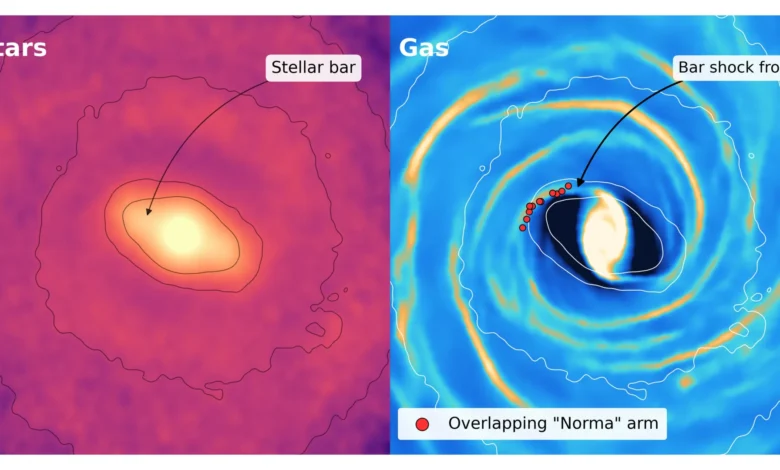
The breakthrough occurred when the team discovered an astonishing spatial correlation between the observed masers and the theoretical shock fronts predicted by their computer simulations. The empirical data aligned so neatly with the models that it forced a radical reevaluation of what astronomers are actually observing in the inner galaxy.
Challenging the Map: The Enigma of the Norma Arm
Perhaps the most provocative implication of the new research centers on the Norma spiral arm. Named after the constellation Norma as viewed from Earth’s southern hemisphere, this feature has long been cataloged in standard galactic atlases as a major spiral arm sweeping through the inner Milky Way.
However, the alignment between the simulation-predicted shock fronts and the observed masers revealed a startling alternative explanation. The data strongly suggests that at least a significant portion of the stellar phenomena previously attributed to the Norma spiral arm is not part of a spiral arm at all. Instead, these regions appear to be manifestations of intense star formation occurring directly along the leading edge of the rotating Galactic bar.
"We found that masers previously associated with the Norma arm closely align with the shock front predicted by our simulations," explained Dr. Davis. "This suggests that at least part of the so-called Norma arm may not be a spiral arm at all, but a region of star formation along the leading edge of the Galactic bar."
If validated by subsequent observations, this revelation fundamentally alters our comprehension of the Milky Way’s inner morphology. It implies that cartographers of our galaxy have misidentified a key structural component, confusing the turbulent wake of the bar for the sweeping curve of a spiral arm. Such a shift demands a comprehensive revision of galactic structural models, proving that even our nearest cosmic neighborhood still harbors profound topographical surprises.
Refining the Dimensions of the Galactic Bar
Beyond rewriting the narrative of the Norma arm, the study provides vital constraints on the physical dimensions and operational parameters of the Galactic bar itself. For years, estimates regarding the length, viewing angle, and rotation speed of the bar have varied wildly among astronomical research groups.
By successfully matching their dynamic simulations to real-world maser data, Dr. Davis’s team was able to narrow down the acceptable parameters for the bar with unprecedented precision. The analysis indicates that the Milky Way’s central bar extends approximately 4.3 kiloparsecs—roughly 14,000 light-years—outward from the exact center of the galaxy along its major axis.
This measurement reinforces the prevailing theory that the Milky Way possesses a relatively long, robust bar that rotates at a measured, deliberate pace, profoundly influencing the orbits of billions of stars and vast complexes of interstellar gas. The synergy between high-performance computing and targeted radio astronomy demonstrates a powerful new paradigm for exploring otherwise inaccessible regions of the cosmos.
Broader Implications and Future Astronomical Outlook
The publication of these findings in Nature Astronomy has resonated widely within the global astrophysical community, offering a timely reminder of how much remains unknown about the galaxy we inhabit. As observational technology continues to advance—bolstered by next-generation ground-based radio telescope arrays and space observatories—astronomers will be able to test the boundaries of Dr. Davis’s models with even finer resolution.
The implications extend beyond our own galaxy, providing a crucial point of comparison for extragalactic astronomers. By understanding how the Milky Way manages to defy the destructive tendencies of its bar and foster star birth within shock fronts, researchers gain a deeper, more nuanced appreciation of galactic evolution across the universe. It highlights that the Milky Way is not a generic template, but a dynamic, idiosyncratic system with its own unique evolutionary history.
Funding for this landmark research was provided by a consortium of major scientific organizations, including the Australian Research Council, the Knut and Alice Wallenberg Foundation, the Swedish Research Council, the Swedish National Space Agency, the LMK Foundation, and the eSSENCE strategic collaboration in Sweden. Computational heavy lifting and secure data archiving were facilitated by the National Computing Infrastructure (NCI) Australia—an NCRIS capability backed by the Australian Government—alongside LUNARC, the Centre for Scientific and Technical Computing at Lund University.
As scientists continue to process the data and refine their digital models, the message from the heart of the Milky Way is clear: the universe continues to reward those who look closer, and even a well-studied galaxy like our own still holds the power to surprise.