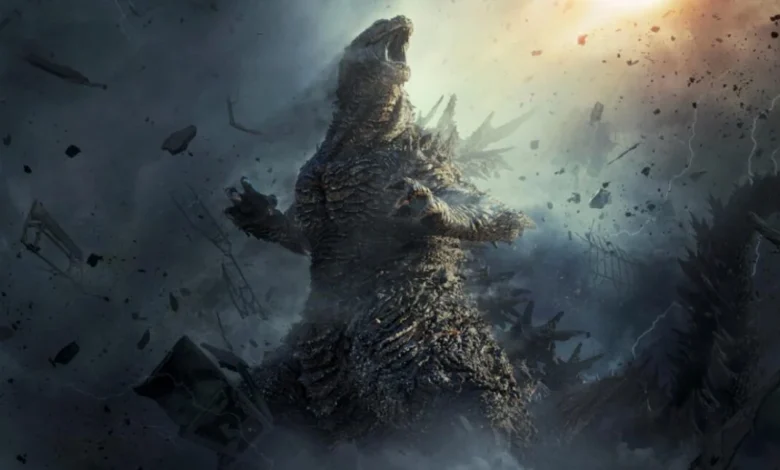
The cinematic landscape of the 21st century has been significantly shaped by the resurgence of practical-digital hybrid filmmaking, a triumph most prominently demonstrated by Toho’s ongoing revitalization of its flagship franchise. Set two years after the cataclysmic events of its Academy Award-winning predecessor, Godzilla Minus Zero re-establishes a fragile post-war Japan striving for normalcy. Returning director Takashi Yamazaki deftly navigates the emotional aftermath of the original narrative, anchoring the high-stakes science fiction in deeply human stakes. Ryunosuke Kamiki and Minami Hamabe reprise their acclaimed roles as Kōichi Shikishima and Noriko, alongside Kio Nagatani as young Akiko. This domestic tranquility, however, is short-lived. The arrival of a mysterious meteorite heralds the emergence of a new extraterrestrial kaiju, setting into motion a sequence of events that expands the cinematic universe, elevates production parameters, and redefines the scale of modern monster destruction.
Narrative Premise and the Arrival of a New Adversary
The narrative framework of Godzilla Minus Zero pivots away from pure post-war devastation toward an imminent planetary-scale crisis. The film opens with the Shikishima family attempting to construct a peaceful existence amidst the ruins of a recovering Tokyo. This hard-won peace is shattered when an unverified celestial body impacts the region. Local wildlife falls victim to serpentine, tentacled horrors that quickly feed and metamorphose into a formidable dragon-like organism. Fans of the enduring franchise immediately recognize this entity as King Ghidorah, whose shadow had been heavily foreshadowed in promotional marketing campaigns.
Faced with this unprecedented menace, civil defense structures are mobilized. Kenji Noda, portrayed by Hidetaka Yoshioka, returns as the Director of the Large-Scale Disaster Response Bureau—distinguished by his signature wavy gray hair and pragmatic administrative approach. Recognizing the limitations of standard military response, Noda once again enlists the traumatized former kamikaze pilot Kōichi Shikishima to aid in operational strategy.
To track the relentless movement of the new threat, the bureau relies heavily on advanced meteorological data. Meteorologist Makoto Aoyama, played by Masami Nagasawa, utilizes tracking algorithms to monitor electrical storms and atmospheric anomalies that precede Ghidorah’s path of destruction. Despite this sophisticated early-warning system, governmental and scientific agencies remain entirely unequipped to neutralize the creature, whose regenerative and destructive capacities far surpass conventional ordnance. True to the thematic conventions of the genre, the impending clash inevitably demands the eventual resurgence of an adversarial Godzilla, setting the stage for a monumental confrontation.
Chronology of Production and Technical Innovation
The development of Godzilla Minus Zero represents a significant financial and technical milestone for Toho Studios. Following the unprecedented domestic and international success of the 2023 film—which secured an Oscar for Best Visual Effects—director Takashi Yamazaki was entrusted with a substantially larger production budget. This increased financial allocation is evident across every frame, manifesting in more intricate creature modeling, larger-scale set pieces, and a seamless integration of computer-generated imagery with practical effects work.
Significantly, Godzilla Minus Zero holds the historic distinction of being the first Japanese feature film shot natively for the IMAX format. Exhibitors and industry analysts have noted that the aspect ratio and visual fidelity demand the premium large-format experience to fully appreciate the complex choreography of the monster sequences. Yamazaki deliberately maintained the visual tone, lighting palette, and atmospheric gravity of the predecessor, ensuring stylistic continuity while leveraging contemporary digital tools.
The chronology of the film’s internal timeline places the events precisely 24 months after the initial Godzilla attack. The pacing of the narrative meticulously maps out the escalation: initial unconfirmed reports of ecological anomalies in the Japanese countryside, followed by the dramatic atmospheric disruptions mapped by Aoyama’s meteorological team, culminating in the full-scale manifestation of Ghidorah. When military forces attempt a conventional bombing campaign against the multi-headed menace, the strategy backfires catastrophically. The attack triggers a biological mutation, forcing the entity to evolve into its iconic three-headed King Ghidorah configuration.
Visual Effects, Budget Allocation, and Choreography
A substantial portion of the expanded production budget was directed toward creature design and action choreography. The cinematic realization of King Ghidorah required complex digital rendering to convey both its serpentine agility and its devastating offensive capabilities. Among the most notable additions to the monster’s repertoire in this iteration is the introduction of a specialized "gravity beam." Unlike the traditional energy ray, this hyper-dense energetic output exhibits localized gravitational manipulation, allowing the creature to levitate entire residential structures—and, during the narrative climax, the freshly regenerated Godzilla itself—high into the air before slamming them back into the earth.
The resulting kaiju versus kaiju combat sequences represent some of the most ambitious choreography attempted in the 70-year history of the franchise. Rather than relying on simple, repetitive destruction loops, the battle between Godzilla and King Ghidorah is choreographed with spatial awareness and tactical escalation. The camera work, tailored specifically for IMAX presentation, emphasizes the sheer tonnage and physical devastation of the combatants, contrasting the colossal scale of the monsters with the fragile infrastructure of the surrounding geography.
Critical Reception and Industry Implications
As details of the plot and technical achievements circulate among industry insiders and film critics, the broader implications for the global monster movie genre are substantial. By proving that a Japanese-produced live-action film can successfully utilize cutting-edge digital effects while retaining narrative depth and historical resonance, Toho has established a new standard for international genre filmmaking.
Industry analysts suggest that the decision to film natively in IMAX will likely influence future greenlight decisions for high-budget Asian cinema, signaling a shift toward premium-format optimization from the inception of principal photography. Furthermore, the narrative integration of classic Showa-era monsters like King Ghidorah into Yamazaki’s grounded, post-war continuity demonstrates that fantastical elements can coexist with serious historical trauma without sacrificing dramatic integrity.
While major plot developments—such as the exact mechanics of Godzilla’s return and the ultimate resolution of the human characters’ arcs—remain guarded by studio embargoes, the early consensus points to a polished, emotionally grounded blockbuster. Godzilla Minus Zero avoids the pitfalls of franchise fatigue by treating its source material with architectural precision, balancing the visceral thrill of giant monster combat with the enduring human story of resilience in the face of insurmountable odds.