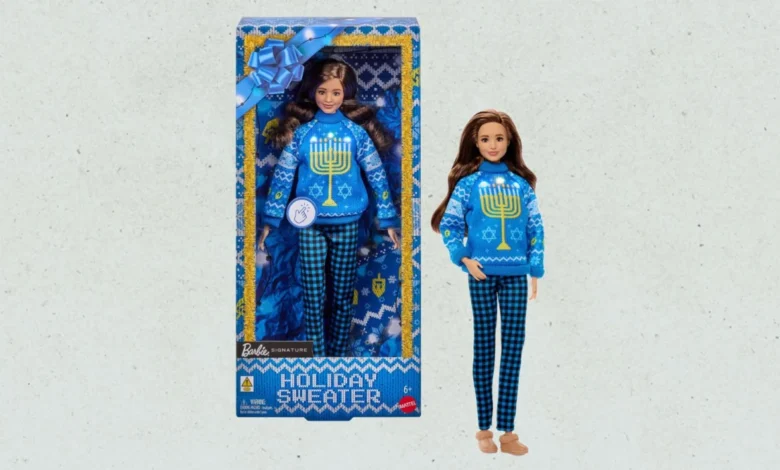
The holiday season is officially underway in the toy retail sector following Mattel’s introduction of a new Hanukkah-themed Barbie doll, highlighted by an interactive holiday jumper featuring a functioning, nine-branched menorah. Released to major retailers this week, the 11-inch collectible forms a key component of the manufacturer’s expanding "Ugly Sweater" doll collection. Retailing for under $30 at outlets including Walmart, the product has drawn substantial consumer interest, with sales velocity prompting heightened inventory tracking as the winter holiday season approaches.
The release arrives amid a broader trend of inclusive toy design by major manufacturers seeking to reflect diverse cultural traditions during the year-end gift-buying period. Alongside its cultural significance, the doll has captured attention for technical accuracy in its holiday iconography, a detail heavily discussed across digital platforms. With historical ties to Mattel’s co-founder and ongoing momentum from recent high-profile celebrity collaborations, the Hanukkah Barbie highlights the intersection of modern toy marketing, cultural representation, and consumer collecting habits.
Chronology and Product Rollout
The rollout of the Hanukkah Barbie aligns with Mattel’s pre-holiday release schedule, which traditionally begins scaling in the early autumn months to accommodate global supply chain logistics and anticipated consumer demand. This year’s holiday lineup features a diverse assortment of festive apparel designed for the iconic doll line, branching out from traditional Christmas-centric designs to incorporate broader winter festivities.
Hanukkah, which spans eight days and nights, is scheduled to run from December 4 through December 12. Retailers began listing the doll online earlier this week, instantly generating heightened digital traffic. Inventory monitoring data from primary distributors indicates that hundreds of units were purchased within the initial 24-hour window following the product drop. Industry analysts anticipate that sales volume will accelerate steadily as the first night of the holiday approaches, mirroring historical purchasing patterns for seasonal cultural items that often experience sudden scarcity due to limited manufacturing runs.

Design Accuracy and Cultural Significance
A primary driver of the doll’s early viral success on platforms such as TikTok and Reddit centers on the detailed execution of its holiday sweater. The miniature garment features an illuminated menorah pattern. Social media users and cultural commentators specifically commended the design team for ensuring the candelabrum possesses the correct number of branches.
In popular culture and commercial holiday merchandise, menorahs are occasionally depicted with an incorrect number of holders—most commonly seven instead of the traditional nine required for Hanukkah (which includes eight lights for each night of the festival plus the central shamash candle used for lighting). Barbie’s version accurately incorporates all nine distinct points, a detail that was widely celebrated across cultural forums online for its authenticity.
Commentary shared across digital communities also emphasized the broader importance of mainstream institutional representation. One widely circulated reaction from a forum user expressed enthusiasm that a global brand incorporated the specific holiday into its seasonal lineup with such attention to detail. In addition to the Hanukkah-themed release, the "Ugly Sweater" series includes two companion dolls dressed in seasonal Christmas-themed crewnecks, creating a cohesive multi-cultural holiday offering for collectors and children alike.
Historical Context and Mattel’s Legacy
The release of a culturally specific Jewish holiday doll carries a distinct historical resonance given the origins of the brand. Barbie was created by Ruth Handler, who co-founded Mattel alongside her husband, Elliot Handler, in 1945. Handler served as the company’s first president and played a foundational role in shaping the toy industry through the introduction of the Barbie doll in 1959, an innovation that revolutionized fashion dolls by giving an adult figure to play with.

Handler, who was Jewish and the daughter of Polish-Jewish immigrants, built Mattel into a global powerhouse. More than eight decades after the company’s establishment, Barbie remains an enduring cultural artifact. Industry estimates indicate that the brand maintains a staggering manufacturing and sales rate, moving approximately three dolls every second globally. The introduction of culturally nuanced holiday dolls represents a continuation of the brand’s evolution toward global inclusivity, aligning with modern consumer expectations for representation while honoring the diverse backgrounds of its foundational creators.
Broader Impact and Market Implications
The launch of the Hanukkah Barbie follows a series of successful, high-engagement product drops by Mattel that have capitalized on cross-generational appeal. Earlier this season, the brand released a viral Lenny Kravitz "Kenbassador" doll, which sparked intense online interest and nearly sold out online within days of its debut after thousands of collectors secured pre-orders.
These targeted, culturally relevant, and celebrity-aligned releases demonstrate a deliberate shift in toy marketing strategy. Rather than relying solely on traditional evergreen inventory, manufacturers are leveraging scarcity, digital word-of-mouth, and niche representation to drive engagement among adult collectors—often referred to in the industry as "kidults"—who comprise a rapidly growing segment of the toy market.
For consumers seeking to purchase the Hanukkah Barbie, retail availability remains fluid. While major big-box retailers like Walmart list the item under the $30 price point, secondary markets and third-party sellers have begun monitoring stock levels closely as the holiday window narrows. Market analysts suggest that consumers interested in securing the doll for the upcoming holiday season should monitor official distributor channels directly, as high demand and limited seasonal manufacturing runs routinely lead to temporary out-of-stock statuses for high-profile cultural items of this nature.