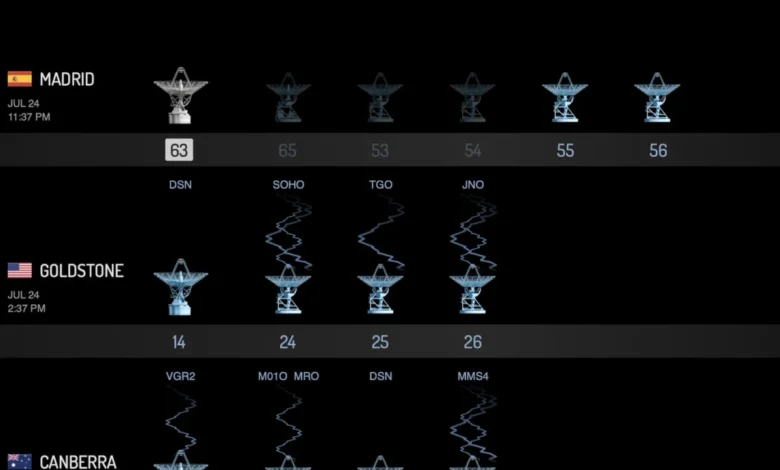
The Madrid Deep Space Communications Complex (MDSCC), a pivotal component of NASA’s global Deep Space Network (DSN), has ceased all operations due to the escalating threat of wildfires in the surrounding region of Spain. This critical outage, confirmed on Friday afternoon, leaves the DSN with significantly constrained capabilities for communicating with distant spacecraft, particularly impacting the vital 70-meter antenna network. While the DSN complexes in Goldstone, California, and Canberra, Australia, maintained active communications with missions such as Voyager 2, exploring interstellar space, and Juno, orbiting Jupiter, the Madrid site’s unexpected closure underscores the vulnerabilities of essential global infrastructure to environmental crises.
The Deep Space Network: An Overview of Humanity’s Cosmic Lifeline
The Deep Space Network is an indispensable international array of large radio antennas that supports interplanetary spacecraft missions for NASA and other space agencies worldwide. Established in 1958, its primary function is to provide the two-way radio link that allows mission controllers on Earth to send commands to spacecraft and receive scientific data and telemetry back from them. This communication is vital for everything from steering probes through the solar system to collecting breathtaking images and groundbreaking scientific measurements from distant planets, moons, asteroids, and even beyond our solar system.
Comprising three geographically separated complexes—Goldstone, near Barstow, California; Madrid, near Robledo de Chavela, Spain; and Canberra, near Tidbinbilla, Australia—the DSN is strategically positioned roughly 120 degrees of longitude apart. This global distribution is not arbitrary; it ensures continuous communication with spacecraft as the Earth rotates, allowing for uninterrupted tracking and data reception for deep space missions that are always "above the horizon" for at least one of the complexes. Each complex is equipped with multiple antennas of varying sizes, including the largest and most powerful, the 70-meter (230-foot) dishes, capable of detecting extremely faint signals from billions of miles away. These colossal antennas are particularly crucial for older, more distant missions like the Voyagers, whose signals have attenuated significantly over their decades-long journeys. The smaller 34-meter antennas offer more flexibility and can handle a larger volume of missions closer to Earth or with stronger signals. The network’s robust design and redundant capabilities are typically its strength, but recent events have tested its resilience.
Madrid Complex Silenced by Spreading Wildfires
The Madrid Deep Space Communications Complex, operated by Spain’s National Institute for Aerospace Technology (INTA) under an agreement with NASA’s Jet Propulsion Laboratory, is located approximately 60 kilometers (37 miles) west of Madrid in the municipality of Robledo de Chavela. It hosts several antennas, including one of the critical 70-meter dishes, DSS-63, and multiple 34-meter antennas. Its role in tracking missions traversing the inner and outer solar system is paramount, providing crucial communication windows that complement those offered by its sister sites.
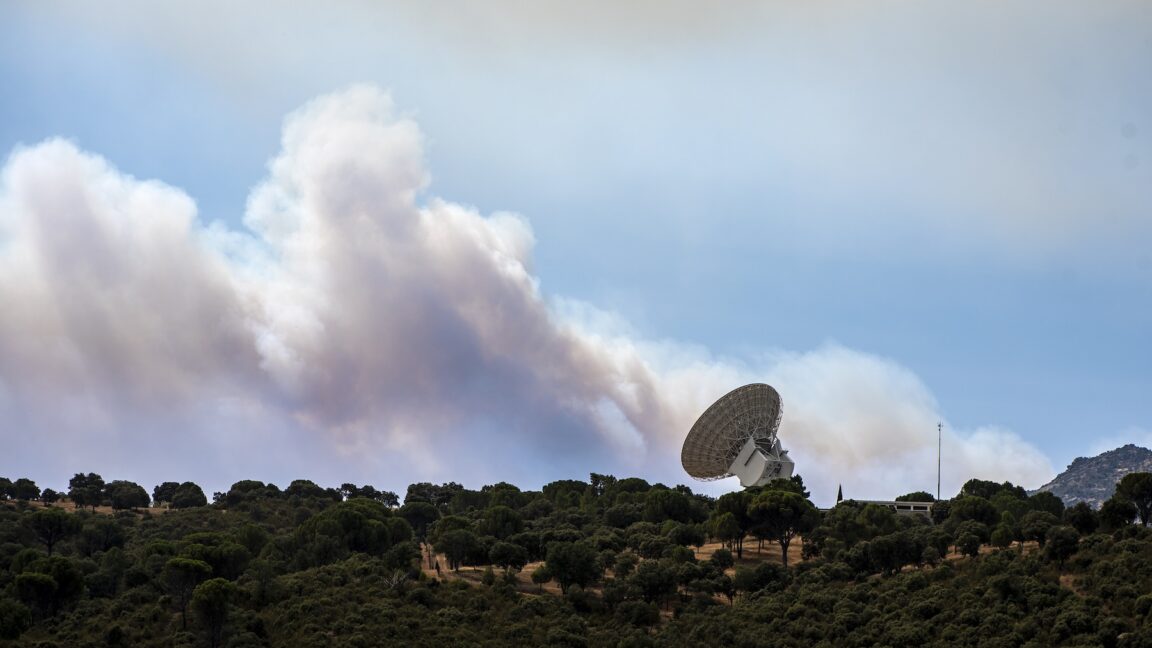
The decision to cease operations at MDSCC was a direct response to the encroaching wildfires, which have ravaged parts of the region. A NASA statement emphasized the immediate priority: "The safety and well-being of our personnel is our highest priority and our thoughts are with the families and neighbors who are also experiencing the impact of the wildfires in the surrounding communities. We will provide updates as conditions evolve." This sentiment underscores the human element behind the complex technical operations, as staff and their families face direct threats from the natural disaster. The closure of such a vital facility highlights the far-reaching impact of environmental crises, extending beyond immediate ecological damage to critical global infrastructure.
Regional Crisis: Spain’s Battle Against Blaze
The wildfires forcing the closure of the Madrid DSN complex are part of a broader, devastating wave of blazes sweeping across Spain and other parts of Southern Europe. Reuters reported that Spanish authorities had ordered the evacuation of more than 19,000 people from towns in the mountains west of Madrid, indicating the scale and severity of the threat. Emergency services have deployed over 2,000 personnel and 10 aircraft in a relentless effort to combat the infernos, which have consumed vast tracts of forest and threatened countless homes.
These wildfires are fueled by a perilous combination of a prolonged summer heatwave, pushing temperatures to extreme levels, and chronic drought conditions that have left vegetation tinder-dry. Scientific consensus points to climate change as a significant exacerbating factor, increasing the frequency, intensity, and duration of heatwaves and droughts, thereby creating ideal conditions for megafires. The current crisis in Spain mirrors similar struggles faced by neighboring France and other Mediterranean countries, illustrating a growing regional vulnerability.
Adding to the complexity, a separate deep space tracking station, the Cebreros tracking station, also fell victim to the same environmental threat. Owned and operated by the Spanish government and the European Space Agency (ESA) as part of ESA’s Estrack network, the Cebreros facility is located just a few miles from NASA’s DSN site. Spanish news reports confirmed its evacuation due to the wildfires. The Cebreros station, with its 35-meter antenna, plays a crucial role in ESA’s interplanetary missions, including those to Mars and Mercury. The simultaneous evacuation of both major deep space communication facilities in the region underscores the widespread nature of the crisis and creates an unprecedented bottleneck in European deep space communication capabilities.
A Network Under Strain: The Goldstone Anomaly
The operational halt at Madrid comes at an already challenging time for the Deep Space Network. The 70-meter antenna at the Goldstone Deep Space Communications Complex in California, DSS-14, has been offline since late last year following a severe incident. This critical antenna, often referred to as "Mars" due to its historical role in Mars missions, suffered an "over-rotation" during routine operations. This mechanical malfunction caused significant damage to its intricate internal structure, specifically impacting vital cables and water lines. The incident led to an estimated 200,000 gallons of glycol-containing water flooding the base of the antenna, posing not only a technical repair challenge but also an environmental hazard requiring extensive cleanup.
The Goldstone outage has placed immense pressure on the remaining 70-meter antennas in Madrid and Canberra. The repair and cleanup efforts at Goldstone are projected to cost between $4.1 million and $4.6 million, a substantial investment that NASA officials are combining with already-planned modernization upgrades for the facility. This strategic decision aims to maximize efficiency and bring the antenna back online with enhanced capabilities. However, the work is extensive and complex, with the antenna not expected to return to service until at least 2028. This means that, even under normal circumstances, the DSN has been operating with only two of its three primary 70-meter dishes for nearly a year, and now, with Madrid offline, it’s down to just one.
Navigating the Cosmos with Limited Channels
The simultaneous unavailability of the Madrid and Goldstone 70-meter antennas represents an unprecedented challenge for NASA’s deep space missions. With only the Canberra complex’s 70-meter antenna (DSS-43) fully operational, the network’s capacity to communicate with the most distant and demanding spacecraft is severely constrained.
Voyager 2, for instance, currently exploring interstellar space billions of miles from Earth, transmits an incredibly faint signal. Detecting this signal and sending commands back requires the utmost sensitivity, a capability primarily provided by the 70-meter dishes. With two of the three offline, communication windows for Voyager 2 become significantly narrower, and the risk of lost data or delayed commands increases. While the Canberra antenna can cover a portion of Voyager 2’s trajectory, the lack of redundancy means any technical issue or adverse weather at the Australian site could temporarily sever contact with this historic mission.
Juno, orbiting Jupiter, presents a different challenge. While closer than Voyager 2, it generates a massive volume of scientific data that needs to be transmitted back to Earth. High data rates typically rely on sustained communication windows and often utilize the larger antennas. While the 34-meter antennas at Goldstone and Canberra can support Juno, the absence of Madrid’s support means that data downlink times might need to be carefully scheduled and potentially reduced, impacting the cadence of scientific returns.
Beyond these high-profile missions, numerous other spacecraft rely on the DSN, including Mars orbiters and rovers (e.g., Perseverance, Curiosity), the New Horizons probe past Pluto, and various heliospheric missions. While many of these utilize 34-meter antennas, the overall strain on the network means that mission planners will have to meticulously prioritize communication times, potentially leading to longer waits for data downloads or command uplinks for less critical operations. The DSN’s inherent design includes a degree of redundancy, where smaller antennas can sometimes substitute for larger ones, albeit with reduced data rates or signal strength. However, this situation pushes the limits of such contingency planning.
The Lifeline for Deep Space Exploration
The Deep Space Network is more than just a collection of antennas; it is the fundamental lifeline connecting humanity to its pioneering robotic explorers. Without the DSN, the vast majority of deep space missions would be impossible, halting the flow of revolutionary scientific data that expands our understanding of the universe. From confirming the existence of water on Mars to capturing the first close-up images of Pluto, every major discovery from beyond Earth’s orbit has relied on the DSN’s capabilities. Its importance extends beyond scientific discovery to inspiring future generations and demonstrating humanity’s reach into the cosmos. The current operational challenges underscore just how vital this infrastructure is and how vulnerable it can be to unforeseen events, whether technical malfunctions or environmental disasters.
Artemis Program’s Future Demands
The timing of these DSN outages, while immediately critical for ongoing robotic missions, also casts a shadow over future human spaceflight endeavors, particularly NASA’s ambitious Artemis program. The Artemis missions aim to return humans to the Moon, establish a sustainable lunar presence, and eventually pave the way for human exploration of Mars. These missions will place extraordinarily high demands on the DSN.
Unlike robotic probes, human-rated spacecraft require constant, real-time communication for safety and operational control. This includes continuous telemetry streams to monitor astronaut health and spacecraft systems, high-resolution imagery downlinks for mission planning and public outreach, and critical voice communication between crew and ground control. The data volume and latency requirements for human spaceflight are far more stringent than for most robotic missions.
The good news for DSN is that the next Artemis mission, Artemis III, which will fly in low-Earth orbit to test the Orion capsule with commercial Moon landers from SpaceX and Blue Origin, is still at least a couple of years away. This mission, while important, will primarily use near-Earth communication networks for its LEO phase. However, Artemis IV, slated for no earlier than 2028, is the program’s first planned lunar landing with astronauts and will require the full, robust capabilities of the DSN. By 2028, NASA anticipates the Goldstone 70-meter antenna will be back online. The hope is that the Madrid complex will also have fully recovered from the wildfire impact and be operational well before then. Any prolonged unavailability of the DSN’s 70-meter antennas could necessitate significant rescheduling or alterations to the Artemis mission profiles, given the tight launch windows and complex orbital mechanics involved in lunar journeys.
Mitigation and Modernization Efforts
In response to both ongoing challenges and future demands, NASA and its partners are actively pursuing strategies for DSN resilience and modernization. The immediate focus during the Madrid outage involves dynamic rescheduling of communication windows, prioritizing missions based on criticality and data needs, and potentially leveraging smaller antennas at the operational sites to pick up some slack, albeit with reduced performance. International cooperation, such as potential increased reliance on ESA’s Estrack network (once Cebreros is back online), could also play a role in mitigating short-term impacts.
Long-term, the DSN is undergoing a significant modernization effort. This includes upgrading existing antennas with state-of-the-art electronics, improving data processing capabilities, and exploring new communication technologies like Ka-band frequencies and optical communications (laser links). These upgrades aim to enhance data rates, increase efficiency, and improve the network’s overall robustness against future outages. The repairs at Goldstone are being integrated into these broader modernization plans, ensuring that the return of DSS-14 will also mark a step forward in the network’s capabilities. Furthermore, NASA consistently evaluates its contingency plans for DSN operations, learning from incidents like the Goldstone anomaly and the Madrid wildfires to build a more resilient and adaptable communication infrastructure for the future.
Looking Ahead: Resilience in Space Communication
The temporary shutdown of the Madrid Deep Space Communications Complex due to raging wildfires, combined with the extended outage of the Goldstone 70-meter antenna, presents a formidable challenge to NASA’s deep space communication capabilities. It underscores the intricate interdependencies of global infrastructure, environmental conditions, and humanity’s ambitions in space. While the immediate focus remains on personnel safety and the containment of the fires, the broader implications for ongoing scientific missions and future human exploration endeavors are profound. NASA’s commitment to prioritizing safety while also planning for resilience and modernization will be crucial in ensuring that humanity’s cosmic lifeline remains robust and capable of supporting the next generation of discoveries and explorations. The world watches, not only the flames in Spain but also the distant signals from our robotic ambassadors, relying on the tireless work of those who maintain the silent, vital connections across the void.