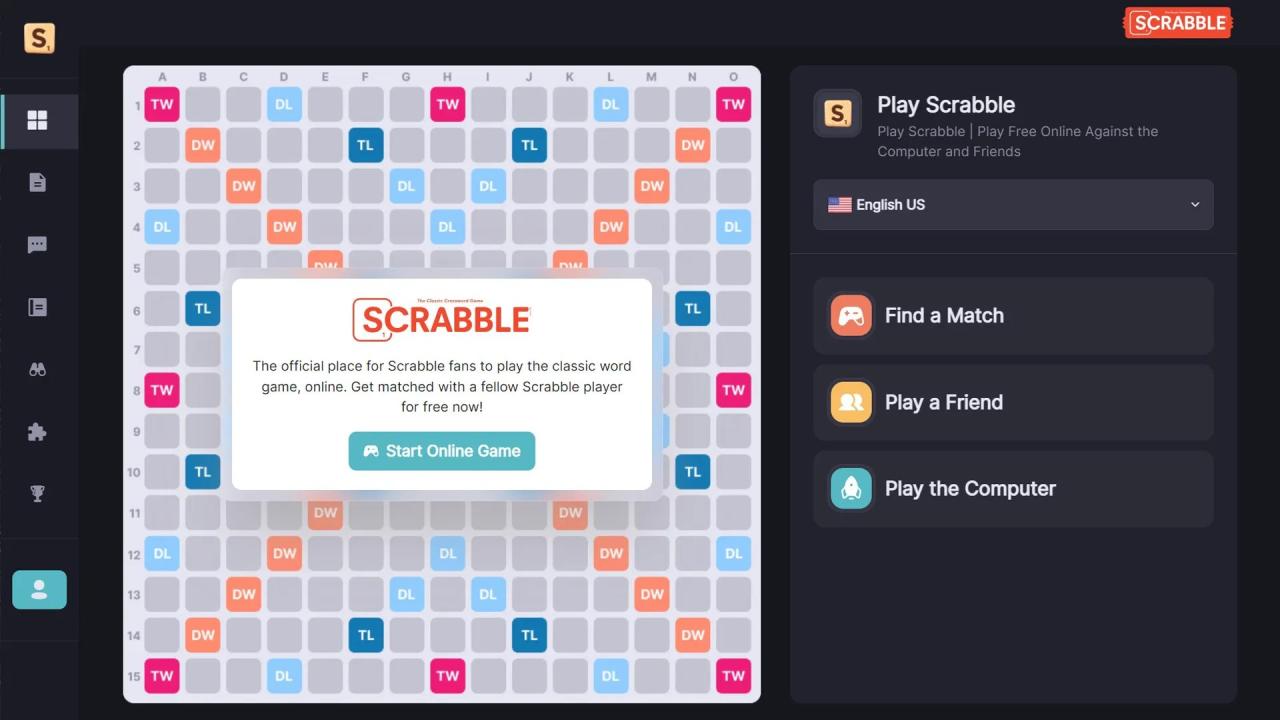
Scrabble Expands to the Web: A Revolution in Word Games
The enduring appeal of Scrabble, a board game that has captivated minds for generations, has witnessed a significant and transformative expansion onto the digital landscape. This transition from a physical board and letter tiles to an online platform has not merely replicated the original experience but has fundamentally revolutionized how players interact with the game, access it, and even perceive its possibilities. The advent of online Scrabble has democratized wordplay, breaking down geographical barriers and making this beloved pastime accessible to a global audience. This article will delve into the multifaceted evolution of Scrabble on the web, exploring its technological underpinnings, its impact on player engagement, the diverse platforms and versions available, the strategic implications of online play, the challenges and opportunities presented by this digital transformation, and ultimately, its profound influence on the enduring legacy of the game.
The technological infrastructure enabling online Scrabble is a complex interplay of server-side logic, client-side interfaces, and robust network protocols. At its core, online Scrabble relies on dedicated servers to manage game sessions, track player progress, validate word formations against comprehensive dictionaries, and ensure fair play. When a player makes a move, their actions are transmitted as data packets across the internet to these servers. The server then processes this data, checking the validity of the proposed word(s) against its lexicon, calculating scores based on letter values and bonus squares, and updating the game state for all connected players. This process is typically facilitated by Application Programming Interfaces (APIs) that allow different software components, such as the game client on a user’s device and the server infrastructure, to communicate seamlessly. Real-time updates are crucial, meaning that the game state, including tile positions, scores, and remaining tiles, must be synchronized across all players’ screens with minimal latency. This requires efficient data management and optimized network communication to provide a smooth and responsive gaming experience, even for players located thousands of miles apart. The choice of programming languages and frameworks for developing these online platforms is critical, with languages like Java, Python, and Node.js frequently employed for their scalability and ability to handle concurrent user connections. Database systems, such as PostgreSQL or MongoDB, are essential for storing user accounts, game history, and dictionary data, ensuring persistent and accessible information.
The impact of web-based Scrabble on player engagement has been nothing short of profound. The convenience and accessibility of online platforms have dramatically increased the number of people participating in the game. Players can now engage in matches anytime, anywhere, eliminating the need for a physical board, set opponents, or scheduled game nights. This has fostered a more spontaneous and frequent engagement with Scrabble. Furthermore, the social aspect of the game has been amplified. Online Scrabble platforms often incorporate features like chat functionalities, allowing players to communicate and build camaraderie, even while competing. Friend lists, player profiles, and the ability to challenge specific individuals transform solitary wordplay into a social activity. The competitive spirit is also ignited through leaderboards, rankings, and tournaments, providing a clear sense of progression and achievement that motivates players to improve their skills. The availability of AI opponents offers a readily accessible practice partner for those looking to hone their strategies without the pressure of playing against another human. This constant availability and diverse range of interaction options have cultivated a vibrant and active online Scrabble community, contributing to its sustained popularity and growth.
The Scrabble ecosystem on the web is characterized by a diverse array of platforms and versions, catering to different user preferences and technological environments. Official versions, sanctioned by Hasbro, are often available as downloadable applications for personal computers and mobile devices, offering a faithful recreation of the classic gameplay. These official versions typically adhere to established Scrabble rules and utilize approved word lists, ensuring a standardized experience. Beyond these official offerings, a multitude of independent developers have created their own interpretations of online Scrabble. These variations might introduce novel game modes, different scoring systems, or specialized dictionaries, appealing to players seeking a fresh take on the familiar. Popular web browsers serve as portals to browser-based Scrabble games, requiring no installation and offering immediate accessibility. These games can be played directly from a website, making them convenient for casual play or for users with limited storage space. Mobile applications for both iOS and Android devices represent a dominant force in the online Scrabble landscape, capitalizing on the ubiquity of smartphones and tablets. These apps often feature intuitive touch interfaces, push notifications for game updates, and robust social integration, allowing players to connect with friends and participate in games on the go. The cross-platform compatibility of some online Scrabble services further enhances accessibility, enabling players to compete against each other regardless of the device they are using. This fragmentation of platforms, while potentially confusing for newcomers, ultimately broadens the reach of Scrabble and caters to a wider spectrum of player needs and technological adoption.
The strategic landscape of Scrabble undergoes a subtle yet significant transformation when played online. While the fundamental principles of word formation, tile placement, and score maximization remain constant, the digital environment introduces new considerations and enhances existing ones. The availability of instant dictionary lookups, whether through integrated game features or external resources, can alter the decision-making process. Players may be tempted to verify word validity more readily, potentially impacting the risk-reward calculus of playing less common words. However, sophisticated online Scrabble players understand that relying solely on immediate dictionary checks can be a crutch. True mastery involves developing an internal lexicon and the ability to anticipate potential word formations. The speed of play, particularly in timed matches, becomes a critical factor. Online platforms often implement timers to maintain a brisk pace, forcing players to think quickly and make decisive choices. This can favor players with strong pattern recognition and a rapid recall of vocabulary. The visual representation of the board and the distribution of tiles on a screen can also influence strategy. Players may develop different visual cues and spatial reasoning strategies compared to their physical board experience. Furthermore, the ease of accessing statistics and analyzing past games online allows players to meticulously study their performance, identify weaknesses, and refine their strategies with unprecedented data-driven insights. The ability to review completed games provides invaluable learning opportunities, allowing players to deconstruct their opponents’ moves and discover more optimal plays. This data-rich environment encourages a more analytical and data-informed approach to strategy, pushing the boundaries of competitive Scrabble.
The expansion of Scrabble to the web is not without its challenges, but these also present significant opportunities for innovation and growth. One of the primary challenges is maintaining the integrity and fairness of the game. Cheating, through the use of unauthorized word lists or external assistance, remains a concern. Developers continuously implement anti-cheat measures, including sophisticated algorithms that detect suspicious activity and human moderation to investigate potential violations. Another challenge is ensuring a high-quality user experience across a multitude of devices and network conditions. Optimizing game performance, minimizing latency, and providing intuitive user interfaces are ongoing endeavors. The issue of dictionary management is also complex. Ensuring that the word lists used are comprehensive, up-to-date, and align with the expectations of the player base requires careful curation and regular updates. Opportunities abound in leveraging new technologies to enhance the Scrabble experience further. The integration of AI and machine learning can lead to more sophisticated and challenging AI opponents, personalized training modules, and even adaptive game difficulty. Augmented reality (AR) and virtual reality (VR) offer intriguing possibilities for immersive Scrabble experiences, potentially bringing the tactile feel of letter tiles and the visual presence of an opponent into a new dimension. Furthermore, the vast datasets generated by online Scrabble play present opportunities for linguistic research and the study of vocabulary acquisition and usage patterns.
The enduring legacy of Scrabble is undeniably being shaped and amplified by its expansion to the web. What began as a tabletop pastime has evolved into a dynamic, globally connected phenomenon. The digital realm has not only preserved the core appeal of Scrabble – the intellectual challenge, the joy of word discovery, and the satisfaction of strategic play – but has also injected new life and accessibility into it. The proliferation of online Scrabble has introduced the game to entirely new demographics and generations who might not have otherwise encountered it. The ease of access and the inherent social features have fostered a continuous cycle of engagement and community building. This digital evolution ensures that Scrabble remains relevant and accessible in a rapidly changing technological landscape. The game’s ability to adapt and thrive in the online space speaks to its fundamental design and its timeless appeal as a test of linguistic prowess and strategic thinking. The future of Scrabble, while unpredictable in its specific technological manifestations, is intrinsically linked to its continued presence and evolution on the web, promising even more innovative and engaging ways for players to connect with the world of words. The transition to the web has been more than just an adaptation; it has been a renaissance, ensuring that the humble game of Scrabble continues to captivate and challenge minds for decades to come.

