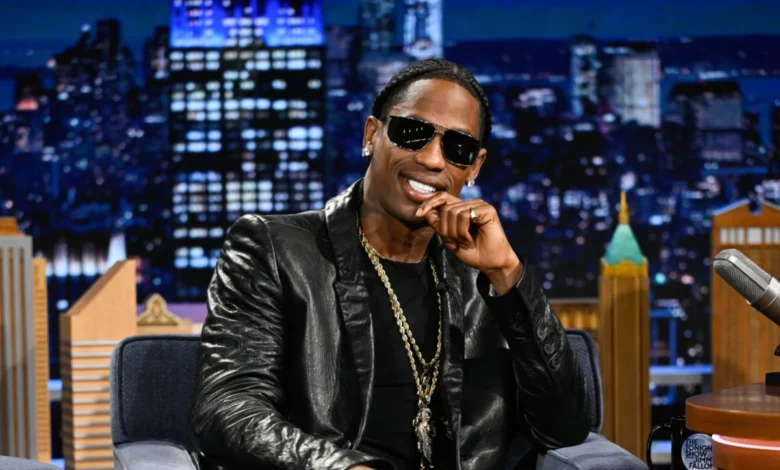
Travis Scott, the influential rapper and producer, recently made a guest appearance on The Tonight Show Starring Jimmy Fallon to shed light on his unexpected foray into acting within Christopher Nolan’s latest cinematic endeavor, The Odyssey. The critically acclaimed film, which has already ascended to the number one spot at the box office, features Scott not only as an actor but also as the artist behind the end credits song, "When I’m Home." This dual contribution marks a significant milestone for the artist, who expressed a profound sense of accomplishment and a touch of disbelief at his newfound success in the realm of blockbuster cinema.
A Leap from Music to the Silver Screen
During his interview, Scott recounted the surreal experience of being approached by Nolan for a role in The Odyssey. The initial contact, a simple text message from "Chris," left him bewildered, contemplating whether the renowned director might be seeking to attend one of his performances. The subsequent offer, however, was far more ambitious: an invitation to act. "My phone went off and it just said Chris and I was thinking, ‘Okay, I don’t know what this is about. Maybe he wants to go to a show,’" Scott shared with Fallon. "So I pick up and he’s like, ‘Would you be interested in acting in a movie?’ But I didn’t think it was for him. I thought it might be for somebody else."
This initial disbelief underscores the magnitude of the opportunity. Nolan, known for his meticulous casting and visionary storytelling, rarely ventures outside established acting circles for significant roles. Scott’s surprise highlights the director’s unique approach and his recognition of the artist’s potential beyond his musical prowess.
Nolan’s Vision: Oral Poetry and Rap’s Resonance
Christopher Nolan himself has previously elaborated on his rationale for casting Scott. In a statement that sheds light on the director’s creative process, Nolan explained, "I cast [Scott] because I wanted to nod towards the idea that this story has been handed down as oral poetry, which is analogous to rap." This comparison draws a direct parallel between the ancient tradition of bards reciting epic tales and the modern art form of rap music, emphasizing its narrative power and cultural significance. Nolan’s vision suggests that Scott’s involvement was intended to imbue The Odyssey with a contemporary resonance, connecting its timeless themes to the vibrant landscape of modern musical storytelling.
This perspective positions Scott’s role not merely as a celebrity cameo but as a deliberate artistic choice aimed at bridging historical narrative traditions with contemporary cultural expressions. It also aligns with Nolan’s history of integrating musicians into his filmography, albeit in distinct ways.
A Star-Studded Ensemble and the Bard’s Burden
The film’s impressive cast, which includes luminaries such as Anne Hathaway, Tom Holland, and Robert Pattinson, added another layer of intimidation for Scott. He admitted to feeling "nervous as F" stepping onto the set alongside such accomplished actors. "I didn’t know that it was going to be Anne Hathaway, Tom [Holland], and Robert Pattinson," he confessed. "A bunch of amazing people. And I don’t know what the fuck I’m doing."
Despite his initial apprehension, Scott found a supportive environment on set. He lauded Nolan as "a real mentor of mine" and praised the collaborative atmosphere that allowed him to overcome his nerves. "Chris is an amazing director. Everybody made me feel comfortable. I was just glad to be there and to watch him." This sentiment reflects the power of strong directorial leadership and a cohesive ensemble to foster growth and confidence, even for seasoned artists venturing into unfamiliar territory.
In The Odyssey, Scott portrays a Greek bard tasked with recounting the epic victories of Odysseus during the Trojan War. This role, steeped in ancient mythology, demanded a performance that could capture the gravitas and lyrical quality of oral tradition. Scott’s immersion in this character, he explained, was a challenge he embraced, though keeping the details of his involvement under wraps proved to be a significant hurdle in itself. "It wasn’t hard to keep his role a secret, but it was hard to ‘make everybody believe that I did this,’" he noted. "I didn’t want people to think I got placed in this." This desire to earn his place through merit rather than mere association speaks to his commitment to his craft.
From "Tenet" to "The Odyssey": A Developing Artistic Partnership
Scott’s collaboration with Nolan is not entirely new. He previously contributed the song "The Plan," produced by Ludwig Göransson, to the soundtrack of Nolan’s 2020 film Tenet. This earlier project served as a precursor to their deeper involvement in The Odyssey. However, the genesis of his role in the latter film was distinctly different. While "The Plan" was a musical contribution, Nolan’s initial approach to Scott for The Odyssey was centered on acting.
This progression from a soundtrack contribution to a significant acting role illustrates a growing artistic relationship between the rapper and the filmmaker. It suggests that Nolan saw a spark in Scott’s previous work that warranted further exploration, leading to a more integrated and multifaceted collaboration.
Crafting "When I’m Home": A Collaborative Soundtrack Effort
The creation of the end credits song, "When I’m Home," also unfolded organically within the production process. Scott expressed his hope that Nolan would enlist him for a song, but this request only materialized after Nolan had a cut of the film. This allowed Scott to craft a piece of music that directly resonated with the film’s narrative and emotional arc.
For "When I’m Home," Scott collaborated with composer Ludwig Göransson, who also scored The Odyssey, and with musician James Blake. The synergy between these artists resulted in a track that has been praised for its evocative quality and its ability to encapsulate the film’s themes. A music video for "When I’m Home," directed by Scott himself, is slated for release, promising a visual complement to the auditory experience.
A Legacy of Musical Talent in Nolan’s Films
Travis Scott’s casting in The Odyssey adds him to a distinguished roster of musicians who have been featured in Christopher Nolan’s films. This tradition of incorporating musical talent into his cinematic universe highlights Nolan’s appreciation for the diverse forms of artistic expression.
One of the most iconic examples is David Bowie’s portrayal of inventor Nikola Tesla in the 2006 film The Prestige. Bowie, a legendary musician and performer, brought a unique gravitas and otherworldly presence to the role, solidifying his status as a multi-talented artist. More recently, Harry Styles, the globally recognized pop sensation, made a significant acting debut as Alex in Nolan’s 2017 war epic Dunkirk. Styles’ performance was widely lauded, marking a successful transition into acting and paving the way for further cinematic ventures.
These instances demonstrate Nolan’s ability to identify and harness the inherent charisma and performance capabilities of musicians, often casting them in roles that leverage their unique stage presence and artistic sensibilities. Scott’s inclusion in this lineage underscores the director’s continued exploration of the intersection between music and film.
The Impact of Box Office Success and Critical Acclaim
The immense success of The Odyssey at the box office, coupled with its critical acclaim, has amplified the impact of Scott’s involvement. Being part of a No. 1 movie, as Fallon noted, represents a new stratosphere of achievement for the artist. Scott articulated this sentiment by stating, "It feels way different. Even my theater teacher from high school, they reached out to my mom. This is like another stratosphere of greatness. All the people [who] were scolding you in when you were in school, trying to make you a great human, are like, ‘You finally did something good.’" This personal anecdote highlights the profound validation that comes with achieving widespread recognition in a field beyond one’s primary domain.
The broader implication of Scott’s success in The Odyssey is the potential for further crossover opportunities for artists in the film industry. As the lines between various creative disciplines continue to blur, the success of individuals like Scott can inspire and pave the way for others to explore diverse artistic avenues. Nolan’s willingness to cast and mentor artists like Scott demonstrates a forward-thinking approach to filmmaking, one that embraces innovation and recognizes talent in its many forms.
In conclusion, Travis Scott’s journey into the world of acting through Christopher Nolan’s The Odyssey is a testament to his versatility and Nolan’s unique directorial vision. From a surprise acting offer to contributing a poignant end credits song, Scott’s involvement represents a significant artistic evolution. The film’s success further solidifies his position as a multifaceted artist, capable of captivating audiences both on the music stage and the silver screen, all while drawing parallels to ancient traditions of storytelling in the modern era.