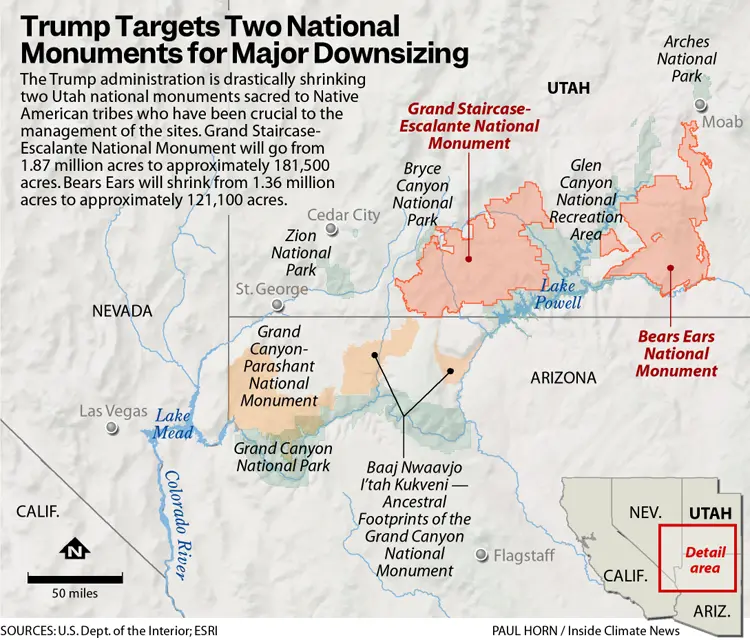
In a move that has reignited one of the most contentious battles in the history of American land conservation, President Donald Trump has signed two executive orders drastically reducing the size of the Bears Ears and Grand Staircase-Escalante National Monuments in southern Utah. The action, taken on a Monday that saw the protected status of millions of acres evaporate by sunset, scales back the monuments to a mere fraction of their previous size. While the administration frames the decision as an effort to restore local control and eliminate federal overreach, tribal leaders, environmentalists, and legal scholars warn that the move threatens thousands of sacred archaeological sites and opens the door for irreversible industrial extraction on some of the nation’s most rugged and ecologically sensitive landscapes.
The executive orders target a combined area that, until this week, spanned more than 3 million acres of high-desert plateau, deep canyons, and forest-covered mesas. By Monday evening, those protections had been stripped from the vast majority of the land, leaving only 302,600 acres under the original monument designations. This reduction is significantly more aggressive than the previous cuts made during Trump’s first term, representing a wholesale dismantling of the conservation boundaries restored by the Biden administration in 2021.
A History of Contention and Shifting Boundaries
The conflict over these Utah landscapes spans decades and multiple presidential administrations, centered largely on the interpretation of the Antiquities Act of 1906. This federal law grants the President the authority to designate national monuments to protect "historic landmarks, historic and prehistoric structures, and other objects of historic or scientific interest."
Grand Staircase-Escalante was established by President Bill Clinton in 1996, covering approximately 1.9 million acres. It was heralded for its unique geology and its status as a "paleontological goldmine," yielding dozens of previously unknown dinosaur species. Bears Ears National Monument was established much later, in late 2016, by President Barack Obama. Spanning 1.35 million acres, it was the first national monument created specifically at the request of a coalition of Tribal Nations—including the Hopi Tribe, Navajo Nation, Ute Indian Tribe, Ute Mountain Ute Tribe, and Zuni Tribe—to protect more than 100,000 cultural sites, including cliff dwellings and ancient rock art.
In December 2017, during his first term, President Trump reduced Bears Ears by 85 percent and Grand Staircase-Escalante by nearly half. These actions were later reversed by President Joe Biden in 2021, who restored the original boundaries and added additional acreage to Bears Ears. Monday’s executive orders do not merely return the monuments to their 2017 levels; they slash the remaining protected acreage to less than a quarter of what survived the first round of reductions.
The Push for Industrial Extraction and Local Control
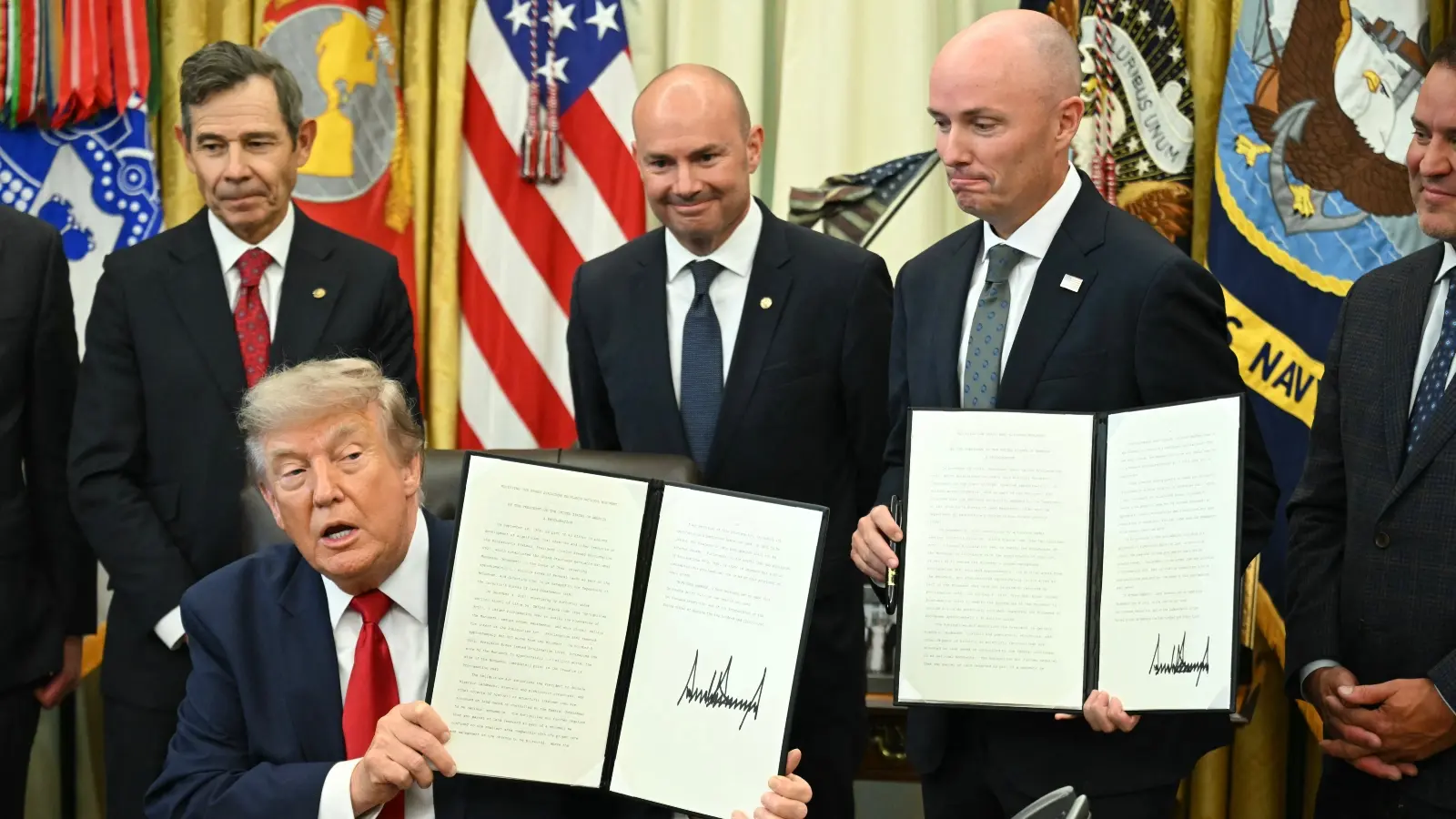
Flanked by Utah’s Republican leadership, President Trump defended the reductions by claiming that monument designations have harmed the local economy and restricted public access. He asserted that the current protections made it "virtually impossible" for citizens to engage in traditional activities such as hunting, fishing, or even walking on the land. However, land management records from the Bureau of Land Management (BLM) and the U.S. Forest Service contradict these claims, noting that both monuments remained open to the public for recreation, including hunting and fishing, under their previous management plans.
The administration’s primary objective, as stated in the text of the executive orders, is to align public land management with goals of energy independence and economic growth. By shrinking the boundaries, the administration effectively removes the "withdrawal" status of the land, which previously prohibited new mining claims and oil and gas leasing.
John Ruple, a law professor and program director at the University of Utah’s Wallace Stegner Center for Land, Resources, and the Environment, noted that the President is being unusually transparent about these motivations. "He’s saying the quiet part out loud," Ruple observed. "He’s being honest: I’m doing this so that we can mine and drill and graze cows."
The prospect of renewed extraction is particularly alarming to local communities in the Four Corners region, where a history of uranium mining has left a legacy of environmental contamination and health crises. Davina Smith-Idjesa, a member of the Navajo Nation, highlighted that her family has already suffered from the toxic remnants of previous mining booms. For her and many others, the land is not merely a source of raw materials but a "grocery store, medicine cabinet, classroom, and church."
Tribal Sovereignty and the End of Co-Stewardship
One of the most significant casualties of the new executive orders is the formal co-management agreement between the federal government and the five tribes of the Bears Ears Inter-Tribal Coalition. Under the Biden administration, a historic co-stewardship model was established, allowing tribal experts to work alongside federal officials to manage the land using both Western science and Traditional Ecological Knowledge.
The new executive orders effectively disband the inter-tribal working group, terminating a partnership that was the first of its kind in U.S. history. Tribal officials reported that they were not consulted prior to the signing of the orders, a move they describe as a violation of the federal government’s trust responsibility to sovereign tribal nations.
"This is a reminder of genocide and that tribes are expendable," Smith-Idjesa said during a press conference following the announcement. She emphasized that the cultural value of the landscape cannot be preserved by protecting isolated "islands" of land while allowing the surrounding areas to be industrialized. "You cannot take a pin, draw a line through the landscape, and tell us what remains should be enough."
Legal Challenges and the Scope of the Antiquities Act
The legality of the President’s actions is expected to be challenged immediately in federal court. The central legal question revolves around whether the Antiquities Act, which grants the power to create monuments, also grants the power to reduce or abolish them.
Legal scholars like Ruple argue that the power to rescind or significantly alter national monuments rests solely with Congress. While the Act allows for monuments to be "confined to the smallest area compatible with the proper care and management of the objects to be protected," environmental groups argue that a 90 percent reduction cannot possibly satisfy the requirement to protect the hundreds of thousands of cultural and scientific objects identified in the original proclamations.
The executive orders come on the heels of a June decision by the 10th Circuit Court of Appeals, which revived a lawsuit from the state of Utah challenging the Biden administration’s restoration of the monuments. By shrinking the monuments now, the Trump administration may be attempting to render that ongoing litigation moot, effectively resetting the legal clock and forcing environmental and tribal groups to start new lawsuits from scratch.
Broader Implications and National Sentiment
The decision to shrink the Utah monuments appears to be part of a broader strategy outlined in "Project 2025," a policy roadmap for the current administration coordinated by the Heritage Foundation. The document calls for a systemic reduction of national monument designations and even suggests the full repeal of the Antiquities Act to prevent future presidents from "locking up" federal lands.
The administration’s stance, however, appears to be at odds with general public sentiment. Polling from the Colorado College "State of the Rockies" Project has consistently shown that a strong majority of voters in the American West support the protection of public lands and the maintenance of national monuments. Critics argue that the administration is prioritizing the interests of a few mining and drilling companies over the preferences of the broader American public.

In Washington, Democratic lawmakers have vowed to fight the executive orders. Senator Ben Ray Luján of New Mexico noted that while the monuments are located in Utah, they are national treasures that belong to all citizens. "This is a trend coming from this administration," Luján said, warning that other protected areas across the country could be next on the list for reduction.
Environmental and Paleontological Risks
Beyond the cultural and legal implications, scientists are concerned about the physical impact on the land. Grand Staircase-Escalante is home to a nearly continuous record of the Late Cretaceous period, and many of its most significant fossil sites are located in the areas now being stripped of protection. Without the rigorous "monument-level" environmental reviews required for development, these sites could be damaged or destroyed by road construction and heavy machinery.
Similarly, the biological diversity of the region—ranging from rare desert plants to critical habitat for the Mexican spotted owl and desert bighorn sheep—faces fragmentation. Environmental groups like Earthjustice and The Wilderness Society have already announced plans to file suit, citing the 60-day window before the orders take effect as a critical period for legal intervention.
Tracy Stone-Manning, president of the Wilderness Society and former director of the BLM, stated that the administration is on the "wrong side of history." She argued that as the nation approaches its 250th anniversary, its focus should be on preserving its natural heritage for future generations rather than handing it over to extraction interests.
Conclusion
The reduction of Bears Ears and Grand Staircase-Escalante represents a pivotal moment in American land management. It sets up a high-stakes confrontation between the executive branch’s desire for industrial expansion and the legal and moral claims of tribal nations and conservationists. As the 60-day countdown begins, the fate of these 3 million acres remains uncertain, likely to be decided in the halls of federal courts rather than on the red-rock soil of southern Utah. For the tribes who call this land home and the scientists who study its ancient secrets, the battle for the monuments is far from over; it has simply entered its most volatile chapter yet.