Advanced Micro Devices (AMD) has escalated its direct challenge to industry titan Nvidia with the official unveiling and impending shipment of its Helios rack-scale system, a meticulously engineered solution designed to power the prodigious computing demands of the world’s most ambitious artificial intelligence laboratories. The announcement, a centerpiece of the company’s Advancing AI conference held in San Francisco, underscored AMD’s strategic pivot and significant investment in the burgeoning AI hardware market, a sector projected to redefine the global semiconductor landscape.
The Dawn of Helios: A New Contender in AI Compute
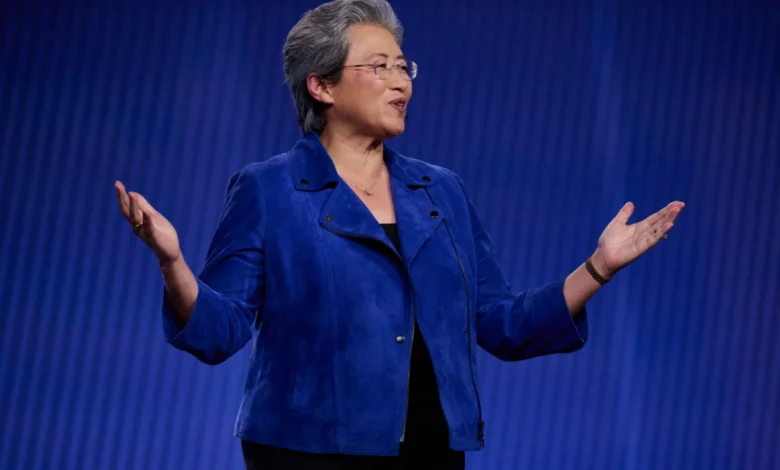
At the sold-out Advancing AI conference on Thursday, AMD Chair and CEO Dr. Lisa Su commanded the stage, promoting not only the formidable Helios AI rack system but also a growing roster of high-profile customers, including Microsoft. The system, slated for shipment later this year, represents a culmination of AMD’s efforts to offer a compelling alternative in a market long dominated by a single player. Dr. Su also took the opportunity to highlight AMD’s latest generation of chips, purpose-built to satiate the insatiable hunger for compute power that characterizes the modern AI industry.
Rack systems, at their core, are integrated units that consolidate numerous high-performance processors into a single, cohesive powerhouse. They form the backbone of modern data centers, serving as the essential infrastructure for training and deploying sophisticated AI models and other compute-intensive workloads that drive innovation across industries. AMD’s Helios, according to Dr. Su, is poised to become the tech industry’s “highest-performance AI rack,” explicitly designed to “train and run the most demanding frontier models in the world at massive scale.” The company further asserted that leading AI enterprises are preparing to deploy Helios at a monumental “gigawatt-scale,” signaling an unprecedented level of computational power dedicated to AI advancement.
Challenging the Incumbent: AMD’s Bid for AI Dominance
For years, Nvidia has held an almost unchallenged hegemony in the AI accelerator market, particularly with its advanced rack-scale systems like the Vera Rubin and Grace Blackwell platforms. These systems have become the de facto standard for large-scale AI training, cementing Nvidia’s position as an indispensable partner for AI developers and researchers globally. AMD’s introduction of Helios is a clear and direct offensive aimed at disrupting this established order. Early performance metrics, as reported by The Register, suggest that Helios possesses a genuine competitive edge, reportedly surpassing Nvidia’s Vera Rubin in several critical performance benchmarks. While specific comparative figures remain proprietary or under embargo, these claims signal a significant leap in AMD’s AI capabilities, suggesting superior processing efficiency, memory bandwidth, or interconnect speeds crucial for large-scale model training. This performance parity, or even superiority in certain aspects, is vital for AMD to carve out a meaningful share in a market where every increment of speed and efficiency translates directly into faster model development and lower operational costs for AI labs.
The development of Helios has been a meticulously planned journey for AMD. First revealed in 2025, the system made a physical appearance onstage at CES 2026 in January, offering a tangible glimpse into its imposing architecture. Its weight, reportedly equivalent to two compact cars, hinted at the sheer computational density packed within its frame. The strategic importance of Helios is further underscored by the impressive roster of early adopters. Industry giants such as OpenAI, Meta, Oracle, Anthropic, and Microsoft have all committed to deploying the system, signaling strong market validation even before general availability.
Microsoft CEO Satya Nadella publicly affirmed his company’s intent to expand its Azure cloud infrastructure with Helios, a move that could significantly enhance Azure’s AI capabilities and offer a powerful alternative to existing Nvidia-powered offerings. This partnership is particularly impactful given Microsoft’s deep investments in AI, including its foundational relationship with OpenAI. Concurrently, a strategic partnership between Anthropic and AMD was announced, detailing plans to deploy up to two gigawatts of AMD Instinct MI450 series GPUs via the new rack system. The MI450 series, building upon AMD’s Instinct accelerator lineage, is designed specifically for extreme AI workloads, boasting enhanced compute performance, memory capacity, and interconnectivity, which are critical for training increasingly complex large language models (LLMs) and other advanced AI architectures. This gigawatt-scale deployment by Anthropic, a leading AI safety and research company, underscores the immense compute power required for frontier AI development and represents a massive win for AMD in establishing its credibility within the elite tier of AI research.
Expanding the AMD AI Ecosystem: Beyond Rack Systems
AMD’s commitment to the AI ecosystem extends beyond the Helios rack system. At the same conference, the company also introduced its Venice-X CPU, a processor specifically engineered for data centers and high-computing workloads. The Venice-X, expected to launch in 2027, is designed to complement the GPU accelerators in complex AI environments, handling the data orchestration, pre-processing, and other CPU-intensive tasks that are crucial for efficient AI training and inference. Featuring an impressive 1152 MB of 3D V-Cache, 96 cores, and a boost clock of 5.15 GHz, the Venice-X, based on the Zen 6 architecture, promises to deliver substantial performance gains for high-performance computing (HPC) and AI workloads, further solidifying AMD’s full-stack approach to AI infrastructure. This dual-pronged strategy—high-performance GPUs in rack systems coupled with powerful CPUs—positions AMD to offer comprehensive solutions that can rival integrated offerings from competitors.
Dr. Lisa Su’s Vision: A Trillion-Dollar AI Accelerator Market
Dr. Lisa Su’s remarks at the conference transcended product announcements, offering a compelling vision for the future trajectory of the chip industry. She boldly claimed that by the year 2030, chips specifically designed to power AI applications would constitute a massive, transformative segment of the overall computing market. This dramatic growth, she explained, is fueled by a “step change in compute demand,” driven primarily by the rapid rise of "agentic AI."
Agentic AI represents a paradigm shift from traditional, reactive AI models to more autonomous, goal-oriented systems. Unlike conventional AI that executes predefined tasks, agentic AI systems are designed to reason, plan, and act independently to achieve complex objectives. As Dr. Su elaborated, “When you ask the agent to do something, it actually has dozens of steps, and it has to reason, and it has to call tools, and it has to access data, and it has to keep doing it over and over until it solves the problem, and so you need lots of GPUs to do all that.” This iterative, multi-step problem-solving approach inherent in agentic AI inherently demands exponentially more computational resources, particularly the parallel processing capabilities of GPUs, to handle the vast number of calculations involved in reasoning, data retrieval, and tool utilization.
This escalating demand underpins Dr. Su’s astounding market projection: “We’re now expecting that by 2030, the AI accelerator market is going to reach about $1.4 trillion.” To put this figure into perspective, she added, “What that means is, by the end of the decade, the AI accelerator market is going to approach the size of the entire semiconductor market today.” The current global semiconductor market is estimated to be around $600-700 billion annually. If Dr. Su’s prediction holds true, the AI accelerator segment alone would more than double the entire semiconductor industry’s present valuation, marking an unprecedented period of growth and strategic importance for this specialized hardware.
Furthermore, Dr. Su emphasized the continued dominance of Graphics Processing Units (GPUs) within this burgeoning market. “We do expect that GPUs are going to make up the vast majority of that market because the algorithms are still very much in their infancy, and we’re still continuing to see the workloads change, and that favors programmability in the overall silicon ecosystem,” she stated. The inherent flexibility and programmability of GPUs, coupled with their architectural design optimized for parallel processing, make them exceptionally well-suited for the rapidly evolving and often unpredictable nature of AI algorithms. As AI research continues to innovate and new model architectures emerge, the adaptability of GPUs provides a significant advantage over more rigid, specialized ASICs (Application-Specific Integrated Circuits) that might become obsolete as algorithms evolve.
Broader Impact and Implications for the AI Ecosystem
AMD’s aggressive push into the AI accelerator market with Helios and Venice-X carries profound implications for the entire technology ecosystem.
- Intensified Competition: The direct challenge to Nvidia’s long-standing dominance will undoubtedly foster a more competitive environment. This competition is expected to accelerate innovation, drive down costs, and offer more diverse choices for AI developers and data center operators. For years, Nvidia’s near-monopoly has raised concerns about pricing power and potential bottlenecks in AI development. AMD’s emergence as a credible alternative provides much-needed market diversification.
- Enabling Frontier AI: The sheer scale of compute power offered by systems like Helios, capable of gigawatt-scale deployments, is critical for pushing the boundaries of AI research. These systems will enable the training of even larger, more complex foundational models, potentially leading to breakthroughs in areas such as general artificial intelligence, scientific discovery, and autonomous systems. The ability to deploy such massive compute resources could democratize access to cutting-edge AI development, albeit for well-funded organizations.
- Energy Consumption Concerns: The "gigawatt-scale" deployments, while impressive from a computational standpoint, highlight the escalating energy demands of advanced AI. A gigawatt is equivalent to the power output of a large nuclear power plant or hundreds of thousands of homes. As AI infrastructure scales, managing power consumption and heat dissipation will become paramount challenges for data center design and operation, potentially driving innovation in energy-efficient hardware and cooling technologies.
- Supply Chain Resilience: A robust competitive landscape, with multiple strong players like AMD and Nvidia, can enhance the resilience of the global AI supply chain. Reliance on a single vendor for critical hardware components can expose the industry to vulnerabilities, including supply disruptions, price volatility, and technological stagnation. Increased competition fosters a healthier, more stable supply chain.
- Economic Impact: Dr. Su’s projection of a $1.4 trillion AI accelerator market by 2030 signals a monumental economic shift. This growth will not only benefit chip manufacturers but also ripple across various sectors, including cloud service providers, software developers, data center infrastructure companies, and industries leveraging AI for transformation. It underscores AI’s role as a fundamental economic driver for the coming decade.
AMD’s Advancing AI conference has clearly marked a pivotal moment in the company’s history and for the broader AI industry. With the Helios rack system and the Venice-X CPU, AMD is not just offering new products; it is actively shaping the future of AI infrastructure, challenging the status quo, and positioning itself at the forefront of what promises to be one of the most transformative technological and economic shifts of the 21st century. The race to power the next generation of AI has truly intensified, and the coming years will reveal the full extent of this high-stakes competition.