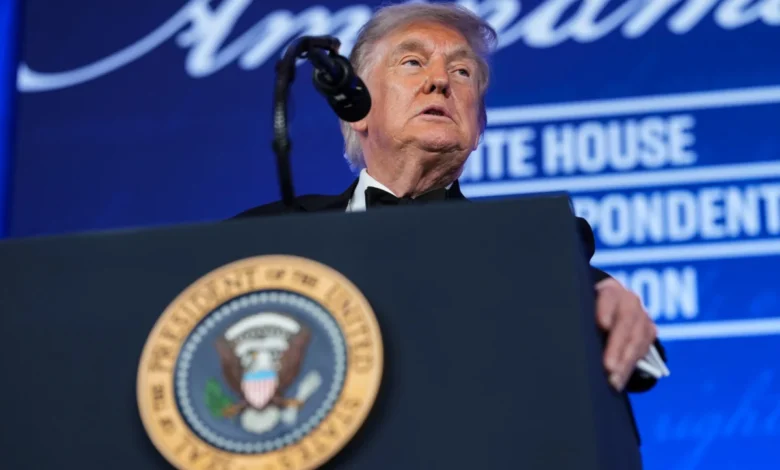
Speaking at the rescheduled White House Correspondents’ Association Dinner on Friday, Donald Trump delivered an hour-long address that critics and attendees alike described as a jarring departure from the traditional comedic roast, instead leaning heavily on familiar campaign rhetoric interspersed with a series of poorly received jokes. This marked Trump’s first appearance as president at the annual event, which had been postponed from its usual April date following a security incident where an individual attempted to breach the ballroom and was apprehended by the Secret Service.
Historically, the White House Correspondents’ Dinner has provided a platform for presidents to engage in lighthearted banter and offer self-deprecating humor, often including playful jabs at the press corps. However, Trump’s address largely eschewed this tradition, devolving into what many characterized as a rally-style speech. While he did offer some personal attacks directed at members of the press, these were often accompanied by unsolicited comments on their physical appearance, a tactic that failed to elicit the expected laughter.
One particular instance highlighted the disconnect between the President’s comedic aspirations and the audience’s reception. A joke targeting the alleged sex life of an elderly U.S. senator reportedly met with stony silence, prompting Trump to question the audience’s comprehension. "Does anybody get that? I thought that was actually great," he remarked, adding with evident disappointment, "That was actually the only thing I thought was good in this whole frickin’ stupid speech. It was the only good one, and that went down with not exactly great laughter."
Throughout the lengthy and, by many accounts, meandering speech, Trump appeared to recognize that his attempts at humor were largely falling flat. The audience’s reaction was characterized by a distinct lack of genuine laughter or enthusiastic applause, with observers noting widespread discomfort, fidgeting, and prolonged periods of near-silence. The stream-of-consciousness style of his address saw him pivot erratically between disparate topics, further contributing to a sense of disorganization.
In an effort to inject some levity, Trump offered a self-referential anecdote regarding the event’s perceived success. "Tonight’s event is even crazier than the last time," he stated. He then relayed an alleged conversation with David Ellison, CEO of CBS parent company Paramount, who, according to Trump, suggested that "next year, they’re going to call it the Trump White House Correspondents’ Dinner." Trump wryly added that changing the name "is the only way you’re going to get me back here," a remark that underscored the strained relationship between the presidency and the journalistic community.
The hour-long address, by all accounts, tested the patience of most attendees, with only the most ardent Trump loyalists demonstrating consistent positive engagement. The sparse and sporadic reactions from the broader audience punctuated long stretches of quiet. The palpable relief was evident as many guests began to depart the venue shortly after Trump concluded his remarks and mentalist Oz Pearlman took the stage.
H2: The Event’s Setting and Attendees: A Rescheduled Affair Amidst Shifting Dynamics
This year’s White House Correspondents’ Dinner took place at the Waldorf-Astoria, a venue notably smaller than the Hilton, where the original April event was slated to occur. The rescheduling was necessitated by the security breach that disrupted the earlier gathering. The Waldorf-Astoria, with its historical ties to the Trump Organization, having previously operated as a Trump hotel, added a layer of symbolic resonance to the evening.
Notable figures from the Trump administration were present, mingling with journalists in the aisles. Among those seen were Chief Legal Officer Makan Delrahim, who attended just hours after news broke of the planned merger between Paramount and Warner Bros. Discovery being stalled due to antitrust challenges. Other administration officials in attendance included Pete Hegseth and presidential advisor Stephen Miller, accompanied by his wife Katie Miller. Additionally, Secretary of Health and Human Services Robert Kennedy Jr. and his wife Cheryl Himes, Commerce Secretary Howard Lutnick, Department of Homeland Security Secretary Markwayne Mullin, and Acting Attorney General Todd Blanche were present. Blanche, in particular, became the subject of one of Pearlman’s mental demonstrations.
H3: Awards and Accusations: A Night of Uneasy Coexistence
The evening commenced with the presentation of annual awards to journalists, a segment that underscored the inherent tension between the presidency and the press. Several honorees were recognized for investigative reporting that had scrutinized the President and his administration. When reporters from The Wall Street Journal accepted an award for their work on the Jeffrey Epstein story, Trump offered a handshake followed by a dismissive gesture, accompanied by a subtle smile. Wolf Blitzer, who was presenting the award, pointedly reminded the audience that Trump had previously sued The Wall Street Journal for $20 billion in relation to the same story, a legal action Trump vehemently denied.
Upon taking the lectern, Trump directed pointedly personal barbs at Josh Dawsey, one of the Wall Street Journal award recipients, and CNN host Kaitlan Collins. These attacks, intended as comedic jabs, were met with the same near-total silence that characterized much of his speech, indicating the audience’s discomfort with the personal nature of the critiques. Weijia Jiang, the outgoing president of the White House Correspondents’ Association, maintained a stoic demeanor throughout Trump’s digressions.
The strained atmosphere prompted CNN to issue a statement during the speech, publicly defending its journalists and their reporting. This unusual intervention highlighted the significant friction between the President and some major media outlets.
H2: A Speech Adrift: From Prepared Remarks to Personal Grievances
Despite appearing to have a prepared set of jokes, Trump frequently deviated from his script. These divergences often led him down tangents, seemingly triggered by the subjects he was addressing. The speech meandered through familiar political attacks, such as criticisms of Adam Schiff’s appearance, and extended discussions about his vision for the White House ballroom. At one point, he drew attention to the chandeliers at the Waldorf-Astoria, referencing his past ownership of the venue. While some of his criticisms of the press were sharp, the sheer length of the speech and the breadth of topics covered may have diluted their intended impact.
H3: A Promise for the Future, or a Lingering Threat?
As the evening drew to a close, mentalist Oz Pearlman humorously alluded to Trump’s future attendance, stating, "I thought he was going to be speaking until next year, actually," in response to an announcement that Trump would attend the following year’s event. This remark, delivered with a wink, underscored the perception that Trump’s presence, and his style of engagement, had been a significant feature of the night.
H2: The Shadow of Security: A History of Disruption
The rescheduled date and enhanced security measures served as a stark reminder of the security incident that had forced the original postponement. In April, an individual attempted to breach a security barricade outside the Washington Hilton ballroom. The sounds of gunshots were audible to guests inside, prompting an urgent evacuation of President Trump and Vice President JD Vance by the Secret Service, along with other dignitaries. The White House Correspondents’ Association had urged the rescheduling, but the shift to the Waldorf-Astoria and the implementation of new security protocols underscored the lingering unease surrounding large public gatherings involving the President.
H3: Broader Implications: The Evolving Relationship Between the Presidency and the Press
The White House Correspondents’ Dinner, a long-standing tradition, has increasingly become a focal point for the complex and often adversarial relationship between the President and the news media. Trump’s presidency has been marked by a consistent pattern of challenging established journalistic norms, including public denunciations of news organizations, threats to revoke broadcast licenses, and instances where his Justice Department has sought to subpoena reporters for their sources.
The recent withdrawal of subpoenas issued to New York Times reporters concerning their reporting on security features of the new Air Force One, following criticism from a federal judge, illustrates the legal and ethical tightrope walked in these investigations. This action, occurring just days before the dinner, added another layer of context to the evening’s proceedings.
Trump’s decision to attend the rescheduled dinner, after skipping the event in previous years and sometimes holding counter-programming, placed him at the center of an occasion that celebrates the very journalists he has frequently attacked. The presence of award recipients for stories critical of his past actions, such as the letter allegedly sent to Jeffrey Epstein, created an atmosphere of palpable tension. Trump’s denial of sending the letter and his subsequent lawsuit against The Wall Street Journal, its publisher, and Rupert Murdoch, further cemented the adversarial dynamic that has come to define his interactions with significant segments of the media. The speech, therefore, was not merely a comedic performance, but a reflection of a deeply intertwined and often fractious relationship between the executive branch and the Fourth Estate.