Saul Hudson, globally recognized by his iconic stage name Slash, has spent decades cementing his legacy as the legendary lead guitarist of the hard rock band Guns N’ Roses. Known for his signature top hat, cascading curls, and wailing guitar solos, Slash’s cultural footprint spans generations of music enthusiasts. However, music has only ever been one half of the artist’s lifelong passions. Away from the stadium stages and recording studios, Hudson has maintained a passionate, lifelong fascination with herpetology—the branch of zoology concerned with the study of amphibians and reptiles. For decades, he has been an outspoken advocate and financial supporter of zoos, natural history museums, and wildlife conservation initiatives, frequently showcasing his extensive personal collection of reptiles, including reticulated pythons.
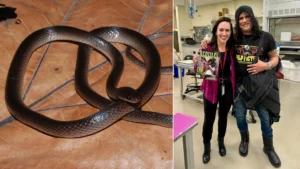
Now, that decades-long dedication to the natural world has culminated in a singular, permanent scientific honor. A team of international herpetologists and evolutionary biologists has officially named a newly identified, elusive snake species native to the tropical rainforests of New Guinea Lielaphis slashi, commonly referred to in scientific literature as Slash’s groundsnake. The formal description of the species was published in the peer-reviewed scientific journal Zootaxa, marking a historic intersection between rock-and-roll history and modern zoological taxonomy.
For Slash, the tribute serves as a surreal milestone bridging his childhood obsessions with his adult life. Expressing his profound gratitude regarding the taxonomic honor, the musician remarked on the deep personal significance of the discovery. As a lifelong herpetophile, he shared that he is extremely honored and humbled to have Lielaphis slashi from New Guinea named after him, adding that the moment is genuinely exciting and something he never could have imagined would transpire during his lifetime.
Childhood Inspiration and the Roots of a Scientific Pursuit
The origin story of Lielaphis slashi traces back several decades, rooted deeply in the formative childhood experiences of the study’s senior author, Dr. Sara Ruane. Currently serving as the Associate Curator of Herpetology at the Field Museum in Chicago, Ruane’s career path was heavily influenced by pop culture and her early adoration for both music and reptiles.
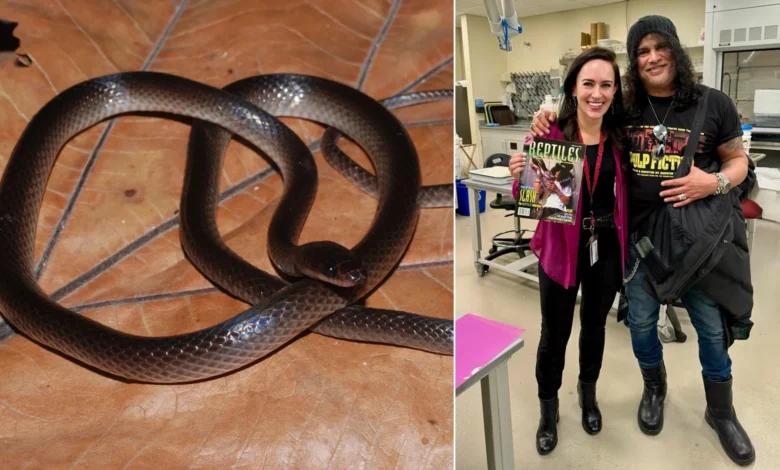
Reflecting on the personal connection behind the species’ name, Ruane noted that Guns N’ Roses had been among her absolute favorite musical acts since she was in the first grade. By the time she reached the fifth grade, her career ambitions were already solidified, having informed her teacher of her lifelong goal to become a professional herpetologist. The convergence of her dual passions occurred when she was twelve years old, opening an issue of Reptiles Magazine that featured a prominent cover photograph of Slash holding his personal pet reticulated python. Seeing a mainstream global rock icon openly sharing her passion for reptiles left an indelible impression on the young science enthusiast.
Years later, after completing her rigorous academic training and establishing herself as a respected researcher with the authority to designate official scientific names to newly recognized species, Ruane revisited that influential magazine interview from her youth. She recalled how the musician spoke extensively about his profound appreciation for natural history museums, zoological parks, and his childhood hobby of exploring the outdoors in search of wild snakes. Recognizing the striking parallels between his childhood trajectory and her own, Ruane concluded that naming a newly discovered species in his honor would be a fitting tribute to a lifelong advocate of the natural world.
The Field Discovery in the Forests of New Guinea
The physical specimen that would eventually become the holotype for Lielaphis slashi was initially collected nearly two decades prior to its formal description. During a nocturnal field expedition in 2006, Dr. Chris Austin—a professor and curator of herpetology at the Louisiana State University (LSU) Museum of Natural Science—encountered an unfamiliar snake while conducting fieldwork in the dense tropical forests of New Guinea.
New Guinea holds the distinction of being the world’s second-largest island, trailing only Greenland in total landmass. Positioned just north of the Australian continent, the island is geographically and politically divided between the Indonesian provinces of Western New Guinea and the independent nation of Papua New Guinea. The island’s equatorial rainforests harbor some of the most staggering biological diversity on Earth, much of which remains poorly documented, understudied, and entirely unknown to formal science.
Detailing the challenges of field research in this remote region, Austin explained the specialized methods required to locate these elusive creatures. Because New Guinea groundsnakes are strictly nocturnal, researchers must conduct searches after dark, typically locating the animals shortly after sunset near the bases of massive rainforest trees where they forage for food. Austin cautioned that conducting fieldwork at night in New Guinea demands extreme vigilance, as the island is home to several highly venomous elapid species that bear a striking morphological resemblance to the harmless, non-venomous groundsnakes.
The path toward formally describing the specimen accelerated years later when Ruane joined Austin at LSU as a postdoctoral researcher in 2016. The two scientists initiated a collaborative research initiative aimed at untangling the complex taxonomy of New Guinea’s poorly understood snake populations, a partnership that has continued to yield significant scientific breakthroughs.
Genetics and Morphology Reveal a Distinct Lineage
Upon initial visual inspection in the field, the 2006 specimen did not immediately stand out as an obvious candidate for a new species to science. Groundsnakes within the region often exhibit conservative external morphologies, making macro-level identification challenging. However, subsequent advanced laboratory analyses performed years later exposed crucial genetic and physical divergences.
Tianqi Huang, a postdoctoral researcher at the Field Museum working alongside Ruane and serving as the primary author of the Zootaxa study, detailed the multi-pronged analytical approach utilized to confirm the discovery. Utilizing cutting-edge genetic analyses, the research team determined that L. slashi is genetically distinct from all other comparable snake lineages within the same genus. Huang emphasized that the definitive realization of a novel species stemmed from a synthesis of distinct physical characteristics—most notably variations in scale counts when compared against closely related taxa—alongside robust molecular evidence. Additionally, the team employed sophisticated ecological modeling techniques to demonstrate that Lielaphis slashi occupies a distinct ecological niche, preferring specific habitat types that differentiate it from its closest taxonomic relatives.
Anatomy, Ecology, and Behavior of Slash’s Groundsnake
Measuring approximately 28 inches in total length and displaying a distinctive reddish-brown coloration, the newly described Lielaphis slashi remains a creature of considerable mystery to herpetologists. Due to the inherent difficulties of tracking secretive, nocturnal reptiles through dense tropical underbrush without alerting them, direct behavioral observations in the wild are exceedingly rare.
Despite these observational limitations, anatomical analysis provides valuable clues regarding the species’ predatory habits and natural history. Ruane noted that snakes within this specific genus frequently possess enlarged teeth positioned at the rear of their jaws. This specialized dentition suggests that New Guinea groundsnakes utilize rear-fanged mechanics to securely grip and consume small, slippery-scaled lizards as well as the eggs of other reptile species. Unlike constricting serpents such as boa constrictors, L. slashi does not subdue its prey through constriction.
Furthermore, while Guns N’ Roses famously earned the moniker of the "most dangerous band in the world" during their peak touring years, their reptilian namesake poses zero threat to human safety. Lielaphis slashi lacks the anatomical mechanisms and venom glands necessary to produce toxins capable of causing serious harm to a human being.
Broader Implications and Conservation Pressures
While Slash’s groundsnake is entirely harmless to people, human activities pose an increasingly severe existential threat to the survival of L. slashi and countless other endemic organisms inhabiting the imperiled forests of New Guinea.
Ruane highlighted the urgent environmental pressures facing the region, noting that the native habitats sustaining Slash’s groundsnake are currently being degraded and destroyed by expanding industrial activities, including commercial coffee farming and extensive mining operations. This ongoing environmental degradation underscores the critical importance of formal taxonomic research and species descriptions. According to conservation scientists, every individual species must be officially recognized and cataloged to foster a comprehensive understanding of complex ecosystem dynamics and ecological interdependencies. Humanity cannot effectively conserve or protect animal populations and botanical lifeforms that remain formally unknown to science.
By officially documenting and publishing species such as Lielaphis slashi, researchers are able to construct a clearer, more accurate cartography of New Guinea’s staggering biodiversity. This foundational data is vital for guiding future conservation policies and identifying vulnerable organisms facing imminent peril amid accelerating habitat loss and global climate shifts.
The comprehensive research study describing Lielaphis slashi was a collaborative international effort, featuring contributions from a diverse team of scientists. Co-authors and institutional contributors include Tianqi Huang of the Field Museum and Rutgers University; Chris Austin of the Louisiana State University Museum of Natural Science; Justin Bernstein representing Slippery Rock University and the American Museum of Natural History; Bulisa Iova of the Papua New Guinea National Museum and Art Gallery; Jackson Roberts of the Virginia Museum of Natural History; Jeffrey Frederick of the University of Kentucky; and Sara Ruane of the Field Museum.