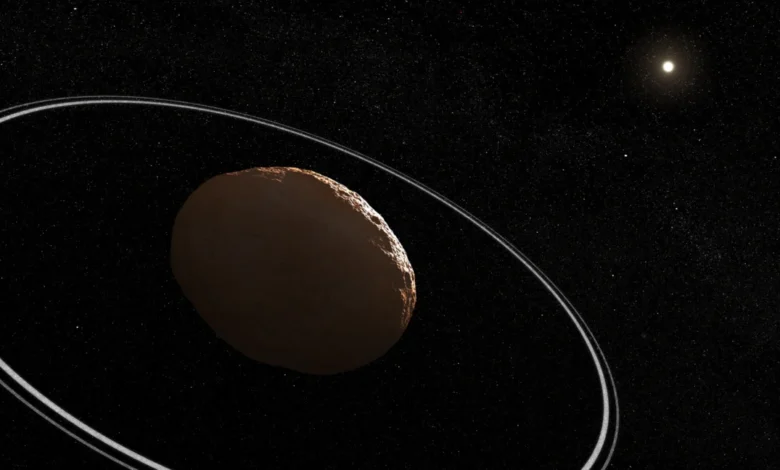
For decades, the conventional wisdom of planetary science held a strict boundary regarding the architecture of our Solar System: rings were the exclusive domain of gas giants and ice giants. Saturn, Jupiter, Uranus, and Neptune wore their icy and dusty halos as majestic badges of their immense gravitational dominance. Small bodies, such as asteroids, comets, and centaurs, were thought to be far too diminutive and gravitationally weak to maintain persistent ring systems.
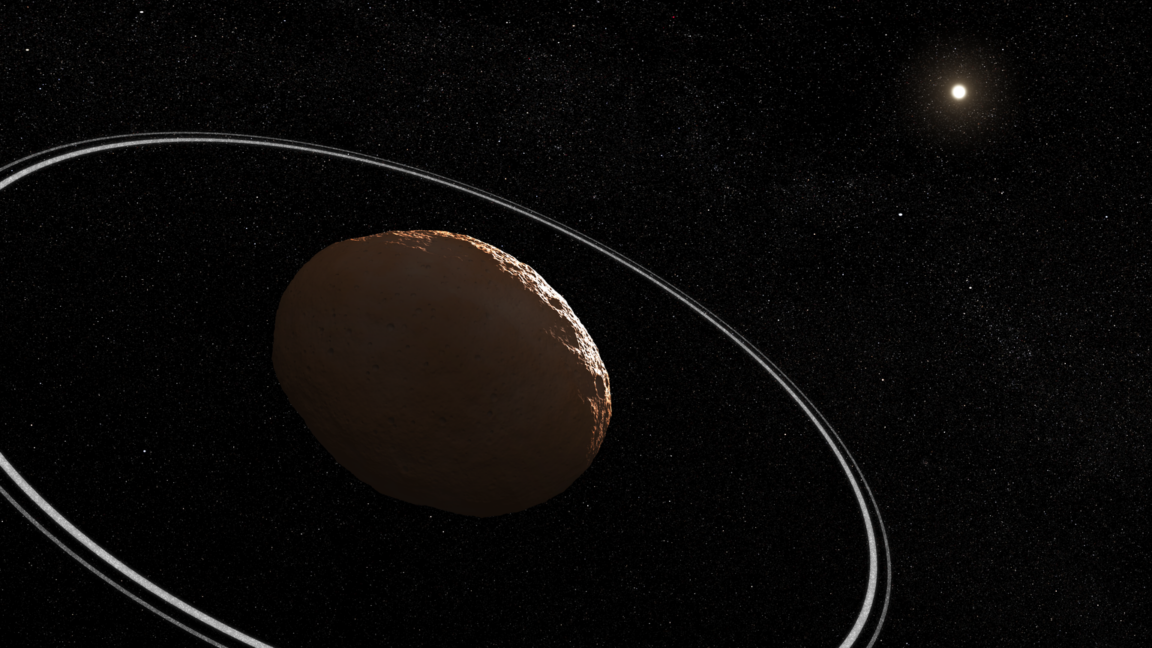
That paradigm-shifting orthodoxy was shattered in 2013 when astronomers, using ground-based telescopes to observe a stellar occultation, discovered that Chariklo—a tiny centaur measuring a mere 250 kilometers in diameter—possessed not one, but two dense and narrow rings. Located in the frigid outer reaches of the Solar System between the orbits of Saturn and Uranus, Chariklo instantly became one of the most intriguing objects in astrophysical research.
Now, a decade after that initial discovery, new observations captured by the James Webb Space Telescope (JWST) have revealed that Chariklo’s rings are not static relics of a primordial collision. Instead, they are actively, mysteriously changing. One ring has grown significantly denser, while its companion has nearly faded from view, upending long-held assumptions about the stability and longevity of ring systems around minor planetary bodies.
The Mechanics of Stellar Occultation
Studying objects as small and distant as Chariklo presents immense technological and observational hurdles. Because these minor bodies are too small and faint to be resolved directly by even the most powerful telescopes, astronomers must rely on an indirect technique known as stellar occultation.
The process requires precise astronomical forecasting. Researchers calculate the exact trajectory of a Solar System body as it passes directly in front of a distant background star from the perspective of Earth or a space-based observatory. As the object transits the star, it blocks the starlight for a fleeting moment. By precisely measuring the timing, depth, and shape of the resulting light curve—the dip in starlight brightness—astronomers can reconstruct the silhouette, size, and shape of the occulting body, as well as detect any surrounding material, such as rings or atmospheres.
When ground-based teams applied this method to Chariklo in 2013, they detected two distinct drops in starlight flanking the main body’s occultation shadow. These drops revealed the presence of a pair of narrow, confined rings, subsequently designated as C1R and C2R. Situated approximately 390 and 405 kilometers from the center of the body, these rings were found to be remarkably narrow—only a few kilometers wide—and separated by a scant 7-kilometer gap.
While ground-based campaigns laid the groundwork for this discovery, observing such events from the surface of the Earth is fundamentally limited by the planet’s atmosphere, which blocks crucial infrared wavelengths and distorts incoming light. To push the boundaries of minor body research, astronomers turned to the premier infrared observatory in space: the James Webb Space Telescope.
Chasing Shadows with the James Webb Space Telescope
Executing a targeted stellar occultation observation with JWST is an extraordinarily complex engineering feat. Stationed at the Sun-Earth Lagrange Point 2 (L2), roughly 1.5 million kilometers from Earth, JWST requires delicate station-keeping maneuvers every few weeks to maintain its stable orbit.
In August 2022, an international team of astronomers led by Pablo Santos-Sanz from the Instituto de Astrofísica de Andalucía in Granada, Spain, identified an upcoming opportunity for JWST to observe a Chariklo occultation. However, pinning down the exact line of sight was fraught with uncertainty. As the team continuously updated their trajectory models in the weeks leading up to the event, the projected shadow path shifted by approximately 110 kilometers—a deviation wide enough to miss the target body entirely.
Compounding the difficulty, JWST scheduling protocols require high-precision observations to be locked in at least 14 days in advance. The team had to commit resources and command one of humanity’s most advanced scientific instruments based on predictions that carried a margin of error.
"We did this maybe a bit blindly, because we didn’t know exactly where the line of sight was," Santos-Sanz remarked. "I’m going to move one of the biggest, best telescopes in space, and we don’t know if finally we will catch this or not."
The gamble paid off. On October 18, 2022, JWST successfully captured the occultation event. Reconstructed geometry revealed that the telescope’s line of sight skimmed precisely 7.4 kilometers above Chariklo’s surface, bypassing the solid body itself while passing directly through its ring system.
Unprecedented Infrared Data Reveals Dramatic Ring Evolution
The JWST observation marked a watershed moment in planetary astronomy. Operating simultaneously in two near-infrared bands—at 1.5 and 3.2 micrometers—the space telescope captured the first-ever infrared occultation data for a minor body’s ring system beyond the 3-micrometer threshold, a spectral range entirely inaccessible from Earth due to atmospheric water vapor and carbon dioxide absorption.
The data returned by JWST immediately stunned the research team. The inner ring, C1R, was unmistakably present, displaying sharp, well-defined edges. However, it was dramatically darker than it had appeared during previous observations. Averaged across approximately 10 historical ground-based occultations, C1R’s normal opacity—the fraction of starlight blocked by the ring material—historically hovered around 0.303. JWST measured its opacity at a staggering 0.431.
"We didn’t believe it at the beginning, so we fought a lot with the data," Santos-Sanz said.
To ensure the reading was not an observational artifact, the team tested the hypothesis that the telescope had simply cut through an unusually dense, localized clump of material rather than a uniform structure. They constructed a sophisticated lumpy ring model and ran 10 million simulated occultations. The statistical probability of randomly reproducing an opacity as high as the one recorded by JWST was calculated to be roughly 1 in 1,000 at 1.5 micrometers, and an infinitesimal 4 in 100,000 at 3.2 micrometers for a single measurement. Because the telescope captured the ring twice—once upon ingress and once upon egress—the odds of a random clump coincidence vanished.
The conclusion was inescapable: the inner ring had physically thickened and grown denser over the decade.
The Fading Outer Ring and the Search for Mechanisms
While the inner ring intensified, the outer ring, C2R, behaved in the exact opposite manner. During the October 2022 event, C2R barely registered at the 1.5-micrometer wavelength and was entirely undetectable at 3.2 micrometers, despite the telescope recording the identical structural region in both bands simultaneously.
"At the beginning, we didn’t even see the outer ring in the light curve," Santos-Sanz noted. "We had to use models. It was really barely visible, so we said, ‘What is happening here?’"
The research team evaluated two primary hypotheses to explain the phenomenon. First, they considered whether the anomaly was purely a wavelength-dependent scattering effect, driven by the fact that JWST was observing in infrared frequencies where ring occultation data had never previously been gathered. Second, they investigated the possibility that the rings had undergone genuine, physical evolution.
Radiative transfer models strongly pointed toward the latter explanation. Historical visible-light observations were consistent with ring compositions consisting of a stable mixture of water ice and silicate dust. However, when the new JWST infrared data points were integrated into the models, no known combination of particle sizes, distribution profiles, or material compositions could reconcile the discrepancy without invoking active structural change.

Intriguingly, the material lost by the fading outer ring did not simply migrate inward to feed the inner ring. Calculations of equivalent width demonstrated that the inner ring gained roughly ten times more material than the outer ring lost, pointing to an external or localized source of replenishment.
The Ghost Moon Hypothesis
To account for the stability of the rings, their sharply defined edges, and the sudden influx of material into the inner ring, astronomers have proposed the existence of one or more unseen "shepherd satellites."
In planetary ring dynamics, shepherd moons are small, inner or outer satellites whose gravitational fields sculpt ring material, maintaining narrow boundaries and preventing particles from dispersing into space. Santos-Sanz and his colleagues suggest that a small, undiscovered moon orbiting near or within the ring system could be dynamically interacting with the material, kicking up debris that continually replenishes C1R.
"This satellite has not been detected yet, if it exists," Santos-Sanz acknowledged.
Computer simulations based on the JWST dataset also provided preliminary insights into the physical composition of the rings. The models suggest that the denser inner ring is likely composed of larger macroscopic particles, whereas the outer ring appears to be dominated by finer, more diffuse dust grains. However, the researchers emphasize that this interpretation remains a work in progress, requiring further empirical validation.
Broader Implications for Planetary Science
The discovery that Chariklo’s ring system is actively evolving challenges long-standing assumptions about the static nature of small-body rings. Furthermore, Chariklo is no longer an isolated anomaly. In the years following its discovery, astronomers have identified ring systems orbiting other minor bodies in the outer Solar System, including the centaur Chiron, the dwarf planet Haumea, and the trans-Neptunian object Quaoar.
Dynamic behavior is well-documented among the massive ring systems of giant planets—such as the measurable shrinkage of Saturn’s D ring and the shifting orbital arcs of Neptune’s Adams ring system over monthly and yearly timescales. The confirmation that minor bodies undergo similar structural shifts suggests that ring dynamics are governed by universal physical processes, independent of the central body’s mass.
To resolve whether the observed changes are driven by true physical evolution or complex infrared scattering effects, the research team is actively searching for future stellar occultations by Chariklo that can be observed in visible light.
"I think this work is just a piece of the puzzle," Santos-Sanz concluded, "but it could be an important clue for broader studies about the rings around minor bodies and around giant planets."
The findings of this research have been published in the peer-reviewed journal Science Advances.