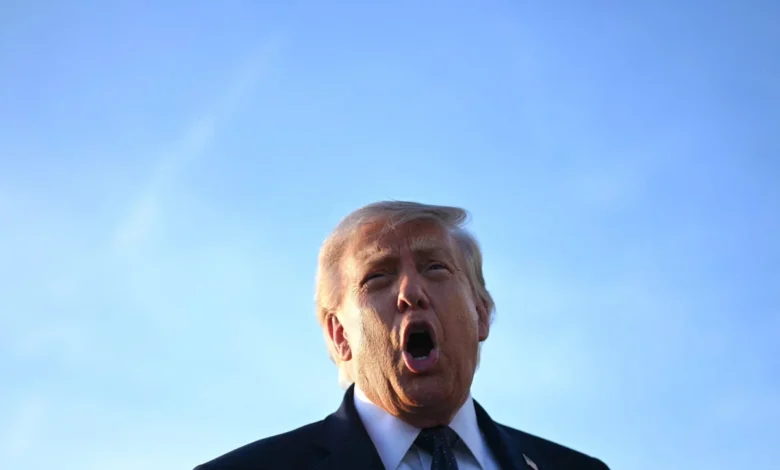
President Donald Trump has formally characterized the burgeoning national and global debate surrounding artificial intelligence safety as a manufactured political strategy, labeling the movement a “hoax” orchestrated by his political opposition. In a series of communications released via his social media platform, Truth Social, the President dismissed growing calls for regulatory guardrails and existential risk mitigation as tactics intended to undermine American technological dominance. This stance marks a significant pivot in federal rhetoric, signaling a clear administration preference for rapid, unchecked development of AI infrastructure over the precautionary measures advocated by a growing coalition of researchers, ethicists, and environmentalists.
The President’s comments follow a period of intense public scrutiny regarding the environmental and societal costs of AI, particularly the massive data centers required to train large language models. Trump’s reaction, which groups these concerns alongside previous controversies such as the Russian interference investigations and climate change policy, indicates that the administration views the regulatory push as a direct extension of domestic partisan friction.
A Chronology of the Regulatory Friction
The tension between the White House and the AI safety community reached a new intensity over the past several months. The timeline of this escalation reveals how quickly the narrative shifted from technological optimism to administrative pushback:
- March 2026: David Sacks concludes his tenure as the administration’s AI and crypto czar, transitioning to the President’s Council of Advisors on Science and Technology. His departure left a vacuum in the direct oversight of the administration’s tech policy.
- May 2026: AI safety becomes a central theme in academic discourse, with numerous commencement speakers warning about the unchecked trajectory of frontier models.
- July 2026: New York State becomes the first major jurisdiction to enact a moratorium on the construction of large-scale data centers, citing energy grid instability and environmental impacts. This action prompted significant criticism from industry leaders.
- September 9, 2026: A senior researcher at Anthropic resigns, citing concerns that industry leaders are “gambling with our lives” by ignoring existential threats posed by self-improving AI.
- September 13, 2026: Former President Barack Obama publicly urges Democratic leadership to develop a comprehensive, binding framework for AI safeguards, further politicizing the issue.
- September 17, 2026: President Trump formally labels the safety movement a “hoax,” initiates a poll to rename “Artificial Intelligence,” and announces the formation of an “AI Force.”
The Rhetorical Shift: From Oversight to “Superior Intelligence”
In his social media postings, President Trump criticized the nomenclature of “Artificial Intelligence” as “ineloquent.” He initiated a poll asking his base to select a more descriptive title, offering “Superior Intelligence,” “Extreme Intelligence,” or “Supreme Intelligence” as alternatives. While seemingly anecdotal, this move serves a broader strategic purpose: rebranding the technology as an instrument of national strength rather than a subject of bureaucratic regulation.
The President further clarified his position by distinguishing between “negative forces” that seek to stifle innovation and his own objective to “cherish, help, and watch over” the industry. This is to be codified through the establishment of an “AI Force”—an administrative entity modeled after the Space Force, which was created during his first term to centralize military and logistical assets in the orbital domain. The President stated that he would soon appoint an “AI Czar,” with the caveat that the role is restricted to “High I.Q. individuals.”
The Industry Perspective: Alignment with the Executive
The administration’s stance finds a vocal ally in the private sector. During the recent All-In Summit, Nvidia CEO Jensen Huang appeared on stage with the President, where he explicitly concurred with the assessment that the current backlash against AI is a calculated effort to slow American progress. “We’re not going to let a slowdown happen,” Huang stated, echoing the President’s sentiment that international competitiveness relies on maintaining a high-velocity development cycle.
This alignment suggests that the administration intends to foster a regulatory environment characterized by industry-led standards rather than federal mandates. By framing the safety debate as a “hoax,” the President effectively delegitimizes the warnings of researchers who argue that the rapid deployment of frontier models could lead to unintended societal harms.
Broader Implications and Market Impact
The federal government’s dismissal of AI safety concerns carries profound implications for the energy and tech sectors. Data centers, which consume vast amounts of electricity and water, have become a focal point of local opposition. By characterizing the criticism of these centers as a “failed attack,” the President is signaling that the federal government may look for ways to override local and state-level permits that impede the construction of AI-related infrastructure.
From a macroeconomic perspective, the administration’s commitment to an “AI Force” implies that the government may increase federal funding or grant tax incentives to companies that align with the national agenda for rapid scaling. This stands in direct contrast to the strategies currently being explored in the European Union and parts of the United States, which focus on “pacing the frontier”—a concept promoted by Anthropic CEO Dario Amodei, which involves slowing the release of new models to ensure that safety testing can keep pace with technological breakthroughs.
Fact-Based Analysis of the Current Landscape
The debate is currently split between two distinct philosophies. On one side, proponents of “AI Accelerationism” argue that any delay in AI development creates a security deficit, potentially allowing adversaries to achieve technological superiority first. They contend that the “existential risk” arguments are largely academic and serve to consolidate power among incumbents.
Conversely, those advocating for guardrails—including a significant portion of the scientific community—point to the immediate, tangible risks: algorithmic bias, the disruption of labor markets, the automation of misinformation, and the sheer environmental toll of training massive neural networks. The fact that states like New York are halting construction suggests that the friction is not merely a political “hoax,” but a practical response to the physical limitations of existing power grids and public infrastructure.
The Road Ahead: The AI Czar and the New Federal Mandate
The announcement of a forthcoming “AI Czar” suggests that the administration is preparing to centralize AI policy, likely removing it from the purview of multiple, potentially conflicting agencies and placing it directly under the executive branch. This move is designed to cut through the regulatory red tape that has stalled data center expansion.
However, the lack of specific details regarding the duties of the AI Force and the Czar creates a level of uncertainty. Without a clear framework for accountability, the industry may face a period of “regulatory volatility,” where federal support is strong, but the legal environment remains contentious as states continue to assert their rights to regulate local land use and energy consumption.
Ultimately, the President’s intervention ensures that AI will remain a primary battleground in the upcoming election cycle. By framing the technology as a matter of national prestige and security, the administration has effectively elevated the debate from one of engineering safety to one of ideological loyalty. As the White House moves forward with the creation of the AI Force, the tension between rapid industrial expansion and the demand for societal safeguards is likely to define the trajectory of the American technological landscape for the remainder of the decade.