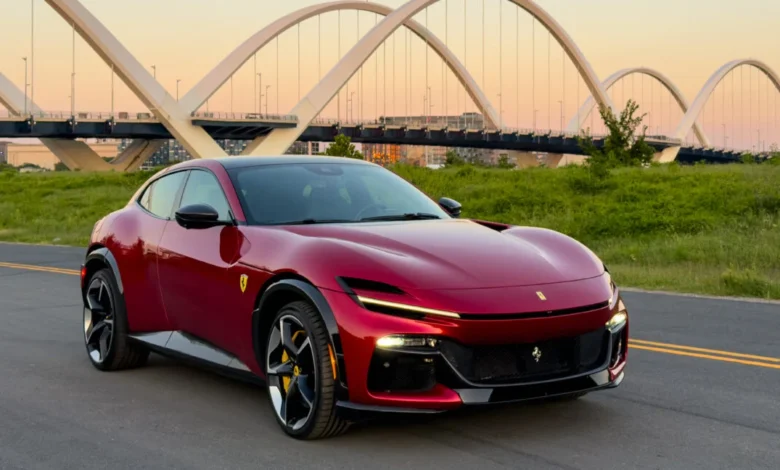
The automotive landscape has shifted dramatically over the past decade, as ultra-luxury and high-performance manufacturers have embraced the high-riding utility vehicle format to satisfy global demand. Among these prestige entries, the Ferrari Purosangue stands out not merely as Maranello’s first-ever four-door, four-seater vehicle, but as a defiant celebration of the naturally aspirated V12 engine in an era dominated by forced induction and electrification. Priced at a base MSRP of $393,350—though quickly escalating with options, as demonstrated by a heavily customized test vehicle carrying a staggering $576,544 price tag—the Purosangue occupies a unique echelon in the luxury automotive market. It vastly undercuts the anticipated pricing of future battery-electric offerings from the brand, such as the upcoming electric Luce, while commanding a significant premium over traditional rivals like the Aston Martin DBX and the Lamborghini Urus.
This review explores the intricate balance Ferrari has attempted to strike: marrying genuine sports car dynamics, daily drivability, and family-friendly packaging with polarizing human-machine interface (HMI) choices and a visceral, albeit thirsty, internal combustion powertrain.
Cabin Ergonomics: Physical Buttons Return, Yet Complexity Persists
When Ferrari introduced the capacitive touch steering wheel controls in models like the 296, the automotive press and consumer base met the design with widespread frustration, citing a lack of tactile feedback and near-usizability on the move. Fortunately, the multifunction steering wheel in the Purosangue takes a step back toward traditional ergonomics by utilizing actual physical buttons for the vast majority of its primary controls.
These real, tactile buttons allow the driver to interact with systems—such as controlling Apple CarPlay while maintaining absolute focus on the road—without diverting their gaze. When active, smartphone projection appears directly within the main instrument display immediately in front of the driver, cleanly integrating into a digital layout that also houses a prominent, central tachometer. This design philosophy honors the traditional driver-centric ethos of Maranello’s grand tourers.
However, modern automotive interior design often necessitates trade-offs, and the Purosangue is no exception when it comes to secondary controls. Adjusting the cabin climate or seat configurations requires interacting with a unique rotating controller that physically pops out of the dashboard. Occupants must swipe or tap its integrated touchscreen display to modify temperature, fan speed, ventilation, or the multi-mode massage functions for each individual seat.
While this mechanism is straightforward enough when the vehicle is stationary, operating it on the move introduces notable challenges. The digital targets on the small touchscreen require a degree of precision that is difficult to maintain on uneven road surfaces. To accommodate rear-seat passengers, Ferrari has replicated this exact functionality via a second, dedicated dial positioned centrally between the back seats. Speaking of the rear quarters, they offer a level of lateral support that rivals the front bucket seats—a necessary inclusion given the vehicle’s capacity to generate serious lateral G-forces through demanding corners.
Infotainment Isolation and Passenger Integration
In keeping with a minimalist approach to the central dashboard real estate, the Purosangue completely omits a traditional central infotainment screen for the driver. Instead, Ferrari has integrated a dedicated, full-size screen dedicated entirely to the front-seat passenger.
This layout serves a dual purpose: it keeps the driver entirely focused on the task of piloting a high-performance machine while granting the co-driver autonomy over entertainment options. The passenger display allows interaction with native media applications and vehicle telemetry. However, functional limitations exist; passengers are unable to project Apple CarPlay onto this dedicated screen, restricting smartphone mirroring primarily to the driver’s instrument cluster. Furthermore, the passenger display is heavily polarized and filtered. During extended testing, drivers frequently reported an inability to discern what their passengers were interacting with on the screen, successfully mitigating potential visual distractions in the cabin.
Exterior Design and Customization Potential
Finished in a lustrous Rosso Portofino paint that catches and reflects summer sunlight with striking depth, the tested Purosangue proved to be an undeniable head-turner. Its presence is visually dramatic, offering a more sculptural and aggressive aesthetic than some of the lighter metallic specifications—such as a yellowy-green press vehicle previously evaluated on the winding roads around Rome earlier in the summer.
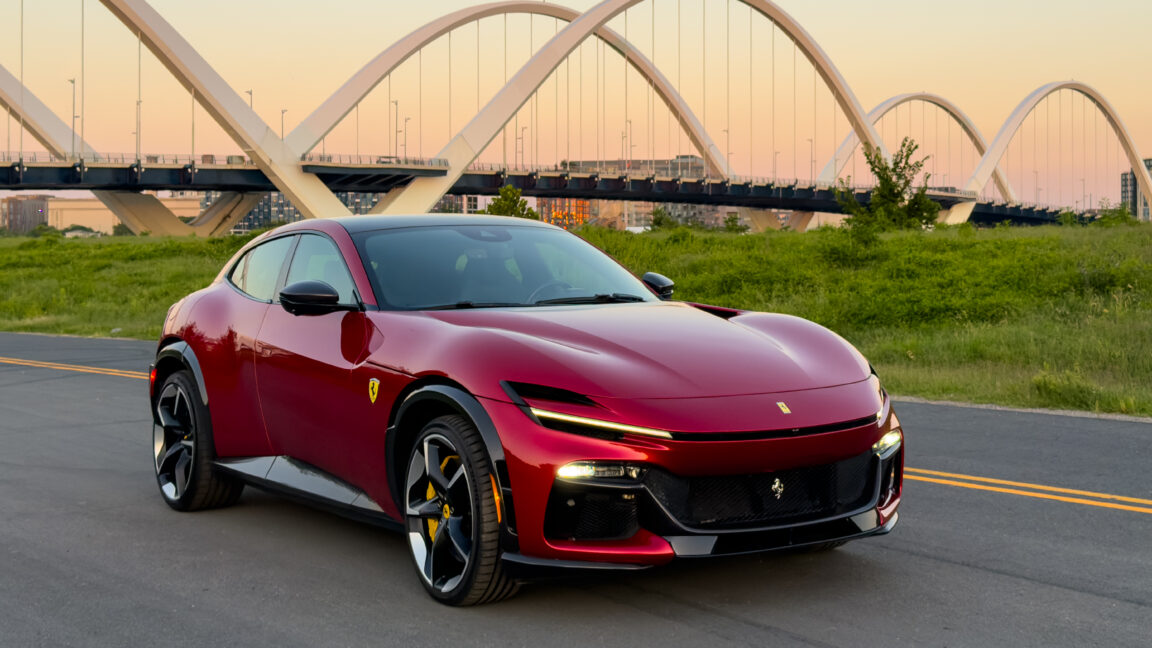
As expected from the prancing horse, exterior and interior finishes are bound only by a buyer’s imagination and financial capacity. Through Ferrari’s exhaustive customization programs, including Atelier and Tailor Made, clients can tailor virtually every square inch of the vehicle, utilizing bespoke hides, carbon fiber weaves, and proprietary paint formulations.
Despite its aggressive styling and supercar pedigree, the Purosangue is engineered to be driven daily. That said, practical daily operation comes with specific caveats. The vehicle delivers a combined fuel economy of approximately 12 mpg (19.6 L/100 km), meaning frequent stops at the fuel station will be a regular part of ownership. For eco-conscious drivers or those prioritizing carbon neutrality, a battery-electric vehicle like the upcoming Ferrari Luce is better suited for urban commuting. Nevertheless, for enthusiasts determined to experience a roaring V12 engine with family in tow, the Purosangue represents a masterclass in packaging. Equipped with the appropriate seasonal tires, it also doubles as a remarkably capable winter cruiser.
Market Context and Competitive Landscape
The introduction of the Purosangue represents a pivotal milestone in Ferrari’s corporate history. For decades, company leadership vehemently denied that the manufacturer would ever produce an SUV or a four-door vehicle, vowing to preserve the purity of its two-seater sports car and mid-engine supercar lineages. However, changing global luxury markets—spurred by the astronomical financial success of rival utility vehicles—forced a strategic re-evaluation in Maranello.
Chronologically, development of the vehicle began in the late 2010s under the internal code name P175. As rumors circulated regarding Ferrari’s entry into the high-performance utility segment, purists expressed skepticism. When the production version was officially unveiled, demand immediately outstripped initial production forecasts, prompting Ferrari to deliberately cap output to preserve exclusivity—a core tenet of the brand’s business model.
When measured against its direct competitors, the Purosangue carves out a distinct mechanical niche. Traditional ultra-luxury heavyweights rely heavily on twin-turbocharged V8 powerplants or forced-induction W12 architectures. The Aston Martin DBX707 and the Lamborghini Urus SE plug-in hybrid deliver blistering straight-line acceleration and impressive utility. Yet, neither offers the symphonic soundtrack, linear power delivery, and prestige of a naturally aspirated 6.5-liter V12 engine.
Industry analysts note that while the Purosangue carries a steep financial penalty—with well-equipped models easily clearing the half-million-dollar threshold—it enjoys a protected market position. Buyers seeking the ultimate expression of Italian internal combustion engineering within a practical body style currently have few alternative options.
Broader Implications and Future Outlook
The market performance and reception of the Ferrari Purosangue hold significant implications for the broader ultra-luxury automotive sector. As global emissions regulations tighten and electrification mandates loom across Europe and North America, the days of the pure internal combustion V12 are strictly numbered. Vehicles like the Purosangue function as a swan song for traditional engine building, demonstrating that manufacturers can still innovate within the combustion space while adapting to consumer demands for comfort, all-weather capability, and increased passenger capacity.
At the same time, the Purosangue serves as a bridge toward Ferrari’s electrified future. By generating substantial profit margins through high-end personalization programs and strong base pricing, the model helps fund the heavy research and development costs associated with Ferrari’s transition to hybrid and battery-electric platforms, such as the aforementioned Luce.
Ultimately, the Purosangue transcends traditional automotive categorizations. It is a polarizing, technologically complex, and immensely expensive machine that nevertheless succeeds in its primary mission: delivering a genuinely thrilling, emotionally resonant driving experience that feels entirely worthy of the badge on its hood.