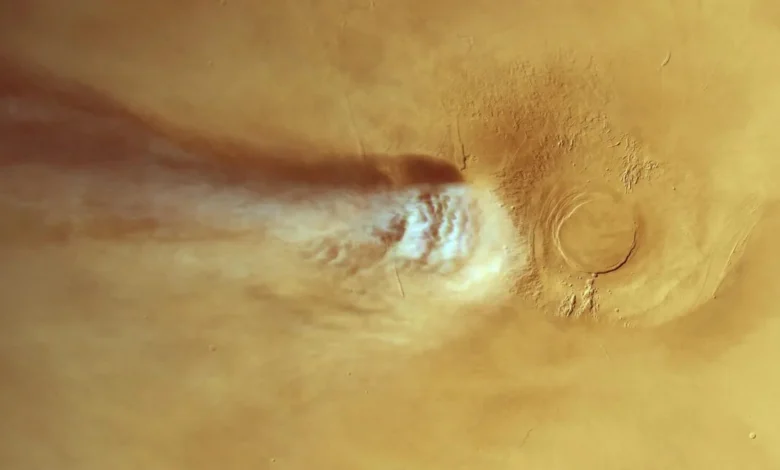
Atmospheric scientists studying the Red Planet have uncovered a rare meteorological phenomenon that challenges our fundamental understanding of how clouds form. Spanning an astonishing 1,800 kilometers, a recurring weather anomaly known as the Arsia Mons Elongated Cloud (AMEC) has provided researchers with the first-ever observational evidence of a process called homogeneous nucleation occurring naturally on a planetary scale. Published in the journal Nature Geoscience, the new study details how this colossal Martian cloud forms entirely without the aid of traditional atmospheric debris, presenting physics that have long been theorized but never witnessed in a natural setting.
The discovery offers a fascinating glimpse into the extreme dynamics of the Martian atmosphere. While terrestrial clouds rely on microscopic impurities like dust, pollen, or sea salt to act as seeds for water droplets and ice crystals, the AMEC bypasses this requirement completely. By analyzing sophisticated atmospheric models and observational data, researchers have confirmed that the gargantuan cloud materializes out of thin air through a process so rare and extreme that it pushes the boundaries of planetary meteorology.
Unpacking the Mechanics of Homogeneous Nucleation
On Earth, clouds are ubiquitous features born from a reliance on solid particles suspended in the troposphere. Water vapor condenses onto these aerosol seeds because doing so requires less energy than forcing vapor molecules to bind together on their own. This process, known as heterogeneous nucleation, governs virtually all weather patterns observed across our home planet, from towering cumulus clouds to delicate cirrus formations.
The Arsia Mons Elongated Cloud operates on an entirely different set of physical rules. According to the research team led by planetary scientists, the AMEC forms via homogeneous nucleation. In this scenario, water vapor transitions directly into ice crystals without the assistance of dust, salt, or any other particulate matter.
Jorge Hernández-Bernal, one of the lead researchers behind the study, vividly illustrated the mechanics of the process for clarity. It is akin to droplets of condensation appearing spontaneously in the middle of an empty room, rather than forming on a cold windowpane, he explained. It is wholly unexpected in a natural planetary environment.
For this rare transition to occur, the atmosphere must undergo a catastrophic and rapid shift in conditions. The study highlights that the phenomenon requires a punishing temperature drop of 30 degrees Celsius within a brief 10-minute window, coupled with extraordinarily high relative humidity. Under normal circumstances, such precise parameters are exceedingly difficult to sustain in a planetary atmosphere, which is why the mechanism has remained largely theoretical until now.
The Role of Arsia Mons and Extreme Geography
The secret to generating these severe meteorological conditions lies in the unique topography of Mars. The phenomenon is anchored by Arsia Mons, a colossal shield volcano that towers roughly 65,000 feet—or nearly 20 kilometers—above the surrounding Martian plains. To put this into perspective, Arsia Mons is more than twice the height of Mount Everest, making it one of the most prominent geographic features in the entire solar system.
The volcano acts as a massive physical barrier to the Martian wind currents. When prevailing winds sweep across the surface and slam into the towering flanks of Arsia Mons, the air is forced upward in a violent, vertical surge. This topographical lifting creates a powerful atmospheric wave that launches moist air miles high into the Martian atmosphere in a matter of minutes.
As the moist air ascends rapidly to these extreme altitudes, it experiences the necessary adiabatic cooling. Temperatures plummet by the required 30 degrees Celsius, and localized humidity spikes dramatically. Once these thresholds are crossed, the vapor undergoes homogeneous nucleation, instantly crystallizing into the sprawling, elongated cloud structure that stretches nearly halfway across the planet.
Intriguingly, the AMEC is not a permanent fixture of the Martian sky. It exhibits a distinct seasonal cycle, appearing and disappearing predictably as the planet completes its orbit around the Sun. The cloud typically forms in the early morning hours, grows rapidly as solar heating interacts with the atmospheric waves, and subsequently evaporates by midday as the sun warms the surrounding air. This predictable cyclicity has allowed scientists to target the phenomenon using orbital assets, capturing detailed imagery and telemetry that made the recent breakthrough possible.
Bridging the Gap in Planetary Data
For decades, astrophysicists and meteorologists have hypothesized that homogeneous nucleation could theoretically occur in the upper atmospheres of other terrestrial planets. Researchers have long suspected that similar processes might take place on Venus, and potentially even within the high-altitude layers of Earth’s atmosphere during extreme weather events. However, obtaining empirical proof has proven persistently elusive.
The primary hurdle has always been the sheer intensity of the environmental prerequisites. The humidity levels required to trigger homogeneous nucleation on this scale are astronomical. According to atmospheric data cited in the study, the localized air humidity necessary to form the AMEC is more than 100,000 times greater than any value ever measured on Earth.
Before the recent modeling breakthroughs, planetary scientists were unaware that such extreme humidity pockets could even exist on Mars. The Red Planet is famously arid, characterized by an exceptionally thin, dry atmosphere that holds a mere fraction of Earth’s atmospheric water content. Discovering that localized microclimates could achieve saturation levels exceeding anything known on our home planet has fundamentally altered how researchers view Martian meteorology.
We do not have nearly as much information about Mars’ atmosphere as we do about Earth’s, so reproducing the AMEC to this degree is a significant success, Hernández-Bernal noted, emphasizing the complexity of the computational models used to validate the findings. The result is remarkable, confirming that our theoretical models of phase transitions can hold true under the most punishing extraterrestrial conditions.
Chronology of the Discovery
The journey toward understanding the Arsia Mons Elongated Cloud spans years of persistent observation and computational refinement.
The cloud first captured widespread scientific attention due to its sheer size and stubborn regularity. Amateur astronomers and space agencies alike noticed the massive plume stretching away from the summit of Arsia Mons during specific seasons. Initially mistaken for volcanic activity or dust storms by early observers, the plume was eventually classified as an orographic cloud—a weather formation caused by the flow of air over mountains.
However, standard orographic models failed to fully explain the cloud’s massive scale, rapid development, and unusual longevity. Traditional physics models could not account for how a cloud stretching 1,800 kilometers could materialize so quickly from the thin Martian air without depleting the local water vapor supply entirely.
To solve the mystery, researchers turned to advanced atmospheric modeling tools, combining archival data from missions like the European Space Agency’s Mars Express and NASA’s Mars Reconnaissance Orbiter. By simulating the complex interplay between topography, wind dynamics, and thermodynamic phase changes, the research team successfully recreated the AMEC’s life cycle in a virtual environment. The resulting simulation not only matched the visual observations captured by orbiters but also revealed the hidden mechanics of homogeneous nucleation operating beneath the visible cloud layer.
Broader Impact and Implications for Space Exploration
The confirmation of homogeneous nucleation on Mars carries profound implications that extend well beyond the realm of theoretical meteorology. Understanding the precise mechanisms of cloud formation and water vapor distribution on the Red Planet is critical for mapping the planet’s broader climate history.
Water is one of the most vital resources for future human exploration of Mars. Determining how water vapor moves through the atmosphere, where it concentrates, and how it transitions between vapor, liquid, and ice phases helps scientists construct more accurate global water inventories. This data is essential for identifying potential subsurface water reserves, predicting weather patterns for landing sites, and designing life-support systems that rely on in-situ resource utilization.
Furthermore, the study serves as a powerful reminder of how alien worlds can serve as natural laboratories for extreme physics. Phenomena that are impossible to recreate or observe directly in Earth’s tightly regulated atmospheric envelope can sometimes be studied in plain sight across our solar system. By pushing the boundaries of what we know about phase transitions in low-pressure, hyper-arid environments, researchers are laying the groundwork for a more universal understanding of atmospheric science—one that will apply not only to Earth and Mars, but eventually to exoplanets orbiting distant stars.