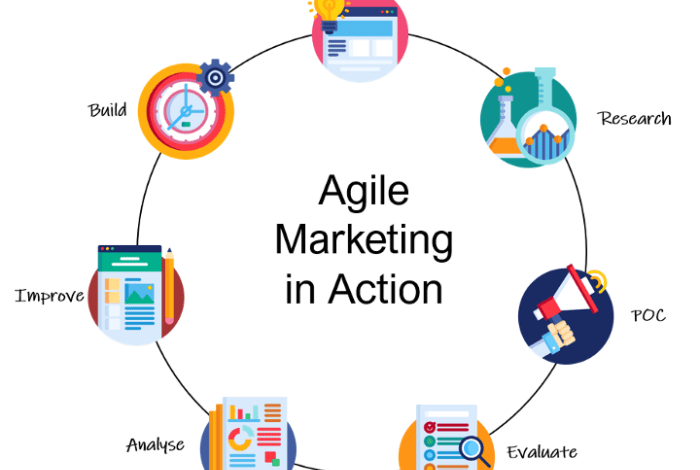

Agile Marketing: Unleashing Speed, Adaptability, and Results in Today’s Dynamic Landscape
The traditional marketing funnel, with its linear progression and lengthy planning cycles, is increasingly ill-equipped to navigate the rapid shifts and unpredictable nature of the modern marketplace. Consumer behavior evolves at breakneck speed, new technologies emerge constantly, and competitive landscapes can transform overnight. This is where Agile Marketing, a methodology adapted from software development, offers a powerful solution. It’s not merely a buzzword; it’s a fundamental shift in how marketing teams operate, prioritizing flexibility, collaboration, data-driven iteration, and continuous improvement to deliver superior results. Embracing Agile Marketing means moving away from rigid, long-term campaigns and towards shorter, focused sprints that allow for rapid testing, learning, and optimization.
At its core, Agile Marketing is built upon a set of principles that emphasize customer value, responsiveness to change, and iterative delivery. These principles, derived from the Agile Manifesto, translate into a marketing context by focusing on delivering working marketing campaigns that generate measurable results, welcoming changes in strategy or tactics, and fostering close collaboration between team members and stakeholders. It’s about empowering marketing teams to be more proactive and less reactive, enabling them to anticipate and capitalize on emerging opportunities rather than being caught off guard by disruptions. The emphasis shifts from executing a pre-defined plan to continuously discovering what resonates best with the target audience through experimentation and feedback loops. This iterative approach allows for a deeper understanding of customer needs and preferences, leading to more impactful and relevant marketing efforts.
The practical application of Agile Marketing often manifests through methodologies like Scrum or Kanban. Scrum, a popular framework, structures work into fixed-length iterations called “sprints,” typically lasting one to four weeks. Each sprint begins with planning, outlining the specific goals and tasks to be accomplished. Daily stand-up meetings, short and focused, ensure alignment and identify any roadblocks. At the end of a sprint, a review demonstrates the completed work and gathers feedback, followed by a retrospective to identify areas for improvement in the team’s process. Kanban, on the other hand, focuses on visualizing the workflow, limiting work in progress, and managing the flow of tasks. This visual approach, often represented by a Kanban board, makes bottlenecks apparent and encourages a steady, predictable output. While Scrum offers a structured rhythm, Kanban provides a more fluid and adaptable system, allowing teams to choose the framework that best suits their specific needs and operational style. The key is to select a methodology that promotes transparency, accountability, and efficient workflow.
The benefits of adopting Agile Marketing are manifold and directly address the pain points of traditional marketing. Foremost among these is enhanced speed to market. By breaking down large projects into smaller, manageable sprints, marketing teams can launch campaigns, test new ideas, and respond to market shifts much faster. This agility allows them to seize fleeting opportunities, get ahead of competitors, and capitalize on emerging trends before they become saturated. Furthermore, Agile Marketing fosters improved adaptability. The iterative nature of sprints allows teams to pivot their strategies based on real-time data and customer feedback. If a campaign isn’t performing as expected, adjustments can be made quickly within the next sprint, rather than waiting for a long-term plan to conclude. This minimizes wasted resources and ensures marketing efforts remain relevant and effective.
Increased collaboration and communication are also hallmarks of Agile Marketing. Daily stand-ups and frequent reviews encourage open dialogue, breaking down silos between different marketing functions and even with other departments like sales and product development. This cross-functional collaboration leads to a more holistic understanding of business objectives and customer journeys, resulting in more integrated and impactful marketing initiatives. Moreover, Agile Marketing promotes a culture of continuous learning and improvement. Each sprint retrospective provides a dedicated time for the team to reflect on what worked well, what didn’t, and how to optimize their processes for future sprints. This commitment to learning ensures that the team is constantly evolving and refining its strategies for maximum effectiveness.
Data-driven decision-making is intrinsically woven into the fabric of Agile Marketing. Instead of relying on assumptions or gut feelings, agile teams prioritize the collection and analysis of data throughout each sprint. Performance metrics are tracked diligently, providing tangible insights into what resonates with the target audience and what needs improvement. This empirical approach allows for informed adjustments to campaigns, messaging, and targeting, ensuring that marketing spend is optimized and efforts are focused on the most impactful activities. The rapid feedback loops inherent in agile methodologies enable marketers to identify what’s working and what’s not much faster, allowing them to allocate resources more effectively and avoid investing in underperforming initiatives.
The transformation to Agile Marketing requires a cultural shift within the organization. It’s not simply about implementing new tools or processes; it’s about fostering a mindset that embraces change, values collaboration, and empowers individuals. Leadership buy-in is crucial, as is the willingness to experiment and accept that not every initiative will be a resounding success. Education and training for marketing teams are essential to ensure they understand the principles and practices of agile methodologies. Building trust and psychological safety within teams is paramount, allowing individuals to voice concerns, share ideas freely, and take calculated risks without fear of reprisal. This cultural transformation is often the most challenging but ultimately the most rewarding aspect of adopting Agile Marketing.
Key elements of Agile Marketing implementation include defining clear objectives and success metrics for each sprint, prioritizing the backlog of tasks based on business value, and fostering a culture of transparency and accountability. The backlog, a prioritized list of all potential marketing activities, is continuously refined and updated. Sprints are planned to tackle the highest-priority items, ensuring that the team is always working on what will deliver the most value. Regular communication channels, such as dedicated Slack channels or project management software, facilitate seamless information flow. Visualizing workflows through Kanban boards or Scrum boards provides an instant overview of progress and potential bottlenecks.
The impact of Agile Marketing can be observed across various marketing disciplines. In content marketing, it means iterating on content types, distribution channels, and messaging based on engagement metrics, rather than committing to a rigid editorial calendar. For social media marketing, it involves rapidly testing different post formats, engagement strategies, and campaign themes in response to real-time trends and audience reactions. Search engine optimization (SEO) benefits from agile by allowing for continuous experimentation with keywords, on-page elements, and link-building strategies, adapting to algorithm changes and competitor activity. Paid advertising campaigns can be optimized with unprecedented speed, allowing for rapid A/B testing of ad copy, creatives, and targeting parameters to maximize ROI.
For established businesses, the transition to Agile Marketing can involve pilot programs with specific teams or campaigns to demonstrate its effectiveness. For startups, it offers a natural advantage, allowing them to be highly responsive to market feedback and customer acquisition challenges from the outset. Regardless of the organizational context, the core principles remain the same: deliver value iteratively, embrace change, and foster collaboration. The goal is to create a marketing engine that is not only efficient but also resilient and capable of thriving in an ever-evolving commercial environment.
Measuring the success of Agile Marketing involves tracking a combination of key performance indicators (KPIs). These can include sprint completion rates, cycle time (the time it takes for a task to move from start to finish), lead generation, conversion rates, customer acquisition cost (CAC), customer lifetime value (CLTV), and return on marketing investment (ROMI). Beyond quantitative metrics, qualitative feedback from team members and stakeholders regarding improved communication, collaboration, and overall team satisfaction is also invaluable. The focus is on demonstrating tangible business outcomes that directly link to the agile way of working.
In conclusion, Agile Marketing is not a passing fad; it is a fundamental paradigm shift that empowers marketing teams to excel in the modern, fast-paced business world. By embracing its principles of speed, adaptability, collaboration, and data-driven iteration, organizations can unlock their potential to deliver more impactful campaigns, achieve superior results, and foster a more dynamic and responsive marketing function. The ability to rapidly test, learn, and optimize ensures that marketing efforts remain relevant, efficient, and ultimately, successful in achieving overarching business objectives. The future of marketing is agile, and the organizations that embrace this evolution will be the ones that thrive.

