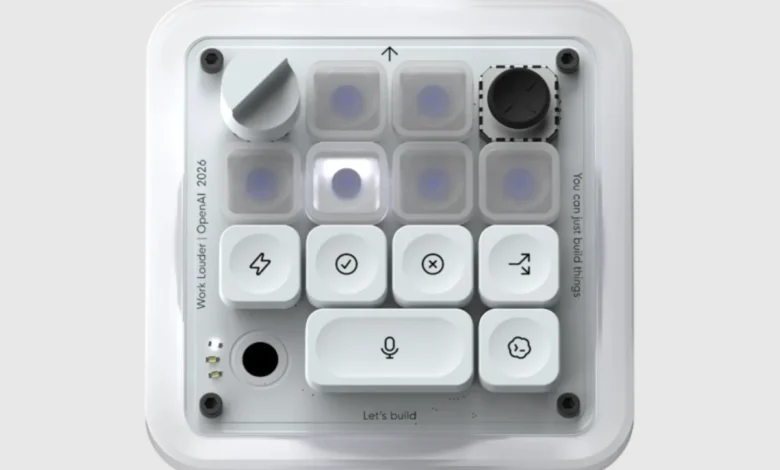
OpenAI, the vanguard of artificial intelligence research and development, last week marked a significant milestone by introducing its inaugural hardware product, Micro. This meticulously crafted keypad, designed to seamlessly integrate with ChatGPT, represents a foray into the tangible world of AI tools, developed in collaboration with specialty keyboard designer Work Louder. Positioned as an artisanal workplace novelty, Micro is poised to captivate a niche segment of tech enthusiasts while potentially leaving a broader audience contemplating its purpose. This debut, however, is not occurring in a vacuum, as OpenAI navigates a complex landscape marked by high-stakes legal challenges and revelations of more ambitious hardware endeavors on the horizon.
The unveiling of Micro comes at a particularly tumultuous period for OpenAI, as the company grapples with a formidable legal offensive from tech giant Apple. Weeks prior to Micro’s launch, specifically on July 10, 2026, Apple initiated a lawsuit against the AI laboratory, alleging trade secret theft. This legal action has ignited what is anticipated to be a protracted and intensely scrutinized legal battle, casting a long shadow over OpenAI’s expansion efforts. The lawsuit’s specifics, though still unfolding in court, reportedly center on proprietary technologies and methodologies that Apple claims were unlawfully appropriated, potentially impacting the development of new AI-driven hardware and software. Such a dispute between two titans of the technology industry highlights the escalating competition and intellectual property concerns within the rapidly evolving AI landscape.
Adding another layer of intrigue to OpenAI’s hardware narrative, reports surfaced shortly after the Apple lawsuit, on July 14, 2026, regarding another smart home product in advanced stages of development. This supposed device, described as a screenless speaker designed to pair with ChatGPT, has garnered considerable attention, particularly due to its development team reportedly comprising former Apple engineers. This detail has fueled speculation about OpenAI’s strategic intent, suggesting a potential pattern of recruiting talent from established hardware innovators and raising questions about the ethical boundaries of competitive hiring practices, especially in light of Apple’s ongoing litigation. The confluence of these events paints a picture of an OpenAI aggressively pushing into new domains, even as it confronts significant challenges to its operational integrity and reputation.
Until these legal entanglements are resolved and OpenAI’s more expansive hardware aspirations fully materialize, Micro stands as the company’s definitive physical offering. This "funky little keypad" is clearly engineered to resonate with the specific demands and aesthetic preferences of the tech industry’s "code monkeys"—a term often used endearingly for developers, programmers, and power users who thrive on optimized workflows and specialized tools. Its very existence signals OpenAI’s strategic pivot from purely software-centric solutions to a more holistic ecosystem approach, where dedicated hardware enhances the user experience and potentially entrenches its AI platforms deeper into daily professional routines.
OpenAI’s Hardware Ambitions and the "Micro" Debut
OpenAI’s venture into hardware is a calculated move that reflects a broader industry trend towards integrated AI solutions. For years, AI has primarily existed as software, running on general-purpose computing devices. However, as AI capabilities grow more sophisticated, there’s a growing recognition that specialized hardware can unlock new levels of efficiency, responsiveness, and user interaction. Micro, developed in partnership with Work Louder, a company renowned for its ergonomic and customizable input devices, is not merely a peripheral but a statement of intent. Work Louder’s expertise in crafting high-quality, often mechanical, keyboards and macropads brings a level of tactile satisfaction and customizability that appeals directly to the enthusiast market. The collaboration suggests a deliberate effort by OpenAI to imbue its first hardware product with a sense of premium craftsmanship and functional design, moving beyond generic input devices. This strategy aims to create a dedicated interface that streamlines interaction with complex AI models like ChatGPT and its agentic coding tool, Codex, thereby enhancing productivity for its target demographic.
The Apple-OpenAI Legal Tussle: A Looming Shadow
The legal dispute with Apple represents a critical juncture for OpenAI. The lawsuit, filed on July 10, 2026, accuses OpenAI of trade secret theft, specifically targeting technologies related to advanced AI processing and hardware integration. While the precise details of the alleged theft remain under wraps due to ongoing litigation, industry analysts speculate that Apple’s concerns may stem from OpenAI’s rapid expansion into areas that touch upon Apple’s core competencies, particularly in on-device AI and specialized silicon design. This legal challenge could potentially constrain OpenAI’s ability to develop or deploy certain technologies, significantly impacting its hardware roadmap. The timing of the lawsuit, just weeks before Micro’s launch, suggests a pre-emptive strike by Apple to protect its intellectual property as OpenAI increasingly encroaches on its traditional domains.
Further complicating matters is the revelation, reported on July 14, 2026, that OpenAI is developing a screenless smart home speaker with a team largely composed of former Apple engineers. This news immediately raised eyebrows, as the recruitment of ex-Apple talent for a directly competitive hardware product could be interpreted as a strategic maneuver to leverage their expertise in hardware design, supply chain, and user experience—areas where Apple has historically excelled. For Apple, this could bolster its claims of trade secret infringement, arguing that the transfer of talent inevitably brings with it proprietary knowledge. The legal battle is thus not just about past actions but also about the future trajectory of both companies, particularly as they vie for dominance in the burgeoning AI-integrated hardware market. The outcome could set precedents for talent acquisition and intellectual property protection across the entire tech industry.
First Impressions: Design, Build, and Apple Echoes
Upon receiving a Micro test unit, TechCrunch noted several immediate impressions that speak volumes about its design philosophy. The device exhibits a remarkable sturdiness, suggesting a robust construction that could easily double as a sophisticated paperweight if its primary AI functions don’t resonate with users. This durability, likely a hallmark of Work Louder’s contribution, contrasts with the often flimsy feel of generic peripherals. More strikingly, the packaging—an immaculate white box with a sleek, clean aesthetic—evokes a strong resemblance to Apple’s iconic product presentation. This "Apple-coded" packaging, as noted by the reviewer and others, is not a trivial detail. It signals an aspiration to premium branding, user experience, and perhaps even a subtle nod to the design excellence that Apple embodies. Whether this is a deliberate homage, a strategic emulation, or a subconscious influence, it suggests OpenAI’s ambition to position its hardware not just as a functional tool but as a desirable, high-quality consumer product. This attention to detail in presentation could be an attempt to appeal to a demographic that values aesthetics and brand prestige alongside functionality.
Under the Hood: Micro’s Functionality and Integration
Micro’s design is centered around optimizing interaction with AI. The keypad features a logical layout comprising six frosted "agent" keys positioned at the top. These keys are fully customizable, allowing users to assign specific tasks or workflows within ChatGPT or OpenAI’s agentic coding tool, Codex. For instance, a key could be programmed to initiate a specific code generation request in Codex, summarize a lengthy document in ChatGPT, or even manage complex multi-step AI agents. Below these agent keys are six command keys, providing intuitive control over the active AI programs, such as executing commands, canceling tasks, or navigating through responses.

Connectivity options are versatile, offering both Bluetooth for wireless convenience and a USB cable for a stable, wired connection, catering to different user preferences and workstation setups. Perhaps one of Micro’s most compelling features is its dedicated button for voice dictation. This allows users to simply hold down the button, speak their requests directly to ChatGPT, and then tap a "send" button to submit the query. This hands-free input method could significantly accelerate workflows, particularly for users who find typing lengthy prompts cumbersome or prefer a more natural interaction style. Customization extends deeply into the user experience, as the Micro keypad can be configured directly within ChatGPT itself. A dedicated Micro tab within the AI interface enables users to adjust parameters ranging from the brightness of the key backlighting to the specific commands and projects associated with each key, ensuring a highly personalized and efficient setup. This deep software-hardware integration is crucial for the device’s utility, allowing the AI itself to become the configuration hub.
Market Reception and Critical Scrutiny
Despite its innovative premise, Micro has faced a largely lukewarm, if not outright critical, reception from its intended target audience: hardcore coders and developers. Reviews across platforms like Reddit have been predominantly negative, with one user famously dismissing it as "a prank and not a real product." Many professional coders have expressed skepticism, arguing that serious developers, who often rely on highly customized mechanical keyboards and sophisticated software macros, would find little value in Micro. They contend that existing tools and workflows, often involving complex keyboard shortcuts and scripting, already provide ample efficiency, making a dedicated, limited-function keypad redundant.
The $230 price tag has emerged as a significant point of contention. An even harsher critique came from the independent outlet Aftermath, whose review, tellingly titled "OpenAI’s expensive macropad feels engineered to piss me off specifically," lambasted the cost as unjustifiable. The review highlighted the abundance of cheaper DIY macropad kits and off-the-shelf alternatives available on the market, many of which offer comparable or even superior levels of customization and functionality at a fraction of Micro’s price. For instance, popular programmable macropads from brands like Glorious or Keychron often retail for under $100, while fully customizable DIY kits can be assembled for even less, providing users with complete control over key switches, keycaps, and software programming. The market for specialized input devices is already saturated with options catering to various budgets and preferences, making Micro’s premium pricing a difficult sell without a truly disruptive or indispensable feature set. Critics argue that for $230, users expect a device that radically transforms their workflow, rather than merely offering incremental convenience.
The User Experience: Learning Curve vs. Efficiency Gain
A recurring theme in the early assessment of Micro is the existence of a notable learning curve. New users, particularly those unaccustomed to specialized macropads or extensive AI integration, may require a significant investment of time to fully grasp its functionalities and optimize it for their specific needs. The device’s color-coded feedback system, while intuitive once learned, demands memorization: white indicates an agent is idle, blue signifies active thinking, green confirms task completion, and red alerts to an error. Similarly, users must commit to memory which specific projects or commands are assigned to each of the customizable keys.
Despite this initial hurdle, the TechCrunch reviewer noted a shift in perspective once the keypad was programmed to their liking. The ability to assign various ChatGPT sessions to specific keys, allowing for seamless toggling between different projects, combined with the voice dictation feature, was found to considerably enhance efficiency and enjoyment. For example, a developer might assign one key to a debugging assistant, another to a code refactoring agent, and a third to a documentation generator, switching between them with a single press. This immediate context switching, without needing to navigate browser tabs or application windows, represents a genuine productivity boost for intensive AI users.
However, the fundamental question remains: Is Micro functionally easier to use than simply continuing to operate with a laptop’s standard keyboard and mouse? For many, the ingrained muscle memory and familiarity with traditional input methods present a high barrier to adopting a new, specialized device. The cognitive load of learning new key assignments and color codes must be offset by a tangible and significant gain in workflow efficiency. For a casual user, or even a professional who only intermittently uses AI, the effort required to master Micro might outweigh the perceived benefits, leading to it being relegated to a desk ornament.
Strategic Positioning and Target Demographics
Ultimately, the utility and value derived from Micro will be directly proportional to an individual’s reliance on ChatGPT and other AI tools in their daily work. The TechCrunch reviewer, who admitted to not being a heavy AI user, concluded that they were likely not Micro’s target audience. This highlights OpenAI’s deliberate strategy to cater to a highly specific demographic: the "ChatGPT power user." This group includes developers, writers, researchers, and other professionals who frequently interact with AI models for complex tasks, code generation, content creation, data analysis, and more. For these individuals, every fraction of a second saved and every mental load reduced can translate into significant productivity gains over time.
The appeal of "vintage-looking hardware with clicky buttons" further defines this niche. There’s a strong resurgence in popularity for mechanical keyboards and retro-inspired tech, driven by enthusiasts who appreciate the tactile feedback, auditory satisfaction, and customizable nature of such devices. Micro taps into this aesthetic and functional preference, offering a premium, dedicated tool that aligns with the specialized setups often found in these users’ workspaces. For a ChatGPT power user with $230 to spare, who values both efficiency and a unique, aesthetically pleasing desk accessory, Micro could indeed be a worthwhile purchase, potentially brightening their day and streamlining their AI interactions. It’s a device for those who want to "feel" their AI, rather than just interact with it through a generic screen and keyboard.
Broader Implications: The Future of AI Hardware
Micro, despite its niche appeal and initial criticisms, represents a significant symbolic step for OpenAI and for the broader AI industry. It signals a future where AI isn’t just software running on existing devices, but an integrated experience enhanced by purpose-built hardware. This move by OpenAI could inspire other AI companies to explore their own hardware ventures, leading to a new wave of specialized AI-centric devices, from smart home assistants to professional productivity tools. The ongoing legal battles and competitive landscape underscore the immense value placed on intellectual property and talent in this rapidly evolving sector. OpenAI’s willingness to enter the hardware arena, even with a seemingly niche product like Micro, demonstrates a long-term vision of creating a comprehensive AI ecosystem, where hardware and software are inextricably linked to provide seamless and intuitive AI experiences. This foundational step, while imperfect, lays the groundwork for more ambitious products, potentially cementing OpenAI’s position not just as an AI software leader, but as a holistic AI solutions provider.
In conclusion, Micro stands as OpenAI’s tangible entry into the hardware market, a collaborative effort with Work Louder, designed to enhance the ChatGPT experience for a specific segment of power users. Its launch is overshadowed by a high-profile lawsuit from Apple and the revelation of future smart home hardware. While offering robust build quality, Apple-esque aesthetics, and specialized functionality for AI interaction, Micro faces criticism for its price point and perceived redundancy by some professional coders. Its success hinges on its adoption by dedicated ChatGPT users who value the blend of niche functionality, tactile feedback, and premium design, signifying a pivotal, albeit controversial, step in OpenAI’s journey to integrate AI more deeply into the physical world.