Larry David has once again graced the screens of HBO Max with his distinctive brand of observational humor, this time delving into American history with his new sketch comedy series, Life, Larry and the Pursuit of Unhappiness. The show, executive produced by Barack and Michelle Obama through their Higher Ground Productions, arrives on the heels of the acclaimed conclusion of David’s long-running, semi-autobiographical sitcom, Curb Your Enthusiasm. However, Life, Larry and the Pursuit of Unhappiness is not merely a solo endeavor; it boasts an impressive ensemble of celebrity guests who embody a wide spectrum of historical figures, transforming familiar events and personalities into David’s signature comedic scenarios.
The series stands out not just for its premise but for the sheer scale of its celebrity involvement. Each episode features over a dozen well-known personalities, drawing from David’s own Curb Your Enthusiasm collaborators to esteemed figures from Hollywood and beyond. Notably, the late Rob Reiner made what is understood to be his final on-screen performance in the series, adding a poignant layer to his appearance. The cast list reads like a who’s who of contemporary entertainment, with major stars such as Samuel L. Jackson, Lin-Manuel Miranda, Jerry Seinfeld, and Jon Hamm donning period costumes and wigs. The Hollywood Reporter is committed to tracking the extensive roster of talent, ensuring due recognition for their contributions to David’s unique historical reimagining.
Life, Larry and the Pursuit of Unhappiness airs new episodes on Friday nights at 9 p.m. on HBO and is available for streaming on HBO Max, offering a weekly dose of historical satire with a distinctly modern, often anachronistic, comedic sensibility.
A Deep Dive into the Episodes: A Star-Studded Historical Tapestry
The series meticulously crafts each episode around pivotal moments and iconic figures in American history, reinterpreting them through Larry David’s lens. The casting choices often lean into meta-commentary and playful juxtapositions, amplifying the comedic effect.
Episode 1: "Livingston"
The premiere episode immediately establishes the show’s ambitious scope and star power. It opens with a surprising and fitting appearance by former President Barack Obama, an executive producer on the series. Obama, in a role that blends his public persona with a touch of amiable critique, addresses the nation as it approaches its semiquincentennial anniversary, offering lighthearted jabs at David himself. This introduction sets a tone that is both celebratory of American history and playfully irreverent.
The narration is provided by the inimitable Samuel L. Jackson, whose commanding voice has become a staple in cinematic storytelling, offering a sophisticated counterpoint to the comedic sketches that follow.
The episode’s first sketch reimagines the drafting of the Declaration of Independence. Henry Winkler, Chris Parnell, and Alan Tudyk step into the roles of founding fathers John Hancock, Benjamin Franklin, and Thomas Jefferson, respectively. They are depicted as humorously resistant to the additions proposed by Larry David’s character, Robert Livingston, to the document’s grievances. This scenario taps into the inherent complexities and debates that surrounded the nation’s founding, filtered through David’s penchant for interpersonal friction.
Following this, David portrays Alexander Graham Bell, grappling with the initial reception of his telephone. He is placed in an awkward social situation with Richard Kind, reprising a role reminiscent of his Curb character, Thomas Watson. The debut of the telephone is met with immediate, anachronistic demands from the public for text messaging and color options, a classic Davidian touch highlighting humanity’s insatiable desire for more, even in the face of groundbreaking innovation. The demanding crowd is populated by sitcom veterans Alison Becker, Mary Sohn, and Rodney J. Hobbs, underscoring the show’s ability to draw from a deep well of comedic talent.
The narrative then shifts to the grim realities of World War I trench warfare. David embodies a cowardly soldier under the command of a stern sergeant, portrayed by Michael Chiklis. His fellow soldiers are played by Mike Castle and Jake Reiner, son of the late Rob Reiner, weaving a personal connection into the historical context.
The episode concludes with a poignant, yet characteristically awkward, encounter. David plays an irritating bus passenger who chooses to sit next to Jurnee Smollett’s impeccably cast Rosa Parks, a moment that juxtaposes the mundane with the profoundly significant, inviting reflection on the courage of ordinary individuals.
Episode 2: "Farewell"
This episode features a highly anticipated reunion between Larry David and Jerry Seinfeld, the creative forces behind the iconic sitcom Seinfeld. The two comedy legends portray explorers Lewis and Clark, undertaking their historic expedition. The sketch cleverly plays on their real-life creative partnership, depicting them as drinking buddies whose extended joint venture on the arduous journey feels almost too convenient. Rita Wilson, as Mavis Lewis, Meriwether Lewis’s wife, offers a grounded, long-suffering perspective on their grand adventure.
David then turns his satirical gaze to the contentious 1876 presidential election, portraying Samuel Tilden. Tilden, having won the popular vote but narrowly losing the Electoral College, becomes the focus of David’s exploration of political contention. His aides are played by Curb alum Matthew Jones and Rich Fulcher, adding to the ensemble’s comedic chemistry.
A segment set during the Great Depression brings together Larry Wilmore and Colton Dunn. In a particularly memorable moment, Kaley Cuoco stars as a grieving widow whom David’s character attempts to leverage to cut in line for bread, highlighting the desperation and social dynamics of the era through a distinctly Davidian lens.
The episode culminates with the aforementioned final screen performance by Rob Reiner, who embodies George Washington. His appearance is used to discuss presidential term limits, serving as a platform for veiled critiques of former President Donald Trump. Adding another layer of meta-humor, Jimmy Kimmel makes a cameo, engaging in what appears to be a playful nod to his ongoing public feud with Trump.
Episode 3: "McCarthy"
Life, Larry and the Pursuit of Unhappiness continues its historical exploration with an episode that tackles the Boston Tea Party and the McCarthy era. David’s character finds himself unceremoniously involved in the Boston Tea Party, a scenario that underscores his tendency to be swept up in significant events with little agency. Lin-Manuel Miranda, whose own Broadway success Hamilton deeply engaged with the Revolutionary War period, plays a charismatic ringleader of the Tea Party, offering a sharp contrast to David’s bewildered participant. Comedian Lou DiMaggio also appears, further emphasizing the comedic potential of David’s character being an outsider in historical moments.
J.B. Smoove injects his signature energy into a segment involving the Underground Railroad, playing a character whose demands and unexpected arrival of companions confound David’s host. This sketch uses humor to navigate a sensitive historical period, focusing on the interactions and potential misunderstandings that could arise.
The Wright brothers’ pioneering flight is also revisited, though with a comedic twist. David portrays a less heroic Wright sibling, engaged in domestic squabbles over butter-churning skills with his wife, while Jon Hamm and Sean Hayes embody the actual Orville and Wilbur Wright, preparing for their momentous achievement. This juxtaposition of the mundane and the monumental is a hallmark of the series.
The episode’s most significant and talked-about segment features David as Senator Joseph McCarthy. Michael McKean, known for his roles in Saturday Night Live and Better Call Saul, plays attorney Joseph Welch, delivering the iconic "Have you no decency, sir?" retort. Rob Huebel, from Human Giant and Transparent, joins as a senator moderating one of McCarthy’s infamous hearings, recreating the tense atmosphere of the McCarthy era with a satirical edge.
Episode 4: "Deepthroat"
The Watergate scandal becomes the subject of Larry David’s satirical treatment in this episode. David portrays "Deep Throat," the anonymous source who provided crucial information to Washington Post reporters during the Watergate scandal. However, in a classic Davidian subversion, his "Deep Throat" offers only nonsensical information to Beck Bennett’s Bob Woodward, highlighting the absurdity that can often accompany even the most serious of investigations.
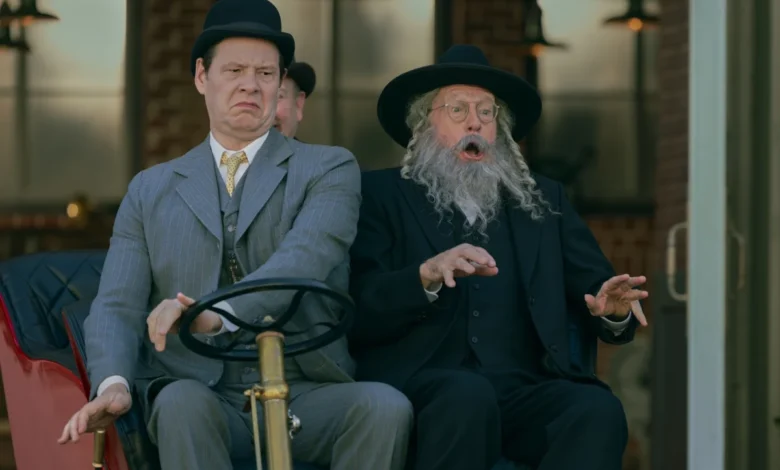
The episode then shifts to Henry Ford, with Ike Barinholtz portraying the industrialist. David’s character, a rabbi, finds himself in a tense exchange with Ford, who is depicted as resistant and antisemitic, making for an uncomfortable and darkly comedic encounter.
David then takes on the role of President James Buchanan, navigating social interactions at a party where he is introduced to the concept of passed appetizers. The sketch uses this anachronistic introduction to explore Buchanan’s character and his social ineptitude. Among the unfortunate women who cross his path are Jordana Brewster of the Fast & Furious franchise and Katie Aselton from The League, with Diallo Riddle as Buchanan’s assistant.
The episode’s most notable segment is a parody of Jonas Salk’s discovery of the polio vaccine. David plays Dora Salk, an overly proud mother bragging about her son’s achievement to her neighbor Evelyn. The sketch takes a personal turn, with David appearing to mock his former friend and Curb co-star Cheryl Hines’ husband, HHS Secretary Robert F. Kennedy Jr. The introduction of a character named Bobby, who voices early skepticism about vaccine safety, injects a contemporary relevance into the historical narrative, mirroring the vaccine hesitancy debates of recent years. This segment showcases David’s ability to connect historical events to present-day anxieties.
Episode 5: "Lincoln"
The penultimate episode of the initial run focuses on two significant moments in American history: the O.K. Corral shootout and the assassination of Abraham Lincoln. The O.K. Corral scene features Timothy Olyphant as Wyatt Earp and Don Johnson as Doc Holliday. Their encounter, typical of Curb Your Enthusiasm‘s style, devolves into an overly detailed and argumentative discussion about the logistics and timing of the famous shootout. Marc Menchaca, a Curb alum, plays a cowboy who confronts David’s character about his perceived incompetence.
The episode then delves into the complex and strained relationship between Abraham Lincoln and his wife, Mary Todd Lincoln. Bill Hader of SNL and Barry portrays a beleaguered Lincoln, who, along with his chief of staff, devises a plan to have Mary removed from the theater during a performance of Our American Cousin. This sketch cleverly uses the historical context of Lincoln’s assassination to explore the domestic tensions within the Lincoln household, offering a darkly comedic take on their marital dynamics. The scene culminates with a dispute between Mary and Lincoln’s chief of staff over a stolen sweater, a moment that feels remarkably akin to the everyday squabbles that define Curb Your Enthusiasm.
Broader Impact and Thematic Resonance
Life, Larry and the Pursuit of Unhappiness is more than just a comedic retread of historical events. It serves as a commentary on the enduring nature of human foibles and the often-unseen absurdities within moments of great historical significance. By casting contemporary figures, the show invites viewers to see historical figures not as static icons but as flawed individuals prone to the same petty grievances and social awkwardness that characterize modern life.
The series also touches upon the power of celebrity and its intersection with public discourse. The Obamas’ involvement lends a gravitas to the project, while the extensive guest list ensures widespread appeal. The meta-commentary, with actors playing historical figures and sometimes acknowledging their own personas or relationships, adds a layer of postmodern humor.
Furthermore, the show’s ability to connect historical events to contemporary issues, as seen in the vaccine parody and the subtle political jabs, demonstrates Larry David’s enduring relevance as a social satirist. Life, Larry and the Pursuit of Unhappiness offers a unique and often hilarious perspective on the American narrative, reminding audiences that history, much like comedy, is often found in the most unexpected and relatable of human interactions. The series, as it continues to unfold, promises to be a significant cultural touchstone, blending education with entertainment in a manner only Larry David could orchestrate.