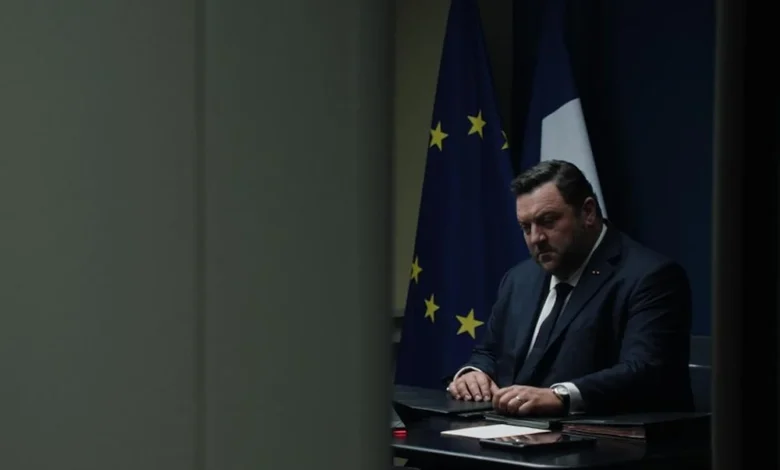
The geopolitical thriller has long served as a cinematic mirror to the anxieties of the contemporary era, yet few recent projects approach the terrifying immediacy of Alexandre Smia’s debut feature, Jupiter. Starring Denis Ménochet as the fictional French President Paul Archambault, the film plunges audiences directly into the harrowing architecture of command and control when a standard diplomatic disagreement violently spirals into an existential nuclear standoff. Eschewing the hyper-kinetic editing and bombastic action sequences typically associated with Hollywood blockbusters, Smia opts for a sober, claustrophobic procedural approach. The result is a tense, tightly wound 87-minute exploration of the machinery of statecraft under maximum pressure, though its clinical focus occasionally sacrifices emotional depth in favor of procedural momentum.
Main Facts of the Crisis
At the center of Jupiter is a fictionalized yet chillingly plausible European flashpoint. President Paul Archambault, portrayed with a gimlet-eyed, stoic resolve by Ménochet, finds himself thrust into a sudden nuclear crisis involving Ukraine and Russia. The narrative engine ignites when the Russian premier, Chernov—described in the film as a volatile despot—survives an apparent assassination attempt. Widely suspected within diplomatic circles to be a false flag operation engineered by Moscow, the incident is swiftly weaponized by the Kremlin to drastically escalate its ongoing military campaign against Ukraine.
As Russian forces redouble their offensive, Archambault is forced to weigh France’s long-standing security pledges to the besieged Ukrainian president, Kovalenko, against the terrifying prospect of a direct nuclear exchange. Compounding the geopolitical complexity, France’s traditional NATO allies refuse to commit to direct military intervention, citing the technicality that Ukraine is not a member-state of the alliance. Consequently, Paris finds itself isolated, forced to decide whether it will act unilaterally to defend a sovereign neighbor at the ultimate risk of its own national security. The crisis reaches a boiling point when Chernov orders the demonstration detonation of an atomic warhead over the Black Sea, prompting Archambault and his inner circle to retreat into the subterranean security of the executive war room.
Chronology of Escalation
The structural pacing of Jupiter mirrors the relentless tightening of a tourniquet, unfolding across a compressed timeline defined by a series of escalating provocations and administrative chapters bearing ominous titles such as "Ultimatum" and "Sacrifice."
Phase One: The Catalyst. The narrative opens in the immediate aftermath of the alleged assassination attempt on Russian leadership. Diplomacy moves at a breakneck speed through secure phone lines and emergency briefings as French intelligence attempts to verify the authenticity of the attack.
Phase Two: The Diplomatic Impasse. President Archambault convenes his core cabinet and advisory team. Divisions quickly emerge between hawkish members advocating for immediate military deterrence and more cautious advisors urging strict adherence to diplomatic appeasement to prevent global catastrophe.
Phase Three: The Show of Force. Rejecting Western diplomatic off-ramps, Russian forces execute a tactical nuclear demonstration over international waters in the Black Sea. The explosion instantly shifts the geopolitical paradigm from a conventional war of attrition to a global game of nuclear chicken.
Phase Four: The Bunker Protocol. With incoming ICBM telemetry data registering on military monitors, the French executive branch relocates to an underground command facility. The Doomsday clock inches twenty seconds closer to midnight as the French president is left with a narrow window to determine whether to blink, retaliate, or seek an untested compromise.
Supporting Data and Character Dynamics
Smia’s script, co-written with Thomas Finkielkraut, deliberately narrows its lens to focus almost exclusively on President Archambault. Cinematographer Nicolas Loir traps Ménochet within relentlessly focused, somber close-ups, visually reinforcing the crushing weight of the executive office. The minimal backstory provided to Archambault—including a brief, thinly sketched mention of a tragic event involving his daughter—serves to humanize the protagonist, yet the film consciously avoids delving deeply into his personal life or political party affiliations, keeping him an archetype of executive duty.
The supporting ensemble features some of French cinema’s most notable talents, though they function primarily as ideological mouthpieces representing competing schools of thought within statecraft:
- Reda Kateb delivers a commanding performance as the hawkish Minister of Defense, pushing consistently for a robust, unyielding military posture.
- Ella Rumpf embodies the voice of diplomatic caution and international law as a key advisory official.
- Céline Sallette anchors the executive cabinet as French Prime Minister Clara Boyer, managing domestic fallout and administrative continuity while the executive branch hunkers down.
Despite the pedigree of the cast, the script’s procedural velocity prevents these characters from fully developing beyond their functional roles. When an aide informs Archambault that civilian staff are requesting shelter inside the fortified bunker, the president issues the humane order to admit as many as possible. However, the film immediately turns away from the visceral human drama of that exclusion process, prioritizing the overarching political clock over the messy, chaotic reality of civilian panic.
Official Responses and Institutional Realism
The film’s central thesis engages directly with the psychology of leadership. Similar to Kathryn Bigelow’s explorations of institutional crisis, Jupiter operates on an idealistic premise: that individuals tasked with evaluating the unthinkable are dedicated public servants possessed of high intelligence, rigorous training, and profound moral integrity.
Within the narrative, the advisory board engages in intense, voluble debates that honor basic humanist principles, even as they disagree vehemently on implementation. There are no mustache-twirling villains within the French war room; instead, the conflict arises from a tragic divergence of valid strategies when faced with an irrational adversary. This approach highlights the inherent paradox of nuclear deterrence theory—that peace relies on the credible threat of mass devastation, managed by leaders whose hands must remain steady while hovering over endpoints from which there is no return.
Broader Impact and Geopolitical Implications
While Jupiter functions exceptionally well as a tightly wound psychological thriller, its narrative constraints invite broader analysis regarding the nature of modern deterrence. By keeping the perspective anchored so tightly to the executive suite, the film poses profound questions regarding unilateral intervention in the twenty-first century.
When international coalitions fracture and traditional security architectures like NATO prove paralyzed by bureaucratic or jurisdictional limitations, the burden of global stability frequently falls upon individual middle powers. The film explores the agonizing gray area between the compromise of the wise and the capitulation of the weak—a dilemma made acutely relevant by contemporary anxieties surrounding nuclear proliferation and great-power competition.
Furthermore, the stylistic choices of the production—featuring a prestige television aesthetic, minimalist interior settings, and a lavish, tension-building score by composer Olivier Marguerit—reinforce the suffocating atmosphere of institutional crisis. Pierre Deschamps’ clean editing ensures that the narrative moves forward with relentless momentum, mirroring the speed at which modern communications can drag nations from routine diplomacy to the brink of annihilation.
Conclusion
Jupiter ultimately concludes on an abrupt, open-ended cliffhanger that cuts sharply to black, echoing the frustrating reality that in an apocalyptic scenario, no executive decision can ever be definitively validated by history. By refusing to offer a neat resolution, Smia underscores the terrifying truth at the core of his debut: that the ultimate burden of leadership is not necessarily making the right choice, but possessing the fortitude to live with the terrifying uncertainty of having made any choice at all. For audiences willing to embrace its cold, procedural austerity, the film stands as an impressive, sobering meditation on the fragility of human civilization.