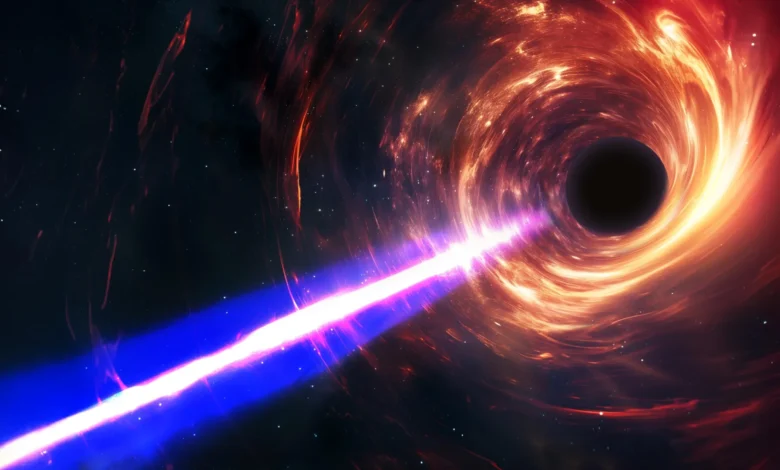
An international team of astronomers has successfully identified what appears to be a universal physical law governing one of the most violent and energetic behaviors in the universe: the production of powerful plasma jets by black holes. By analyzing a rare set of cosmic events where supermassive black holes devour wandering stars, the researchers demonstrated that these massive cosmic engines launch their signature radio jets at the exact same critical stage of their feeding cycle, regardless of whether they weigh ten times or millions of times the mass of our sun.
The groundbreaking research, co-led by Andrew Mummery, a Martin A. and Helen Chooljian Member at the Institute for Advanced Study (IAS) in Princeton, New Jersey, and Adelle Goodwin, a Forrest Research Foundation Fellow at Curtin University’s International Centre of Radio Astronomy Research (ICRAR) in Western Australia, bridges a decades-long gap in astrophysics. Published in the journal Nature Astronomy, the study synthesizes years of complex observational data compiled from a global network of space- and ground-based telescopes spanning the Americas, Australia, India, and South Africa.
Decoding the Cosmic Vacuum Cleaner
For decades, popular science has frequently described black holes as cosmic vacuum cleaners, relentlessly sucking in everything that crosses their event horizons. However, astrophysicists have long known that the reality is far more chaotic and messy. When a black hole feeds, it rarely swallows matter in a clean, orderly fashion. Instead, the infalling gas, dust, and stellar debris form a swirling accretion disk subject to immense magnetic and gravitational stresses.
A fraction of this material is eventually funneled and violently expelled back out into space at near-light speeds, forming colossal plasma jets that can stretch across hundreds of thousands of light-years. These massive outflows act as regulators for galactic evolution, injecting immense amounts of energy and heavy elements into the surrounding intergalactic medium, thereby quenching or triggering star formation in host galaxies.
Despite the prevalence of these jets, predicting when they will ignite has remained a persistent challenge. While some black holes blast out radio waves almost immediately after shredding a star, others remain completely dormant, only to unexpectedly awaken months or even years later.
"We really wanted to figure out this massive puzzle," explained Mummery. "Why do some supermassive black holes blast out radio jets right after shredding a star, while others just sit there looking completely dormant, only to suddenly fire up their jets months or even years later?"
The Eureka Moment in Madrid
Confirming universal behaviors across different classes of black holes has historically proved exceptionally difficult due to temporal constraints. Stellar-mass black holes—typically formed from the collapsed cores of massive stars—evolve rapidly, with their feeding cycles playing out over days, weeks, or months. In contrast, supermassive black holes residing at the centers of galaxies possess masses millions or billions of times greater, causing their evolutionary changes to unfold over thousands or millions of years—far longer than human recorded history.
To circumvent this temporal barrier, the research team turned their attention to tidal disruption events (TDEs). A TDE occurs when a star ventures too close to a supermassive black hole. The black hole’s intense, differential tidal gravitational forces exert a stretching effect so extreme that the star is literally ripped apart. This sudden influx of stellar material provides scientists with a rare window of observation, allowing them to watch a supermassive black hole feed and react over a compressed timescale of just a few years.
The conceptual breakthrough for the new study happened unexpectedly. During an astrophysics conference in Madrid, Spain, Mummery and Goodwin found themselves discussing their independent observations in a local establishment. As they compared the dynamics of smaller stellar-mass black holes with the erratic behavior of supermassive ones during TDEs, they realized that the same physical rule governing jet production in smaller systems might universally apply to the universe’s largest gravitational titans.
Methodology and Observations
To rigorously test their hypothesis, the research team assembled a comprehensive sample of twenty tidal disruption events. They gathered multi-wavelength observations covering optical light, ultraviolet light, X-rays, and radio waves. After a stringent filtering process designed to eliminate contaminated or incomplete datasets, the astronomers narrowed their focus to ten high-quality events. For this refined sample, they were able to reliably and accurately determine both the precise feeding rate of the black hole—known as the accretion rate—and the exact timing of its corresponding radio outflows.
The subsequent data analysis revealed a distinct, two-phase timeline for how and when these cosmic jets form.
The first phase occurs almost immediately after the star is consumed, during an initial period when the black hole is feeding at an exceptionally high, super-Eddington rate. The second phase, however, occurs much later—often hundreds or even thousands of days post-disruption.
Crucially, this delayed jet formation consistently occurs when the black hole’s consumption rate drops to approximately two percent of its Eddington limit. The Eddington limit is the theoretical threshold where the outward radiation pressure from the hot, infalling gas perfectly balances the inward pull of gravity.
This specific two-percent threshold is already well-documented among smaller, stellar-mass black holes residing within our own Milky Way galaxy. Finding that supermassive black holes obey this exact same percentage demonstrates that fundamental black hole physics remains scale-invariant across an astonishing range of masses—from objects ten times the mass of the sun to monsters weighting millions of solar masses.
Implications for Future Astronomy and Telescopes
Beyond expanding theoretical astrophysics, the discovery carries immediate practical benefits for observational astronomers scheduling telescope time around the globe.
Because telescope time on premier facilities is heavily oversubscribed, efficiently scheduling observations is a persistent logistical challenge. By establishing a predictive baseline for when delayed black hole jets will erupt, astronomers can now pinpoint optimal windows for data collection. This targeted approach minimizes wasted observation hours on dormant systems and maximizes the likelihood of capturing ephemeral high-energy events in real-time.
This predictive capability will prove especially crucial for the next generation of massive astronomical facilities currently coming online or entering late-stage development. Projects such as the Square Kilometre Array (SKA) radio telescope—an international mega-science project spanning South Africa and Australia slated to begin full scientific operations around 2028—will generate unprecedented volumes of radio sky data. Understanding the exact mechanical thresholds of jet production will enable observatories like the SKA to automatically trigger follow-up observations the moment a distant tidal disruption crosses the critical two-percent accretion threshold.
"We hope that our work will pave the way for even more profound discoveries about our universe," Mummery concluded. As international teams continue to catalog tidal disruption events with instruments like the Vera C. Rubin Observatory, this universal rule of jet formation will serve as a foundational tool for interpreting the chaotic, violent life cycles of black holes across cosmic time.