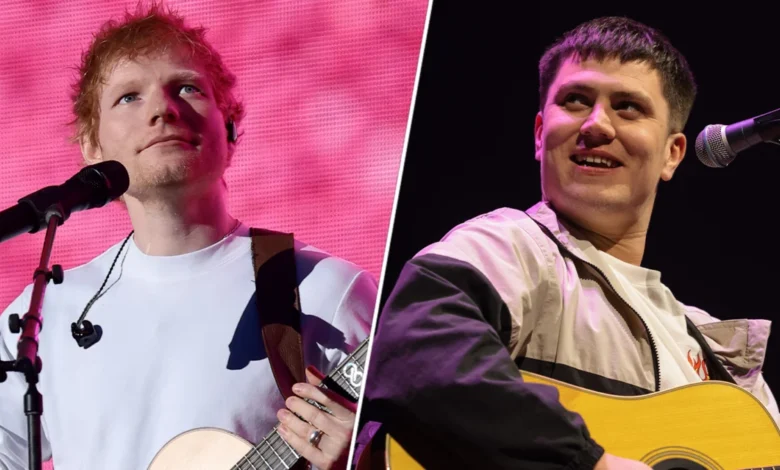
The international music industry is currently grappling with the fallout of a high-profile controversy surrounding Ed Sheeran’s ongoing Loop Tour, which has resulted in a significant exodus of supporting acts and widespread public scrutiny regarding the intersection of performance, political expression, and corporate influence. The dispute, which reached a breaking point this week, centers on the removal of rapper Macklemore from the tour’s lineup—a decision prompted by pressure from venue ownership, specifically Robert Kraft, owner of Gillette Stadium, following Macklemore’s vocal support for the Palestinian cause.
As the touring infrastructure around Sheeran has begun to fracture, Aaron Rowe, one of the artists who elected to depart from the tour in protest, has issued a public defense of Sheeran. While acknowledging that the situation resulted in a profound tactical error, Rowe argued that the focus of public outrage has been misdirected toward the British singer-songwriter, rather than the power structures that exerted influence over the tour’s production.
The Chronology of the Conflict
The friction began to manifest in mid-September 2026, when Macklemore, an outspoken critic of the ongoing humanitarian crisis in Gaza, made comments from the stage during his opening set on the Loop Tour. His remarks, which included explicit "Free Palestine" messaging, triggered an immediate backlash from certain stakeholders within the touring industry.
By Monday, reports confirmed that Macklemore had been removed from the remainder of the tour dates. The decision sparked an immediate and intense reaction from fellow performers. Ed Sheeran, addressing the public outcry, released a statement clarifying that the decision to remove Macklemore was not his own, but rather a move mandated by venue promoters after Robert Kraft reportedly gathered representatives from multiple venues on the tour route to deliver an ultimatum: either the political rhetoric stopped, or the venues would refuse to host the performances.
Following this revelation, the tour experienced a cascade of departures. Artists including Finneas and Lukas Graham, as well as Sheeran’s long-term backing band, Beoga, announced their withdrawal from the tour. Aaron Rowe was among those who chose to leave, though he has now emerged as a distinct voice seeking to contextualize the behavior of the headliner.
Aaron Rowe’s Perspective on Human Error
In a video statement released on Instagram, Rowe provided a nuanced view of the events. He characterized Sheeran’s decision to concede to the pressure from Kraft and other stakeholders as a "human fucking error," rather than an act of ideological malice.
"I’m going to be honest, I think you are all focusing on the wrong person here," Rowe stated in his address. "All I keep hearing is Ed Sheeran this, Ed Sheeran that, but you really should be focusing on the likes of Robert Kraft."
Rowe’s argument hinges on the distinction between personal belief and institutional panic. He posited that Sheeran, facing immense pressure from multiple venues simultaneously, made a panicked decision—a mistake he believes the singer regrets. Rowe emphasized his personal experience with Sheeran, noting that the star has consistently supported burgeoning artists and maintains a character defined by "kindness."
Furthermore, Rowe pointed to the composition of the tour itself as evidence that Sheeran does not align with the "Zionist lobby" that critics accuse of silencing pro-Palestinian voices. "If Ed Sheeran was a fucking Zionist, why would he have all these fucking people on the fucking tour?" Rowe asked, referencing the fact that the majority of the selected openers had expressed similar pro-Palestine sentiments.
The Role of Corporate Influence in Live Entertainment
The incident has reignited a long-standing debate regarding the degree of control venue owners and promoters exert over the content of live performances. In the United States, most major music venues operate under private ownership or via high-stakes contracts with event management corporations. These entities often include "morality clauses" or broad discretion in their contracts, allowing them to cancel events or demand changes if they believe a performer’s conduct—political or otherwise—threatens the brand image or community relations of the venue.
Robert Kraft, a prominent billionaire and the owner of the New England Patriots, holds considerable sway in the stadium circuit. By orchestrating a unified front among venue owners, Kraft demonstrated the ability of capital to dictate the boundaries of acceptable speech within the live music ecosystem.
Industry analysts suggest that this event is a bellwether for the future of touring. As geopolitical tensions continue to influence public discourse, artists are increasingly finding themselves caught between their personal convictions and the restrictive requirements of the large-scale, corporate-sponsored tour model. The ability of a single influential figure to "shut down any opinion they don’t agree with," as Rowe described, highlights a consolidation of power that has become a point of contention for activists and artists alike.
Implications for the Music Industry
The departure of high-profile acts like Finneas and the withdrawal of the supporting band Beoga present a significant logistical challenge for the remaining legs of the Loop Tour. Beyond the immediate touring logistics, the broader implication of this event is the potential for a "chilling effect" on artistic expression.
If artists are systematically removed from tours for their political affiliations or commentary, it may lead to an environment where performers self-censor to maintain their livelihood. Conversely, the solidarity shown by Rowe and his peers suggests that a subset of the industry is willing to sacrifice professional opportunities to preserve their autonomy.
Economically, the cancellation of appearances by prominent openers can result in breach-of-contract litigation, insurance claims, and loss of revenue for both the performers and the venues. Furthermore, the public relations fallout for venues associated with the removal of artists is becoming a measurable risk. Social media campaigns targeting the reputations of venue owners, as suggested by Rowe, indicate that the power dynamic is not entirely one-sided; the audience now has the tools to amplify their grievances directly against the stakeholders behind the scenes.
Broader Context of the Israel-Hamas Conflict
The friction within the music industry is a microcosm of the intense polarization seen globally regarding the conflict in Gaza. Since October 2023, the discourse surrounding the war has permeated nearly every aspect of public life, from academic institutions to corporate boardrooms.
The music industry, which has historically positioned itself as a platform for progressive thought and social advocacy, is currently struggling to reconcile its commercial interests with the deeply held beliefs of its most prominent creators. The "Free Palestine" movement has gained significant traction among younger artists and their fan bases, creating a direct collision course with the traditional establishment of the entertainment industry, which often seeks to remain "neutral" to avoid alienating donors, sponsors, or venue partners.
Analysis of the Current Landscape
As of mid-September 2026, the situation remains fluid. Sheeran has not issued a follow-up statement since his initial explanation regarding the promoter’s decision. The remaining tour dates are currently under review as management assesses the impact of the mass exodus of support acts.
From a structural perspective, the events demonstrate that the "neutrality" of concert venues is increasingly untenable. When venue owners take an active role in curating the political content of a show, they essentially become participants in the political arena, stripping away the veneer of being mere service providers.
The defense offered by Aaron Rowe serves as a pivot point for the conversation. By redirecting the focus from the artist (Sheeran) to the infrastructure (Kraft and the venue owners), Rowe is attempting to reframe the debate from a narrative of "celebrity betrayal" to one of "systemic censorship." Whether this reframing will resonate with the broader public or whether the momentum of the controversy will continue to consume the tour remains to be seen.
Ultimately, this incident serves as a significant case study in the modern era of celebrity activism. It highlights that in a landscape of hyper-connected communication, the private decisions of tour operators are no longer immune to public scrutiny. As the industry moves forward, it will likely face increased pressure to clarify its policies on free speech and the extent to which venue owners may influence the creative content of the artists they host. For now, the Loop Tour stands as a stark reminder of the volatile intersection where global politics meets the global stage.