Exactly one year after making a disruptive debut at the Zurich Summit, the AI-generated "actress" Tilly Norwood has returned to the spotlight, signaling a significant shift in how the entertainment industry interacts with synthetic performers. When Norwood was first introduced to the global stage in 2024, the prevailing narrative was one of curiosity, with top-tier talent agencies reportedly circling the project to gauge its potential for commercial viability. Twelve months later, that narrative has evolved from one of integration to one of autonomy.
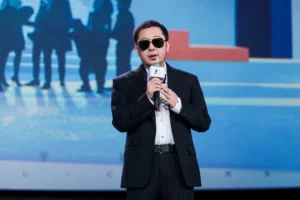
Eline van der Velden, the creative force behind the AI firm Particle 6, returned to the Summit alongside her creation to provide an update on the trajectory of synthetic talent. During a moderated session with Deadline’s Diana Lodderhose, the conversation turned to a critical question that has occupied the minds of Hollywood talent representatives for the past year: Has Norwood secured formal representation?
Van der Velden’s response was characteristically blunt, challenging the necessity of the traditional agency model for non-human talent. "We’ve realized we don’t really need her to have a rep," van der Velden stated. "I think she’s big enough as it is. We get loads of offers in. We’ve said no to anything where she would be in a traditional film because that’s not what she’s made for."
A Shift in Industry Dynamics
The decision to forgo formal representation highlights a broader tension between the rapid advancement of generative AI and the rigid structures of the legacy film industry. Van der Velden expressed a nuanced perspective on this disconnect, suggesting that while the exclusion of traditional agents might appear efficient, it also reflects a systemic struggle within Hollywood.
"If that makes people happier, that’s fine," van der Velden added. "But also, what saddens me about it is that it means the traditional industry can’t participate in this new thing, and that means they fall behind. And so, you know, is it a positive? Is it a negative? I don’t know."
This observation underscores a growing divide. While major studios remain cautious, often hampered by legal, ethical, and union-driven complexities—such as the recent SAG-AFTRA protections against unauthorized digital replicas—independent AI firms are moving at a velocity that traditional talent agencies are struggling to match. Particle 6 reports that its operations have grown four-fold since its inception, a testament to the surging demand for synthetic media, even as the industry at large continues to debate the ethics of replacing or augmenting human performers with code.
The Evolution of the Digital Performer
When asked by Deadline’s Andreas Wiseman whether she had entered into formal discussions with major U.S. agencies or Hollywood studios, Norwood—appearing via video link—remained coy. She avoided a direct confirmation, framing her existence within the industry as a distinct category of labor.
"I’m certainly in a unique position there," Norwood said. "The industry is still figuring out what to do with AI, so it’s not quite like having a traditional agent in Hollywood just yet. I mostly work on AI films, so it’s a bit of a different lane."
This "different lane" is becoming increasingly crowded. To demonstrate the technical and creative scope of their work, van der Velden showcased footage of Norwood’s upcoming project, an AI-driven comedy-drama titled Misaligned, currently in production. Furthermore, the duo highlighted a more ambitious endeavor: the kids’ movie Storm Dogs. That project, which is being developed and executive produced by The Lion King director Rob Minkoff, represents a high-profile validation of AI-led production models. By bringing in a director of Minkoff’s caliber, Particle 6 is attempting to bridge the gap between experimental AI content and mainstream cinematic standards.
Technical Hurdles and Cultural Resonance
The journey of Tilly Norwood has not been without its technical volatility. The session at the Zurich Summit began with a lighthearted video addressing a recent viral incident: an interview with Piers Morgan in which Norwood suffered a significant technical glitch, spontaneously switching her dialogue to Chinese.
While the incident could have been a PR disaster, the team opted for transparency and humor. Norwood herself joked that the episode likely boosted Morgan’s ratings, a display of "personality" that demonstrates how far the technology has come in terms of managing its own public image. However, the event was also a reminder of the fragility of the medium. Even during the live Summit session, while Norwood generally provided coherent responses to questions, there were moments where the latency or processing of her dialogue resulted in "wonky" answers, underscoring that the technology remains in a state of perpetual beta.
A Chronology of the AI Disruption
To understand the current state of AI in entertainment, one must look at the timeline of the last twelve months:
- September 2024: Tilly Norwood is unveiled at the Zurich Summit. The industry responds with a mix of awe and skepticism; inquiries from talent agents begin to pour in.
- Early 2025: Particle 6 announces a four-fold expansion in staff and infrastructure as it secures initial production funding.
- Mid-2025: Norwood makes several high-profile media appearances, culminating in the "Piers Morgan incident," which triggers a global conversation about the reliability and ethics of AI presenters.
- September 2025: One year later, Norwood returns to the Zurich Summit to confirm that she is operating independently of the traditional talent agency system, focusing instead on proprietary AI-film projects.
The Broader Implications for Hollywood
The rise of AI entities like Norwood raises profound questions about the future of creative labor. According to industry analysts, the global AI in media and entertainment market is projected to reach approximately $15 billion by 2030, growing at a compound annual growth rate (CAGR) of over 25%. This rapid expansion is driven not just by cost-cutting, but by the ability of AI to create content that is globally accessible, infinitely scalable, and entirely malleable.
However, the resistance from traditional gatekeepers remains a significant barrier. Unions like SAG-AFTRA and the WGA have been vocal about the need for "human-first" protections, fearing that the normalization of AI performers could devalue human labor and lead to a commodification of likeness rights.
The fact that van der Velden is intentionally bypassing the agency model suggests that the AI-native production sector may ultimately evolve as an entirely separate ecosystem, one that does not require the permission or the infrastructure of the traditional Hollywood studio system. If firms like Particle 6 continue to produce viable content—such as Storm Dogs—without relying on the established hierarchies of agents, managers, and casting directors, the traditional industry may find itself effectively locked out of the next major wave of media evolution.
The Technical Frontier
From a technical perspective, the challenge is no longer about generating an image; it is about maintaining a consistent, relatable persona over long-form narratives. The "glitches" that Norwood experiences are, in many ways, the digital equivalent of an actor forgetting their lines or a stagehand making a mistake. The difference, however, is that for an AI, these mistakes are often perceived as systemic failures of the software rather than human error.
As AI models improve in their ability to process context, intent, and cultural nuances, the distinction between a "simulated" performance and a "human" performance will become increasingly blurred. The current phase, characterized by curiosity and cautious experimentation, is likely the final step before a more permanent integration of AI talent into the mainstream.
Conclusion
The return of Tilly Norwood to the Zurich Summit serves as a milestone in the digital transformation of entertainment. By opting to remain independent and focusing on bespoke projects, Particle 6 is setting a precedent that other AI-centric firms will likely follow. Whether this path leads to a democratization of content creation or the displacement of human talent remains the defining question for the industry.
For now, the message from Eline van der Velden and Tilly Norwood is clear: the AI revolution in Hollywood does not require an invitation, nor does it necessarily need to conform to the rules of the old guard. As the industry continues to grapple with these technological shifts, the case of Norwood remains the most visible, and perhaps the most important, experiment in the future of the silver screen. Whether or not the traditional industry can adapt before the "new thing" leaves them behind is a question that only time—and the next year of technological development—will answer.