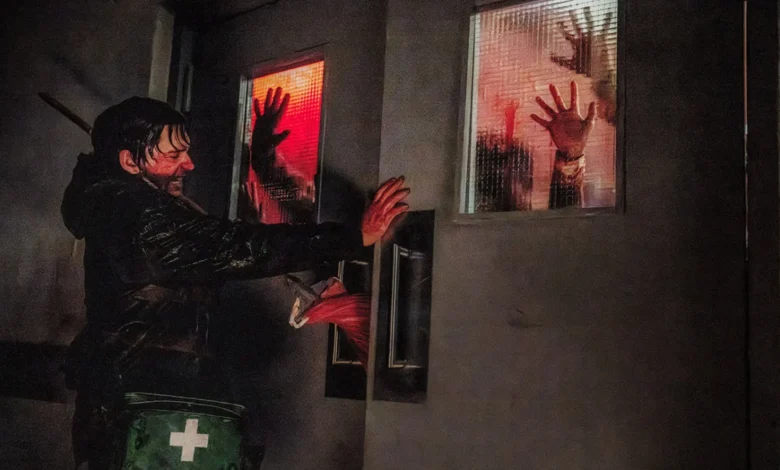
The entertainment landscape is currently witnessing a significant paradigm shift in genre filmmaking, anchored by the creative partnership between director Zach Cregger and actor Austin Abrams. Following their breakout collaboration on the 2023 hit Weapons, the duo has returned with a bold reimagining of the iconic Resident Evil franchise. The film, which recently opened to a record-breaking $60 million domestically, marks a departure from traditional horror tropes, opting for a character-driven narrative that challenges audience expectations regarding hero arcs and survival narratives.
This success comes at a pivotal moment for the 30-year-old Abrams, who is currently dominating the box office with back-to-back leading roles in high-stakes genre projects. His upcoming film, Whalefall, directed by Brian Duffield and slated for an October 16 release, further cements his reputation as an actor capable of carrying grueling, physically demanding roles. As Abrams navigates this newfound status as a premier leading man, his work with Cregger has become a focal point for critics and fans alike, particularly regarding the risky, uncompromising narrative choices that have defined their collaboration.
The Evolution of a Genre Partnership

The professional trajectory of Austin Abrams has been marked by a series of deliberate choices that prioritized creative synergy over conventional industry momentum. During the tumultuous period of the 2023 industry strikes, which saw numerous productions stall or collapse, Abrams remained steadfastly committed to the development of Cregger’s project, Weapons. This loyalty, born from his admiration of Cregger’s distinctive directorial voice in 2022’s Barbarian, proved to be a defining moment in the actor’s career.
While Abrams had multiple high-profile opportunities during the production hiatus, he chose to prioritize the material that would eventually secure critical acclaim and an Academy Award for co-star Amy Madigan. This commitment earned him the lead role in the Resident Evil reboot, a franchise that has historically struggled to find a consistent critical footing. By grounding the chaotic, monster-filled environment of Raccoon City in the visceral, human anxieties of a medical courier named Bryan, Cregger and Abrams have successfully revitalized a long-standing property.
A Chronology of the Outbreak: Deconstructing the Resident Evil Narrative
The narrative structure of Cregger’s Resident Evil serves as a subversion of the typical zombie origin story. The film opens with a mundane, relatable conflict: Bryan, a medical courier, is juggling a high-pressure organ delivery with a strained domestic situation involving his pregnant girlfriend, Michelle. The screenplay, penned by Cregger, utilizes these early scenes to establish a sense of grounded realism before the T-virus outbreak forces the protagonist into a series of increasingly impossible scenarios.

The progression of the film follows a precise, albeit frantic, timeline:
- The Inciting Incident: While en route to Raccoon City General Hospital, Bryan inadvertently strikes a pedestrian. His attempt to provide assistance leads to an encounter with an infected police officer, signaling the beginning of the local outbreak.
- The Farmhouse Escalation: Bryan’s attempt to regroup at a rural farmhouse culminates in a pivotal moment where he witnesses the fusion of two infected bodies. This imagery serves as a metaphor for the relentless, transformative nature of the virus, and marks Bryan’s transition from a bystander to a combatant.
- The Tunnel and the RV: The middle act of the film forces Bryan to confront his own vulnerability. His failed attempt to save a young girl in an abandoned RV provides the emotional core of the character’s arc, forcing him to kill the girl as she succumbs to the infection. This loss serves as a precursor to his own inevitable decline.
- The Final Delivery: Upon reaching the 28th floor of the hospital, Bryan delivers the neutralizing base. However, the failure of the Umbrella Corporation scientists to synthesize the antidote serves as the film’s darkest narrative turn. Bryan succumbs to his wounds, transforming into the very monster he has been fleeing, effectively turning the film into a tragic origin story for a creature that audiences would typically disregard as a background enemy.
Data-Driven Success and Audience Reception
The financial performance of the Resident Evil reboot is a testament to the current market appetite for prestige-adjacent horror. With a $60 million opening weekend, the film has achieved the highest-grossing start in the franchise’s history. Analysts point to the "Cregger effect"—a blend of viral marketing, intense test screening word-of-mouth, and the deliberate choice of a non-traditional action lead—as the primary driver for this success.
Despite the film’s "downer" ending—a narrative device that traditionally faces resistance from studio test audiences—the reception has remained overwhelmingly positive. This suggests a shift in viewer sentiment, where audiences are increasingly seeking narrative risks and tragic character arcs rather than the standard "happily ever after" conclusion. Abrams, in discussions regarding the film’s conclusion, emphasized that the decision to have the hero succumb to the infection was a necessary, albeit risky, artistic choice.

The Ethics of Survival: Analytical Implications
The thematic core of Cregger’s work often centers on the idea of change as an unavoidable, often violent, force. In Resident Evil, this is exemplified by Bryan’s reluctance to face impending fatherhood, which mirrors his struggle to survive the T-virus outbreak. By the time Bryan reaches the hospital, his realization that he loves his girlfriend and desires to start a family comes too late, creating a layer of tragedy that elevates the film above standard creature-feature fare.
Furthermore, the film offers an implicit commentary on the cultural legacy of video games. A notable scene where Bryan credits his survival to years of gaming serves as a meta-commentary on the skills—problem-solving, vigilance, and pattern recognition—that digital entertainment has instilled in generations of players. While the director has not explicitly confirmed a deeper sociological intent, the inclusion of such a dialogue suggests a conscious effort to validate the gaming community’s influence on modern survival logic.
The Professional Perspective: A Conversation with Austin Abrams

In a post-production interview, Austin Abrams reflected on the physical and psychological toll of his recent roles. Between the claustrophobic, aquatic dread of Whalefall and the relentless, fast-paced terror of Resident Evil, Abrams has spent the better part of two years in a state of high-stress performance.
"In certain ways, they are one and the same," Abrams noted regarding the comparative difficulty of his recent projects. "The wetsuit in Whalefall is an endurance test of a different kind, while Resident Evil required a level of exactness and physical output that was equally taxing. The laughs on the set of Resident Evil, however, provided a necessary catharsis that helped navigate the darker thematic material."
Addressing the film’s ending, Abrams defended the choice to deny the audience the comfort of a saved voice memo. "That’s the tragedy of it all," he stated. "He changed. He became the person he was afraid to be, and he was ready to embrace that life. The fact that his final, vulnerable moment remains unheard is a testament to the chaos of the world Cregger has built. It’s beautiful and devastating in equal measure."
The Road Ahead: Beyond the Horror

As Abrams transitions out of a period defined by intense, high-stakes genre work, the industry is closely watching his next steps. While his recent credits have firmly established him as a master of the "harrowing one-man crucible," he expresses a desire for diversity in his future roles.
"I’m looking for something that offers a bit more of a lullaby," he joked when asked about his future plans. "But ultimately, the project depends on the filmmaker and the strength of the material."
For now, the success of the Resident Evil reboot serves as a clear indication that the collaboration between Zach Cregger and Austin Abrams is one of the most potent in modern cinema. By refusing to compromise on the integrity of their vision, even when that vision requires the destruction of their own protagonist, they have managed to capture the attention of a global audience and set a new standard for what the horror genre can achieve. As the film continues its theatrical run, the industry will undoubtedly continue to analyze the "Abrams-Cregger" formula, a model that prioritizes human emotion over digital spectacle, and in doing so, creates something truly memorable.