After a meticulous, decades-long scientific pursuit spanning more than forty years, researchers at the European Organization for Nuclear Research (CERN) have achieved a monumental breakthrough in modern particle physics. Working with the state-of-the-art LHCb experiment at the Large Hadron Collider (LHC), an international team of scientists has successfully detected compelling evidence of one of the rarest known particle decays in the universe. This rare event—in which a specific composite particle transforms into a pair of heavier, electron-like particles known as muons—is mathematically predicted to occur roughly only once in every ten billion beauty particle decays.
The finding, formally unveiled during a high-profile seminar at CERN’s headquarters in Geneva, Switzerland, marks a historic milestone. For the very first time, a single particle physics experiment has accumulated sufficient statistical evidence to isolate this extraordinarily elusive event from the overwhelming noise of subatomic interactions. Beyond its sheer rarity, the decay holds immense value for the global scientific community. It acts as an indirect portal, granting researchers a method to investigate hypothetical fundamental particles that are far too massive to be created directly by even the most powerful particle accelerators operating today.
The Anatomy of a Rare Subatomic Transformation
At the very heart of this groundbreaking discovery lies a specific composite particle designated by physicists as the $textB_textd$ meson. This subatomic particle is composed of a beauty quark (also frequently referred to as a bottom quark) bound together with a down antiquark. For decades, theoretical physicists working within the framework of the Standard Model—the reigning paradigm that successfully describes nearly all known fundamental particles and their interactions—have calculated the expected probabilities of various particle transformations.
Through the course of the recent analysis, researchers found robust evidence that the $textB_textd$ particle can spontaneously decay into a pair of muons ($mu^+mu^-$). Muons are fundamental particles that share many characteristics with ordinary electrons, including carrying a negative electric charge and participating in the same types of electroweak interactions, but they possess a significantly greater mass—roughly 200 times heavier than an electron.
Crucially, the newly measured rate of this decay aligns closely with the precise theoretical predictions laid out by the Standard Model. While this agreement reinforces the validity of existing physical theories, it simultaneously narrows the margin of error, restricting the parameter space where undiscovered particles might hide. By continuously refining these measurements, experimentalists can better test the boundaries of our current understanding of the cosmos.
Why Rare Particle Decays Act as Windows to New Physics
To understand why physicists invest decades of meticulous effort into tracking down exceedingly rare phenomena, one must examine the intricate quantum mechanical nature of subatomic processes. According to the principles of quantum mechanics, a particle undergoing decay does not exist in a vacuum. Instead, its transformation can be subtly influenced by virtual particles—transient quantum fluctuations that pop into and out of existence.
This quantum mechanics reality means that even hypothetical particles that are far too heavy to be manufactured directly inside the massive ring of the Large Hadron Collider can leave microscopic, indirect traces. These massive, undiscovered particles can subtly alter the rates at which rare decays occur. By measuring these rates with extreme, unprecedented precision, researchers can compare experimental outcomes against theoretical predictions. Any statistically significant discrepancy or deviation between the two could serve as the long-sought smoking gun, providing indirect evidence of new, hitherto unknown physics beyond the Standard Model.
Generally speaking, the rarer a decay pathway is, the more sensitive it becomes to these hidden quantum influences. The specific transformation known as $textB_textd to mu^+mu^-$ belongs to a select, elite category of processes that theoretical physicists have long regarded as "golden channels." During this intricate event, a beauty quark and an antiquark carrying the opposite electric charge annihilate one another entirely. In a dramatic conversion of mass into energy, their combined energy is instantly transformed into a muon and its corresponding antiparticle.
A Chronology of the Hunt: From Early Observations to Modern Breakthroughs
The path toward detecting the $textB_textd to mu^+mu^-$ decay has been characterized by decades of incremental progress, technological upgrades, and fierce international collaboration. The historical timeline of this specific research avenue highlights the immense experimental hurdles involved:
- The 1980s and 1990s: Theoretical physicists formulate the initial mathematical frameworks predicting ultra-rare decays within the burgeoning Standard Model, setting off a long-term experimental quest.
- 2010 to 2018 (Run 1 and Run 2): The Large Hadron Collider begins operations. The LHCb collaboration embarks on dedicated searches for rare beauty particle decays using early detector configurations.
- 2015: In a major milestone for the field, a joint analysis conducted by the LHCb and CMS experimental collaborations publishes the first confirmed observation of a related, slightly more common process—the $textBtexts to mu^+mu^-$ decay. This landmark paper also yielded initial, tantalizing hints of the much scarcer $textBtextd$ decay.
- The Late 2010s: Subsequent analyses incorporating the full dataset collected through the end of LHC Run 2 in 2018 prove inconclusive, failing to robustly confirm the earlier hints of the $textB_textd$ decay due to statistical limitations.
- 2024: Following a major, multi-year technological overhaul of the detector, the upgraded LHCb experiment resumes data collection at an unprecedented rate, operating at five times the intensity of previous runs.
- 2024–2025: Analyzing the fresh, high-precision datasets gathered during this modern era, researchers successfully identify strong statistical evidence of the $textB_textd to mu^+mu^-$ decay, finally validating decades of theoretical work.
The mathematical disparity in rarity between the two related beauty particle decays is striking. While the $textBtexts$ decay occurs approximately three times per billion beauty particle decays, the $textBtextd$ process is predicted by theory to happen roughly 30 times less frequently, making it an extraordinarily difficult needle to find in a cosmic haystack.
Technological Advancements: Upgraded Detectors and Machine Learning
The primary reason previous analyses struggled to definitively isolate the $textB_textd$ decay comes down to the sheer volume of background noise generated by proton-proton collisions at the Large Hadron Collider. Every second, millions of collisions produce a chaotic deluge of ordinary particles, threatening to completely swamp the microscopic signals of rare events.
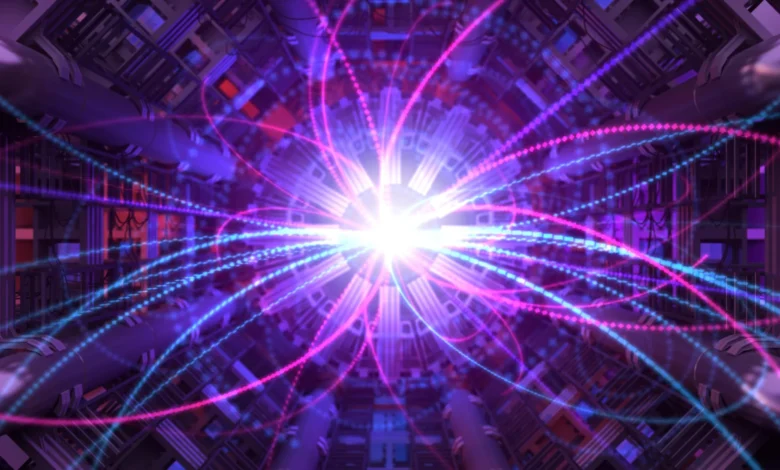
Overcoming this monumental obstacle required a sweeping technological reinvention of the LHCb detector. Following an extensive, multi-year upgrade program, the experiment began collecting data with vastly improved tracking and particle-identification capabilities. The modernized detector provided researchers with an exceptionally clear, high-resolution picture of the complex particle trajectories emerging from collisions.
Furthermore, the international analysis team integrated advanced machine learning algorithms and sophisticated data-filtering techniques into their pipeline. These computational tools were trained to comb through petabytes of collision data in real time, successfully separating the faint, signature tracks of the rare muon pairs from the overwhelming sea of background events. Without these cutting-edge hardware and software improvements, the elusive decay would have remained entirely undetectable.
"Physicists have been chasing this decay for more than forty years," noted Marco Santimaria, who co-led the international analysis team of 19 scientists responsible for the current study. "Extreme precision is required to pick the muons out of the overwhelming background."
Statistical Significance and the Road to Confirmation
In the rigorous realm of experimental particle physics, claims of new phenomena or rare processes must adhere to strict statistical standards. Researchers quantify their certainty using standard deviations (often represented by the Greek letter sigma, $sigma$). To qualify as official "evidence" of a new or rare physical process, a measurement must typically reach a statistical significance of 3.0 standard deviations. At this threshold, the mathematical probability that the observed signal is merely the result of a random statistical fluctuation—rather than a genuine physical process—is approximately 0.3 percent.
By analyzing the rich datasets collected throughout 2024 and 2025, the LHCb collaboration successfully identified evidence of the $textB_textd to mu^+mu^-$ decay at a significance level of exactly 3.0 standard deviations. When the researchers combined these fresh measurements with historical data gathered between 2011 and 2018, the combined statistical significance climbed to 3.2 standard deviations, comfortably crossing the threshold required to claim formal evidence.
Additionally, this comprehensive investigation yielded the most precise measurements ever recorded for the related $textB_texts to mu^+mu^-$ decay, shedding further light on the dynamics of these ultra-rare transformations.
Despite the magnitude of this achievement, the physics community acknowledges that a definitive milestone remains ahead. To graduate from "evidence" to a confirmed, fully established "observation," an experimental result must reach a statistical significance of 5.0 standard deviations—a level of certainty where the chance of a fluke is roughly one in 3.5 million. If upcoming data collection campaigns succeed in reaching that rigorous standard, $textB_textd to mu^+mu^-$ will officially be crowned the rarest beauty particle decay ever observed in human history.
Future Horizons: The High-Luminosity LHC and Beyond
Far from marking the end of the road, this discovery represents a springboard for the next generation of particle physics research. CERN engineers and physicists are already looking ahead to major upcoming upgrades designed to supercharge the capabilities of the accelerator complex.
The High-Luminosity LHC (frequently called the HiLumi LHC) is currently scheduled to commence operations around 2030. This massive upgrade will significantly increase the collision intensity, or luminosity, of the particle accelerator. Concurrently, another major structural upgrade to the LHCb experiment itself is planned for the mid-2030s. Together, these technological leaps are expected to boost the experiment’s overall data collection rate by another order of magnitude—a staggering tenfold increase.
Gathering vastly larger datasets will enable researchers to detect significantly more of these ultra-rare decays, allowing them to measure their properties with unprecedented accuracy. This exponential increase in experimental sensitivity could ultimately allow physicists to spot the subtle, hidden signatures of undiscovered particles that currently lie far beyond the direct reach of existing technology.
"Seeing evidence of this rare decay is incredibly exciting, opening up new possibilities to probe beyond the direct reach of the LHC," explained Harry Cliff, LHCb’s Rare Decays Convener and Analysis Co-lead. "The future LHCb upgrade will allow us to observe many more of these decays, providing even greater sensitivity to undiscovered particles."
For the global community of physicists who have dedicated their professional lives to hunting down this elusive subatomic signal, the new findings represent a profoundly satisfying vindication of decades of patient experimentation. As humanity peers ever deeper into the fundamental fabric of matter, these rare decays offer a promising, illuminating pathway toward answering whether our current understanding of physics is the final word, or merely a single chapter in a much larger and more wondrous cosmic story.