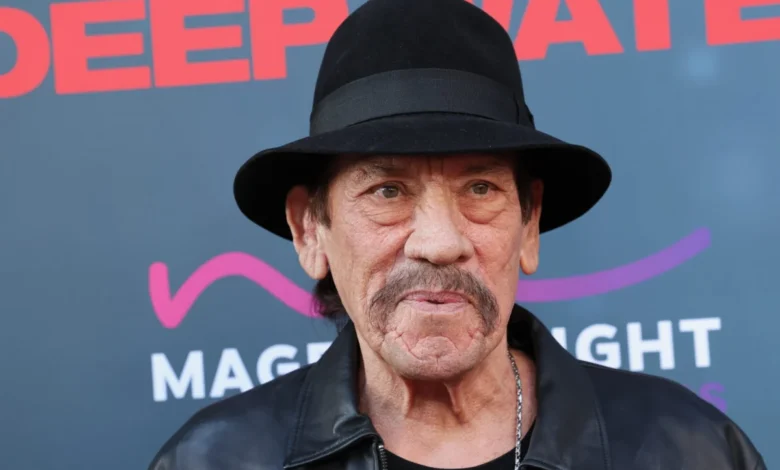
Legendary actor Danny Trejo has revealed that he attempted to withdraw from his role in the controversial, pro-Immigration and Customs Enforcement (ICE) film Pawn Shop, produced by Ben Shapiro’s media company, The Daily Wire. However, according to Trejo, his efforts to sever ties with the project were met with explicit legal threats that forced him to stay on board under contractual duress.
The revelation underscores the growing friction between traditional Hollywood talent and conservative independent production studios entering the cinematic landscape. As streaming platforms, alternative media networks, and independent political companies increasingly fund and distribute narrative features, high-profile actors are finding themselves navigating complex ideological minefields that can alienate their traditional fanbases.
The Confrontation and Legal Threats
Speaking to TMZ, Trejo detailed his frustration with the production when asked if he had tried to walk away from the film.
"You know what? I tried, and they said no, they’d sue the hell out of me," Trejo stated. Realizing that abandoning the project entirely was financially and legally untenable, the veteran actor adopted an alternative strategy to mitigate his involvement with the script’s underlying messaging. "So I just didn’t say what they wanted me to say. You know, I just changed the lyrics a little… the first thing I said, they told me they’d sue me."
Trejo’s remarks provide further clarity regarding a controversy that first erupted in October, when public backlash mounted against the actor for attaching his name to a project associated with conservative commentator Ben Shapiro. Responding to mounting criticism from fans and community advocates, Trejo released an initial statement via TMZ distancing himself from the politics of the film.
"I am a proud Mexican who has always been and will always be a supporter of my community. I am also obviously pro-immigrant. I am not pro-ICE," Trejo asserted at the time. "I know where I come from and I know our struggles. I am an actor. My job is to tell a story."
Behind the Scenes: The Family’s Perspective on the Casting
The timeline of the controversy sheds light on how casting deals are occasionally secured in independent cinema without actors fully realizing the ideological affiliations of the production entities. Shortly after the initial backlash, Trejo’s son, Gilbert Trejo, took to Instagram to offer a detailed defense of his father, explaining the circumstances under which the elder Trejo accepted the role.
According to Gilbert, the cast was unaware of Ben Shapiro’s direct involvement until approximately two weeks into principal photography. Furthermore, Gilbert claimed that his father had no prior familiarity with the conservative political commentator.
"I had to explain to him who that is, and what kind of guy he is," Gilbert wrote on his Instagram story, addressing fans upset by the collaboration. He emphasized that contractual obligations prevented his father from publicly criticizing Shapiro or walking off the set. "He couldn’t walk away without being sued for breach of contract. He couldn’t even release the statement he wanted to."
The situation highlights the stringent legal safeguards production companies implement to protect their investments, particularly when casting recognizable talent for politically charged or niche content. Standard talent agreements typically feature robust morality and non-disparagement clauses, alongside severe financial penalties for unexcused breaches of contract, leaving actors with limited recourse if ideological differences arise mid-production.
Inside Pawn Shop: Premise and Plot
The film at the center of the controversy, Pawn Shop, deals with volatile contemporary social and political themes. According to the official logline provided by the studio, the narrative is set against the backdrop of civil unrest:
"When a Minneapolis riot forces a young ICE officer to complete a high-stakes arrest alone after his partner is killed, he is hunted through the streets by a furious mob intent on freeing the prisoner and punishing anyone who still upholds the law. Barricaded inside a neighborhood pawn shop with a hard-edged Hispanic veteran and the man’s progressive college-age grandson, ordinary men must choose between the rule of law and the chaos that wants to burn it all down in a modern siege of honor and defiance."
By centering the narrative on an ICE officer during a urban riot, the script touches directly upon deeply polarizing immigration debates and law enforcement policies. For an actor like Trejo—whose public persona has long been intertwined with Hispanic community advocacy, charitable work, and anti-gang outreach—association with a narrative framed around a pro-enforcement perspective created an immediate public relations challenge.
Broader Industry Trends: Hollywood Figures and Independent Conservative Studios
The controversy surrounding Pawn Shop is not an isolated incident. In recent years, alternative conservative media companies like The Daily Wire have expanded their operational footprint into narrative filmmaking and entertainment distribution, seeking to counter what they characterize as progressive homogeneity in mainstream Hollywood. This expansion has inevitably drawn established industry veterans into collaborative partnerships that occasionally generate friction.
Recently, actor Rob Lowe faced a similar wave of public scrutiny over his decision to star in Confession, a film penned by Ben Shapiro and distributed by The Daily Wire. Addressing the criticism during an appearance on Coleman Hughes’s "Conversations With Coleman" podcast, Lowe acknowledged that his representatives had expressed significant reservations about his involvement with the project.
"There were people who were definitely like, ‘Are you crazy?’ But… I’m old enough, established enough, people know me well enough, to know that I’m not an ideologue at all," Lowe stated.
Defending his career choices, Lowe emphasized a long-standing pattern of bipartisan engagement across the American political spectrum. "I’m not telling anybody how to live, how to think, on either side of the aisle. I’ve campaigned for Republicans. I’ve campaigned for Democrats… I have my bona fides in both worlds."
While Lowe embraced his involvement and defended his right to work across ideological lines, the contrasting public responses from Lowe and Trejo illustrate the different ways veteran actors handle political backlash. While Lowe leaned into open dialogue regarding his project choices, Trejo and his family pointed to a lack of initial transparency regarding the studio’s political alignment and the binding nature of their legal agreements.
Implications and Next Steps
As of publication, representatives for The Daily Wire have not publicly commented on Danny Trejo’s recent statements regarding the alleged threats of litigation. The ongoing dispute raises broader questions regarding transparency in independent casting processes, where actors may sign onto gritty genre films without fully grasping the political branding or ideological advocacy of the financing entities.
For industry observers, the episode serves as a case study in the evolving intersection of partisan politics and commercial entertainment. As independent studios continue to leverage star power to build alternative cinematic ecosystems, talent agencies, managers, and performers will likely exercise heightened diligence regarding script origins, corporate backers, and exit clauses to avoid similar contractual and reputational friction in the future.