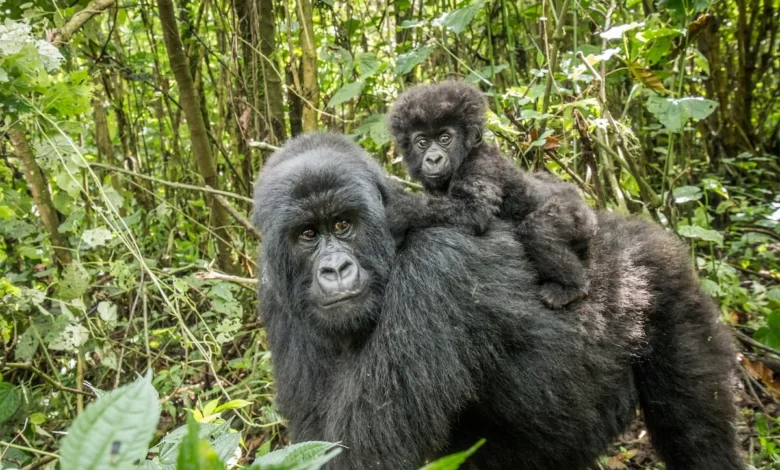
The Democratic Republic of the Congo (DRC) has moved to auction off more than half of its landmass to oil and gas exploration, a decision that environmentalists warn could lead to an ecological catastrophe of global proportions. According to a comprehensive new report titled "Forests to Frontlines: Oil Expansion Threats in the DRC" by Earth Insight, the central African nation is offering 52 oil blocks—a massive expansion from previous licensing rounds—placing 306 million acres of intact tropical forest and vital wildlife habitats at risk. This move directly contradicts the DRC’s international reputation as a "solution country" for climate change and threatens the survival of some of the world’s most endangered species, including the mountain gorilla, the eastern lowland gorilla, and the bonobo.
The expansion marks a dramatic escalation in the government’s pursuit of fossil fuel revenue. While a 2022 auction of 30 blocks already drew international condemnation, the 2025 licensing round represents a doubling down on extraction-based development. The proposed drilling areas cover approximately 53 percent of the country’s total area, overlapping significantly with protected national parks, critical carbon sinks, and the ancestral lands of millions of people.
The Ecological Stakes: The Lungs of Africa Under Siege
The Congo Basin is often referred to as the "second lungs of the Earth," trailing only the Amazon in size and importance for global climate regulation. The DRC contains the majority of this basin, housing the second-largest tropical rainforest on the planet. These forests are not merely collections of trees; they are complex, ancient ecosystems that regulate rainfall patterns across the continent and sequester billions of tons of carbon dioxide.
Central to this ecosystem is the Cuvette Centrale, the largest tropical peatland complex in the world. Peatlands are highly efficient carbon stores, and the Cuvette Centrale alone is estimated to hold roughly 30 gigatons of carbon—equivalent to approximately three years of total global fossil fuel emissions. The Earth Insight report reveals that the majority of this peatland complex is now included within the newly designated oil blocks. If these areas are drained or disturbed for road construction and drilling, the resulting "carbon bomb" could release vast amounts of greenhouse gases, effectively neutralizing global efforts to meet Paris Agreement targets.
Beyond carbon sequestration, the DRC’s forests are a bastion of biodiversity. The country is home to thousands of plant species, endemic birds, and forest elephants. Most notably, it serves as the final refuge for the great apes. The Virunga National Park and other sensitive regions are now in the crosshairs of energy companies. The encroachment of industrial machinery, the construction of access roads, and the inevitable risk of oil spills pose an existential threat to gorilla populations that have only recently begun to recover from decades of poaching and civil unrest.
A Massive Geographic and Demographic Overlap
The scale of the proposed expansion is difficult to overstate. The Earth Insight data indicates that the oil blocks intersect with:
- 165.1 million acres of intact tropical forests.
- 21.3 million acres of Key Biodiversity Areas (KBAs).
- 20.5 million acres of formally protected areas.
The human cost is equally staggering. It is estimated that 39 million people live within the boundaries of the auctioned oil blocks. Many of these inhabitants belong to forest-based and Indigenous communities who have lived in harmony with the ecosystem for generations. These communities rely on the Congo River and its tributaries for water, food, and transport, all of which would be jeopardized by large-scale hydrocarbon extraction.
Pascal Mirindi, a campaign coordinator for the activist group Notre Terre Sans Pétrole (Our Land Without Oil), has been vocal about the lack of logic in the government’s current trajectory. Mirindi points out a glaring contradiction: the government is simultaneously promoting the Kivu-Kinshasa ecological corridor—a project intended to foster sustainable development and conservation—while auctioning off 72 percent of that very corridor to oil interests.
"We are reminding our leaders that the Congolese people are the primary sovereign," Mirindi stated. "Where is the logic? Where is the coherence? We will not remain silent while certain people organize themselves to sell off our future."

Chronology of a Controversial Pivot
The DRC’s shift toward aggressive oil expansion has been a source of friction on the international stage for several years.
- November 2021: During the COP26 climate summit in Glasgow, the DRC signed a 10-year, $500 million agreement with the Central African Forest Initiative (CAFI) to protect its forests. The deal included milestones for forest preservation and a ban on logging in sensitive areas.
- July 2022: Only months after the COP26 pledge, the DRC government launched an auction for 30 oil and gas blocks. At the time, officials argued that the country had a sovereign right to exploit its natural resources to alleviate poverty, famously asking why the DRC should remain poor to save the world’s climate while developed nations continue to pollute.
- 2024-2025: The government expanded the scope of the auction to 52 blocks, covering more than half the country. This expansion includes areas previously considered "off-limits" due to their ecological sensitivity.
The Earth Insight report, produced in partnership with the Rainforest Foundation UK and the DRC-based coalition CORAP (Coalition des Organisations de la Société Civile pour le Suivi des Reformes et de Action Publique), argues that this trajectory is a "drastic expansion" that undermines every conservation goal the country has previously set.
Economic Development vs. Environmental Sovereignty
The DRC government, led by President Félix Tshisekedi, has consistently framed the oil auctions as an economic necessity. The country remains one of the poorest in the world despite its immense mineral wealth. Government ministers have argued that oil revenues could fund infrastructure, education, and healthcare, potentially transforming the national economy.
However, many economists and environmentalists warn of the "resource curse." History in neighboring regions, such as the Niger Delta, suggests that large-scale oil extraction often leads to localized environmental devastation, corruption, and social conflict rather than broad-based economic prosperity. Furthermore, as the world shifts toward renewable energy, there is a significant risk that the DRC’s oil infrastructure could become "stranded assets"—expensive investments that lose their value before they can turn a profit.
Anna Bebbington, a research manager at Earth Insight, emphasized the global implications of this local decision. "Oil and gas development in these fragile ecosystems would have devastating impacts on biodiversity, communities, land rights and the global fight against climate change," she noted.
Analysis of Policy Implications and Global Response
The international community finds itself in a precarious diplomatic position. On one hand, Western nations are urging the DRC to preserve its forests for the sake of the global climate. On the other hand, the DRC points to the hypocrisy of the Global North, which grew wealthy on fossil fuels and is now expanding its own drilling in places like the North Sea and the United States to ensure energy security.
The "Forests to Frontlines" report proposes a different path forward. It calls for the DRC government and its international partners to:
- Cancel the 2025 licensing round and halt all future hydrocarbon expansion in sensitive ecosystems.
- Respect Indigenous rights: Ensure that any development projects have the free, prior, and informed consent of the local populations.
- Align financing with conservation: International donors must provide tangible, large-scale financial incentives that make forest conservation more economically attractive than oil extraction. This includes debt-for-nature swaps and direct payments for ecosystem services.
- Promote Transparency: Environmental governance must involve civil society and local communities to prevent the opaque "selling off" of national resources.
The report highlights that the credibility of the DRC as a climate leader is at a breaking point. If the auctions proceed, the Kivu-Kinshasa Green Corridor, once touted as a flagship of sustainable development, will likely lose its ecological integrity and its status as a viable climate solution.
Conclusion: A Turning Point for the Congo Basin
The DRC stands at a historic crossroads. The decision to open 53 percent of its territory to the fossil fuel industry is not just a domestic policy choice; it is a move that will resonate across the global climate landscape for decades. While the government seeks a path out of poverty, the "Forests to Frontlines" report suggests that the cost of this particular path—the destruction of the world’s second-largest rainforest, the release of massive carbon stores, and the loss of irreplaceable biodiversity—is a price the world cannot afford to pay.
As the 2025 licensing round approaches, the pressure from local civil society and international environmental groups continues to mount. The fate of the 39 million people living in these blocks, along with the survival of the great apes and the stability of the global climate, now hangs in the balance. The call from organizations like Earth Insight and CORAP is clear: the future of the DRC lies not in the oil beneath its soil, but in the life-giving forests that stand upon it.