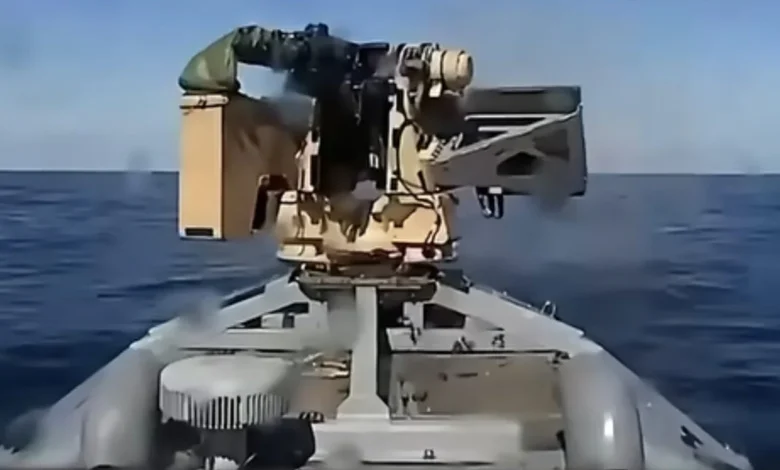
The ongoing conflict in Ukraine has officially entered an unprecedented technological dimension following what defense analysts have confirmed as the world’s first recorded combat engagement between two uncrewed surface vessels at sea. In a development that signals a paradigm shift in naval warfare, a Ukrainian military naval drone utilized a remote-controlled machine gun turret to hunt down, engage, and completely destroy a Russian explosive drone boat in the contested waters of the Black Sea.
This landmark confrontation, which took place on September 12, transcends a mere tactical victory for Kyiv; it represents a historic turning point where autonomous and remote-controlled robotics have actively clashed on the water, mirroring the aerial dogfights of flying drones and the mechanized trench warfare of ground robots seen throughout the nearly three-year-old conflict. As military tacticians worldwide closely monitor the evolution of the war in Eastern Europe, this high-stakes naval duel offers a sobering glimpse into the future of maritime combat, where human operators increasingly direct machinery to fight battles on their behalf.
The Anatomy of the Engagement
The lopsided yet historic battle unfolded when operatives within Ukraine’s Defense Intelligence directorate detected a hostile Russian uncrewed surface vessel navigating the turbulent waters of the Black Sea. Recognizing the imminent threat posed by the craft, military controllers rapidly redirected a Ukrainian Navy drone boat already on patrol to intercept, identify, and neutralize the intruder.
According to prominent naval analyst H.I. Sutton, writing in Naval News, the Russian vessel was positively identified as an Orcan-class surface drone. This particular model is characterized by a jet-ski-type steerable water jet propulsion system, engineered specifically for high-speed maneuverability, and carries a heavy payload designed to ram enemy targets and detonate on impact. These kamikaze-style explosive boats are built to bypass traditional naval defenses, exploiting the low radar cross-section of uncrewed vessels to strike ports, coastal infrastructure, and commissioned warships with devastating precision.
To counter this looming maritime threat, the Ukrainian military deployed a Sargan-3000 drone boat. Unlike its target, which was configured primarily as a suicidal delivery system for high explosives, the Sargan-3000 serves as a heavily armed patrol and interception platform. It was outfitted with a 12.7-millimeter heavy machine gun mounted on an advanced remote weapon station manufactured by the Norwegian defense technology company Kongsberg. This stabilization and targeting system allows human operators stationed miles away to acquire targets and deliver lethal fire with pinpoint accuracy, even while bouncing across open sea swells.
The official video footage released by the Ukrainian Navy and distributed via the government-backed media platform United24 paints a vivid picture of the tactical execution. Operating from a distance of approximately one kilometer, the Ukrainian Sargan-3000 opened fire on the Russian Orcan drone. Initial rounds targeted the vessel’s exposed communications antenna—a critical maneuver designed to sever the link between the Russian craft and its remote handler or guiding reconnaissance asset. Once the communication links were disabled and the target was rendered helpless, the Ukrainian drone continued to riddle the Russian vessel with heavy machine gun fire until structural integrity failed, causing the explosive craft to detonate prematurely and sink beneath the waves.
The Convergence of Air and Sea Domains
The September 12 incident did not occur in a vacuum; rather, it is the culmination of years of rapid technological innovation and tactical evolution driven by the Black Sea theater. Since the escalation of hostilities in February 2022, the Ukrainian military—facing a vastly superior conventional Russian Navy—pioneered the asymmetric use of uncrewed surface vessels to neutralize larger warships, protect coastal grain corridors, and project power far beyond its immediate coastline.
Over time, however, Moscow adapted its defensive strategies, deploying its own fleets of explosive drone boats, such as the Orcan, to retaliate against Ukrainian ports, infrastructure, and remaining naval assets. Furthermore, these maritime operations have increasingly integrated cross-domain tactics. According to defense analysts, Russian Orcan drones frequently operate in tandem with aerial reconnaissance platforms, such as Iranian-designed Geran-2 loitering munitions. These flying drones serve a dual purpose: they gather intelligence on Ukrainian coastal defenses and act as aerial communication relays, boosting the operational range and signal fidelity between remote operators and their drone boats navigating deep in the Black Sea.
This multi-domain integration made a naval engagement between uncrewed craft an absolute statistical certainty. As H.I. Sutton noted in an interview with New Scientist immediately following the engagement, "It was inevitable that there would be USV-on-USV combat. We have seen the same in the air and on the ground."
The battlefield in Ukraine has long served as a live-fire laboratory for robotics, where first-person-view (FPV) quadcopters routinely hunt enemy infantry, ground-based delivery robots clear minefields and supply frontline trenches, and automated turret systems defend static positions. The addition of uncrewed surface combatants dueling at sea closes the loop, confirming that no operational environment remains untouched by autonomous or remotely piloted warfare.
A Chronology of Maritime Drone Warfare
To fully understand the significance of the world’s first drone-on-drone naval battle, it is necessary to examine the rapid evolutionary timeline of uncrewed maritime systems in the Black Sea conflict:
- Early 2022: Following the full-scale invasion, Ukraine faces a severe naval deficit, lacking heavy capital ships to challenge the Russian Black Sea Fleet. In response, defense engineers accelerate development of indigenous uncrewed surface vessels capable of carrying explosive payloads.
- Late 2022 to 2023: Ukrainian kamikaze sea drones score historic successes, successfully striking Russian warships stationed in occupied Sevastopol, damaging logistics vessels, and forcing the Russian Navy to relocate the bulk of its fleet from Crimea to safer ports such as Novorossiysk.
- 2024: Both belligerents expand their uncrewed arsenals. Russia introduces and deploys various classes of explosive surface drones, including jet-ski-style platforms like the Orcan, aiming to contest Ukrainian maritime dominance and threaten critical export infrastructure along the Danube and Black Sea coastlines.
- Mid-2024: Ukraine pivots toward multi-role versatility by upgrading its drone fleets. The introduction of platforms like the Sargan-3000, equipped with remote-controlled heavy machine gun turrets, transitions Ukrainian strategy from purely kamikaze operations to maintaining sea control and actively hunting hostile maritime threats.
- September 12, 2025/2026 (Refined Timeline): Ukrainian Defense Intelligence detects a Russian Orcan explosive drone in the Black Sea. A Sargan-3000 interceptor is dispatched, culminating in the historic first-ever destruction of an enemy drone boat by a remote naval combatant.
Strategic Implications and the Future of Naval Combat
The implications of this brief yet decisive engagement extend far beyond the geopolitical boundaries of the ongoing war in Eastern Europe. Military leaders and naval architects across the globe, from the Pentagon to the Indo-Pacific command centers, are studying the video and telemetry of the September 12 clash to recalibrate their own future defense procurement and operational doctrines.
For decades, modern navies have invested heavily in multi-billion-dollar surface combatants—destroyers, frigates, and aircraft carriers—designed to counter traditional threats like cruise missiles, submarines, and fighter jets. However, the rise of cheap, mass-producible uncrewed surface and subsurface vessels has exposed a critical vulnerability in traditional naval fleets: cost asymmetry. A surface drone costing tens or hundreds of thousands of dollars can potentially disable or destroy a warship worth hundreds of millions of dollars.
Consequently, major military powers are rapidly pivoting toward counter-swarm and counter-USV technologies. The successful deployment of the Kongsberg remote weapon station on the Ukrainian Sargan-3000 demonstrates that armed interceptor drones are a viable, cost-effective solution for patrolling coastal waters, protecting ports, and securing maritime choke points without risking human sailors in direct gunfights.
Furthermore, this engagement highlights the shifting nature of command and control at sea. As artificial intelligence, machine learning, and satellite communications continue to mature, future naval engagements will likely feature autonomous swarms making split-second tactical decisions without human intervention. The transition from human-piloted interceptors to fully autonomous hunter-killer drone swarms is no longer a theoretical concept found in science fiction; it is the active trajectory of military technology being forged in the waters of the Black Sea.
As the conflict in Ukraine grinds forward, the lessons learned from the world’s first naval drone duel will reverberate through military academies and defense ministries worldwide. The sea, once the exclusive domain of manned warships and sailors, has officially become the newest frontier for automated warfare, forever altering the calculus of global naval power.