The FIFA World Cup, the pinnacle of international association football, is set to embark on an unprecedented journey for its 2030 edition, marking a centennial celebration that bridges three continents and six nations. In a decision that reflects both the historical reverence of the sport and the modern trend of multi-national hosting, FIFA has confirmed that the 2030 tournament will primarily be hosted by Spain, Portugal, and Morocco. However, in a symbolic nod to the competition’s origins, the opening matches will take place in Uruguay, Argentina, and Paraguay, making it the first World Cup in history to span the Atlantic Ocean and integrate South America, Europe, and Africa into a single competitive framework.
This complex arrangement serves as a 100-year anniversary tribute to the inaugural 1930 World Cup held in Montevideo, Uruguay. By distributing the tournament across such a vast geographical area, FIFA aims to honor the past while showcasing the global reach of the modern game. The decision, ratified by the FIFA Council, sets the stage for a logistical undertaking of massive proportions, involving 104 matches and potentially an expanded roster of participating nations.
A Centennial Return to the Rio de la Plata
The heartbeat of the 2030 World Cup will begin where the story first started. On June 8, 2030, the Estadio Centenario in Montevideo, Uruguay, will host the tournament’s first match. This venue holds a unique status in the annals of football history; it was built specifically for the 1930 World Cup and remains the only stadium to be designated by FIFA as a Historical Monument of World Football, a title it received in 1983.

The history of the 1930 final between Uruguay and Argentina is legendary. The match was nearly derailed by a dispute over which nation’s ball would be used. The impasse was only resolved when officials decided to use an Argentine ball for the first half and a Uruguayan ball for the second. While Argentina led 2-1 at halftime, the hosts roared back to win 4-2, securing the first-ever Jules Rimet Trophy. A century later, Uruguay will again take the field in Montevideo to open the centennial festivities, with Argentina and Paraguay hosting subsequent opening-round matches in Buenos Aires and Asunción, respectively.
To prepare for this historic moment, the Estadio Centenario is scheduled for a comprehensive 30-month renovation beginning late in 2024. The project aims to modernize the facility while preserving its iconic tower. Key upgrades include the installation of a roof over nearly all stands and an increase in seating capacity from approximately 60,000 to 63,000. These three South American host nations have already been granted automatic qualification for the tournament, alongside the three primary hosts in Europe and North Africa.
The Mediterranean Core: Spain, Portugal, and Morocco
Following the ceremonial openers in South America, the tournament will shift entirely to the Mediterranean basin. This region represents the competitive and logistical heart of the 2030 bid. Spain, which last hosted the World Cup in 1982, is expected to provide the majority of the venues. Major cities such as Madrid and Barcelona are certain to be focal points, though the final list of host cities is still undergoing rigorous evaluation to meet FIFA’s stringent stadium requirements.
Portugal will make its debut as a World Cup host in 2030. Despite a rich footballing heritage and world-class infrastructure, the nation has never hosted the senior men’s tournament. Matches are slated for Lisbon and Porto, utilizing iconic venues like the Estádio da Luz and the Estádio do Dragão. Portuguese officials have expressed that this tournament represents a crowning achievement for a nation that has consistently produced some of the world’s finest players and coaches.

Morocco’s inclusion in the hosting trio is particularly significant. It will become only the second African nation to host the World Cup, following South Africa in 2010, and the first in North Africa. Morocco has long sought to host the event, and its successful bid is seen as a victory for the entire Confederation of African Football (CAF). Matches will be spread across six cities, including Tangier, Agadir, and Marrakech.
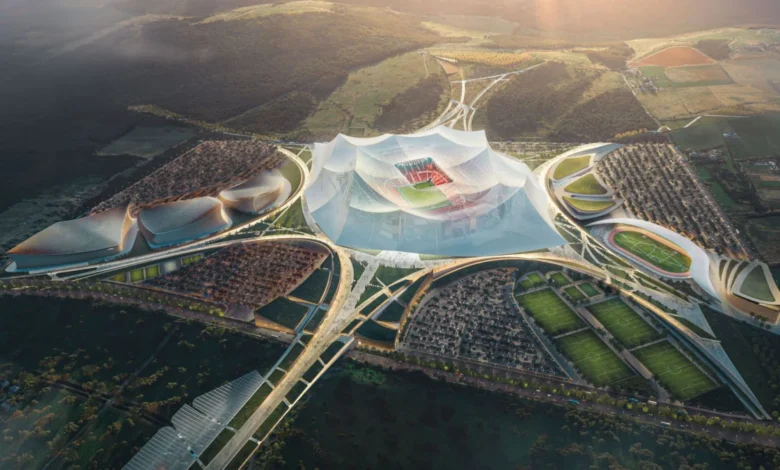
The centerpiece of Morocco’s contribution is the construction of the Grand Stade Hassan II in Benslimane, just outside Casablanca. Designed to resemble a traditional Moroccan tent, the arena is projected to have a capacity of 115,000, which would make it the largest football stadium in the world. This ambitious project underscores Morocco’s commitment to providing a world-class stage and highlights its intent to host the tournament’s final match.
Logistical Hurdles and Player Welfare
The 2030 format is not without its critics, primarily due to the immense travel distances involved. Teams playing their opening matches in South America will have to travel roughly 6,000 miles to reach the main tournament hubs in Europe and North Africa. This transcontinental leap introduces significant concerns regarding jet lag, recovery time, and the carbon footprint of the event.
FIFA has addressed these concerns by promising a revised schedule that includes "extra rest days" for the teams involved in the South American openers. Typically, a World Cup is held within a compact geographical region to minimize travel. The 2026 World Cup, hosted by the United States, Canada, and Mexico, already pushed these boundaries, but the 2030 plan takes it a step further by involving three distinct continents.

For fans, the logistics are equally daunting. Chasing a team from Montevideo to Madrid requires significant financial resources and time. However, once the tournament settles into the Spain-Portugal-Morocco region, travel becomes significantly more manageable. The proximity of Spain and Morocco—separated only by the narrow Strait of Gibraltar—allows for unique travel opportunities. Fans could theoretically watch a game in Seville and take an hour-long ferry or a short flight to Tangier for an evening match. Morocco’s high-speed rail network, Al Boraq, the first of its kind in Africa, will further facilitate rapid movement between host cities like Tangier and Casablanca.
The Battle for the Final
While the opening matches are settled, the location of the 2030 World Cup Final remains a point of intense diplomatic and sporting competition. Three primary contenders have emerged:
- The Santiago Bernabéu (Madrid, Spain): Recently renovated and located in the heart of the Spanish capital, the Bernabéu is often considered the frontrunner due to its history and prestige.
- Spotify Camp Nou (Barcelona, Spain): Currently undergoing a massive reconstruction, the Camp Nou will offer one of the highest capacities in Europe and a state-of-the-art fan experience.
- Grand Stade Hassan II (Casablanca, Morocco): With its projected 115,000-seat capacity, Morocco is making a strong case that the world’s biggest game should be played in the world’s biggest stadium.
Spanish officials have long operated under the assumption that Madrid would host the final, but recent reports suggest that Morocco’s bid is gaining significant momentum within the FIFA Council. A final decision on the venue for the July 21, 2030, championship match is not expected until December 2026.
Expanding the Field: 48 or 64 Teams?
The 2030 tournament is currently structured for 48 teams, following the expansion set to debut in the 2026 edition. This format results in 104 matches over a six-week period. However, there is growing discussion within the football community about a further expansion.

CONMEBOL, the South American football confederation, has floated the idea of increasing the field to 64 teams. While FIFA President Gianni Infantino has not officially committed to this change, he has indicated a willingness to review the proposal following the conclusion of the 2026 tournament. An expansion to 64 teams would significantly increase the revenue potential and inclusivity of the event but would also exacerbate the logistical and scheduling challenges already present in a multi-continental format.
Economic and Geopolitical Impact
The 2030 World Cup is expected to be a massive economic driver for all six host nations. For Spain and Portugal, it offers a chance to revitalize tourism and upgrade aging infrastructure. For Morocco, the tournament is a cornerstone of its national development strategy, providing a platform to showcase its modernization and attract foreign investment.
Geopolitically, the joint bid represents a rare moment of cooperation between North Africa and the Iberian Peninsula. By linking these regions through sport, the host nations hope to foster stronger diplomatic ties and promote a message of unity. The inclusion of the South American nations further broadens this impact, creating a "World" Cup in the truest sense of the word.
Chronology of Key Milestones
- October 2023: FIFA Council announces the joint Spain-Portugal-Morocco bid as the sole candidate for 2030, with the centennial matches in South America.
- Late 2024: Commencement of major renovations at Estadio Centenario in Montevideo.
- December 2026: FIFA officially confirms the full list of host cities and the venue for the Final match.
- June 8, 2030: Opening match kicks off in Montevideo, Uruguay.
- June 2030: Tournament transitions to Europe and North Africa after the initial three matches.
- July 21, 2030: The World Cup Final is held.
- 2034: The tournament moves to Saudi Arabia, which was awarded hosting rights concurrently with the 2030 ratification.
As the global football community looks toward 2030, the focus remains on whether this ambitious "three-continent" experiment can succeed. If successful, it could redefine how major sporting events are hosted in the future, moving away from single-nation bids toward regional and even global collaborations. For now, the world awaits a tournament that promises to be as much a journey through history as it is a celebration of the world’s most popular sport.