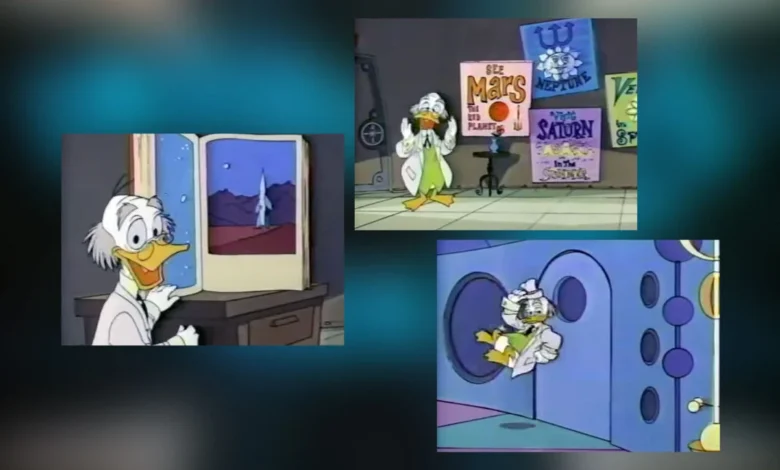
Sixty-five years ago, on September 24, 1961, the Walt Disney Company forever changed its television landscape by introducing Ludwig Von Drake, the first character created specifically to debut on the small screen. Billed by Disney himself as a "renowned scientist, lecturer, psychologist, and world traveler," the brilliant and eccentric uncle of Donald Duck quickly became a household fixture. With a penchant for explaining complex scientific principles and technological concepts to millions of viewers tuning into NBC’s Walt Disney’s Wonderful World of Color, Von Drake bridged the gap between academic rigor and family entertainment. Yet, beyond his distinct European accent, oversized glasses, and comedic pedagogical style, the character carried a profound historical footprint: he was inspired, in part, by the real-life pioneers of the early Space Age.
Main Facts of the Character’s Debut and Purpose
The introduction of Ludwig Von Drake arrived at a critical juncture in American history, coinciding with the rapid escalation of the Space Race. As the United States poured unprecedented resources into aerospace engineering, rocketry, and satellite technology, public curiosity reached an all-time high. Recognizing this cultural shift, Walt Disney leveraged his Sunday evening television platform not merely for escapism, but for education.
Von Drake served as the embodiment of this mission. Defined by his encyclopedic yet delightfully erratic knowledge base, he was uniquely suited to demystify emerging technologies for a post-World War II generation. Whether lecturing on the physiology of color television, advocating for the health benefits of physical exercise, or tracing the rich history of human aviation, the character used self-deprecating humor and whimsical graphics to make daunting scientific fields accessible to viewers of all ages.
Chronology of the Space Age and Disney Collaboration
The genesis of Ludwig Von Drake and Disney’s educational space programming cannot be understood without examining the broader timeline of the mid-20th century aerospace movement.
- October 4, 1957: The Soviet Union successfully launches Sputnik 1, the world’s first artificial satellite, shocking the American public and igniting the Space Race.
- December 4, 1957: Following the launch of Sputnik, Disney broadcasts seminal episodes of the Disneyland television series, including "Man in Space," "Man and the Moon," and later "Mars and Beyond." These programs rely heavily on consultations with actual rocket scientists.
- September 24, 1961: Ludwig Von Drake makes his official television debut on the premiere of Walt Disney’s Wonderful World of Color, establishing a new format for character-driven educational media.
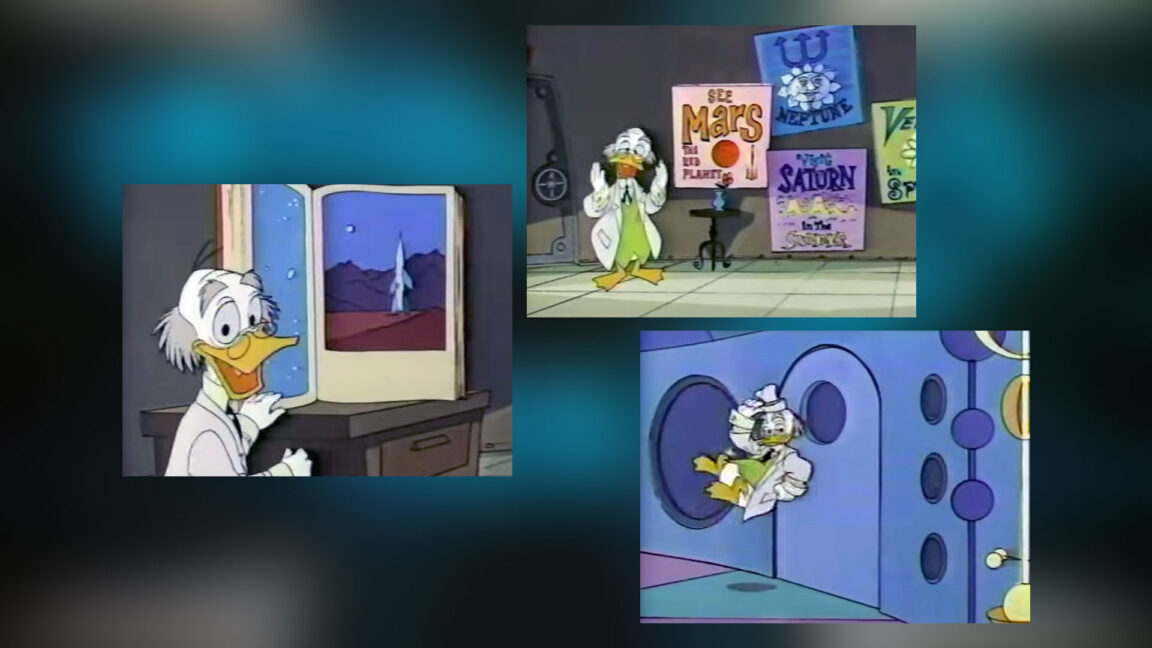
- February 10, 1963: Von Drake addresses the ultimate frontier in the episode "Inside Outer Space," utilizing repurposed and updated animation from the earlier 1950s space documentaries.
Supporting Data: The Real-Life Rocket Scientists Behind the Animation
While Ludwig Von Drake was animated with a comedic flair, his foundational philosophies on space exploration were anchored by genuine scientific authority. In developing its mid-century space programming—which later fed directly into Von Drake’s curricula—Disney collaborated closely with top-tier aerospace engineers and science communicators who had immigrated to or worked within the United States following World War II.
Prominent among these figures was Dr. Wernher von Braun, the aerospace engineer and space architect who played a pivotal role in the development of the V-2 rocket in Germany and later led the Saturn V development program for NASA. Alongside von Braun were Heinz Haber, an eminent expert in aviation medicine who contributed extensively to the understanding of physiological hurdles in high-altitude flight, and Willy Ley, a prolific science writer and historian of rocketry.
These intellectuals did not merely consult on broad themes; they provided rigorous technical frameworks for Disney’s animators. They conceptualized everything from multi-stage orbital rockets to the mechanics of zero-gravity environments and theoretical "bottle suits" designed for space walks. When Von Drake later lectured on interplanetary travel, his scripts and visual aids were direct descendants of the precise, forward-thinking blueprints drawn up by von Braun, Haber, and Ley.
Official Responses and Institutional Reactions
At the time of his debut, the academic and aerospace communities offered largely favorable receptions to Disney’s populist approach to science education. NASA officials, heavily invested in cultivating public support for the Apollo program, recognized the immense value of reaching millions of American households through mainstream media. By framing rocket science not as an impenetrable mathematical fortress, but as an attainable human endeavor, Disney’s programming helped soften public anxieties regarding the rapid militarization and technological acceleration of the Cold War.
Educators also praised the character of Ludwig Von Drake for introducing analytical thinking into children’s programming. The trope of the absent-minded yet brilliant professor allowed young viewers to see intellectual curiosity as both a noble pursuit and a source of gentle humor.
Broader Impact and Implications
The legacy of Ludwig Von Drake extends far beyond mid-century nostalgia. By weaving real-world scientific consultation into fictional narratives, Disney established a blueprint for modern edutainment that influences media production to this day.
Furthermore, the integration of aerospace science into prime-time television played a subtle yet vital role in cultural normalization. When Von Drake aired his "Inside Outer Space" segment in February 1963—bragging about his guidebook before it became "obsolete" and "prices go up"—the American public was already mentally primed to accept the inevitability of lunar missions. Although the animation itself frequently repurposed older segments from 1957 broadcasts, the underlying message remained aggressively progressive.
Ultimately, Ludwig Von Drake stood at the intersection of entertainment and education, transforming the esoteric musings of Space Age rocket scientists into universally understood household wisdom.