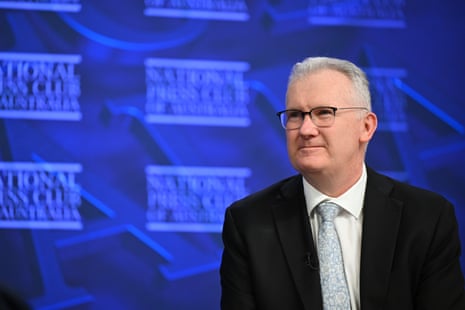
Federal Home Affairs Minister Tony Burke has robustly defended the Albanese government’s deliberate timeline for releasing its long-awaited national immigration plan, pushing back against stinging opposition criticism and insisting that navigating Australia’s complex visa system requires painstaking policy calibration. The release of the strategy, which has broad implications for international students, family reunions, and visa overstayers, follows a protracted consultation and drafting phase that pushed back Burke’s scheduled address at the National Press Club by six weeks.
Appearing on the ABC’s 7.30 program following the formal unveiling of the plan, Burke addressed pointed inquiries regarding the administration’s delays. He emphasized that the government prioritized structural integrity and economic stability over political expediency, noting that immigration intersects with virtually every facet of the contemporary Australian economy.

"Every part of the economy is affected by immigration these days for Australia," Burke told the public broadcaster. He stressed the importance of balancing population inflows with existing infrastructure constraints, particularly housing supply. "Dealing with the challenges we’ve got with housing supply, which is not immigration’s fault, but immigration needs to be part of the answer—to do that in a way that has the softest landing for the economy is something you’ve got to get right."
The justification has done little to placate the federal opposition. Coalition Leader Angus Taylor seized upon the policy roadmap, arguing that the government had failed to deliver meaningful reductions to net overseas migration during a housing crisis. Taylor revealed that the Coalition had previously established concrete preconditions for bipartisan cooperation on immigration reform, which the government ultimately failed to satisfy.
"The numbers are too high, and what we’ve seen from the government today is no cut to the numbers," Taylor asserted. While acknowledging Australia’s identity as a successful multicultural nation, the opposition leader insisted that migration caps must be strictly tied to available housing supply, community infrastructure, and essential public services—benchmarks he claims the government has consistently missed in recent years.

Chronology and Policy Background
The release of the Labor administration’s immigration blueprint marks a critical juncture in a multi-year debate over Australia’s post-pandemic population growth. Following the reopening of international borders, net overseas migration surged to historic highs, exacerbating structural shortages in the residential rental market and placing unprecedented strain on urban infrastructure.
Throughout late 2024 and 2025, the Department of Home Affairs faced mounting pressure from industry groups, economists, and state premiers to rationalize student visa processing, clamp down on non-genuine applicants, and target visa overstayers. Although Burke was initially slated to outline the comprehensive overhaul at the National Press Club in early August, the address was indefinitely postponed. Government insiders indicated that inter-agency friction between the Treasury, the Department of Education, and Home Affairs necessitated extended negotiations to prevent severe disruptions to labor-dependent sectors like agriculture, hospitality, and tertiary education.
By mid-September 2026, the framework was finalized. It introduces tighter oversight on higher education enrolments, targets systemic loopholes exploited by temporary visa holders, and establishes stricter pathways for compliance. However, it stops short of the aggressive numerical caps demanded by the Coalition, maintaining that targeted regulatory management is preferable to blunt-force reductions that could trigger economic contraction.
Ministerial Pushback and Inter-Agency Defense
Cabinet ministers have mobilized to defend the administration’s strategy against claims that the immigration adjustments are either too timid or damaging to regional workforce needs. Federal Employment Minister Amanda Rishworth rejected assertions that the migration adjustments would imperil food security or drive up the cost of living by starving the agricultural sector of seasonal labor.
Speaking to ABC News, Rishworth maintained she "doesn’t accept the premise" that lower migration thresholds would harm primary producers. She highlighted the ongoing availability of the Pacific Australia Labour Mobility (PALM) scheme alongside working holiday maker programs, which continue to mandate regional employment for visa extensions.
"I’d encourage farmers to have a look at that scheme, because there is opportunity," Rishworth said. "But more broadly, when it comes to migration, it is about taking a response that ensures that we have integrity in the system, that we have compliance in the system."

The government’s stance reflects an ongoing balancing act: attempting to satisfy urban voters concerned about housing affordability while reassuring rural industries heavily reliant on overseas labor.
Broader Legislative and Geopolitical Developments
The immigration debate unfolds against a backdrop of sweeping legislative and diplomatic shifts dominating Canberra and state parliaments.
In New South Wales, the state Labor government successfully steered landmark medicinal cannabis driving reforms through parliament, resolving a contentious legal grey area for patients. Under the newly enacted framework, drivers prescribed medicinal cannabis will no longer face an immediate three-month licence suspension for trace amounts of THC, provided their blood concentration remains below 50 ng/ml, they hold a valid prescription, and they complete an online road safety education program. While the Minns government framed the legislation as a vital step toward fairness and destigmatization for chronic illness sufferers, the state opposition condemned the move, arguing that roadside safety would be compromised due to an absence of scientific consensus regarding THC impairment thresholds.

Concurrently, Prime Minister Anthony Albanese prepared to depart for the United States, balancing domestic technology governance with high-stakes international diplomacy. Prior to attending the United Nations General Assembly in New York—where Australia is aggressively lobbying for a non-permanent seat on the UN Security Council for 2029 and 2030—Albanese planned a stop in California to meet with Apple executive chair Tim Cook. The meeting follows the introduction of Australia’s groundbreaking digital duty of care legislation and under-16 social media bans, with Apple’s recent parental controls reportedly inspired by Canberra’s regulatory model.
In Washington, discussions surrounding the AUKUS security pact drew renewed attention as senior allied officials reflected on the strategic partnership’s five-year milestone. Sir Stephen Lovegrove, the UK prime minister’s special representative on AUKUS, told a Center for Strategic and International Studies event that the intensity of opposition from potential adversaries serves as a primary metric of the pact’s success. Australian Ambassador to the United States Greg Moriarty echoed these sentiments, defending the multi-decade, $368bn nuclear submarine acquisition against criticisms that it is destabilizing the Indo-Pacific region, pointing instead to the rapid expansion of China’s naval capabilities.
Economic Implications and Future Outlook
As the federal parliament enters its next sitting fortnight, the immigration strategy will face intense legislative scrutiny. Economic analysts suggest that while the policy framework attempts to engineer a "soft landing" for a property market strained by rapid population growth, the lack of immediate, drastic numerical cuts will leave the government vulnerable to persistent attacks from the opposition.
Ultimately, the success of Labor’s immigration overhaul will be measured not by political rhetoric, but by its practical execution: whether it can effectively alleviate housing and infrastructure pressures without starving critical industries of the human capital required to sustain economic growth.