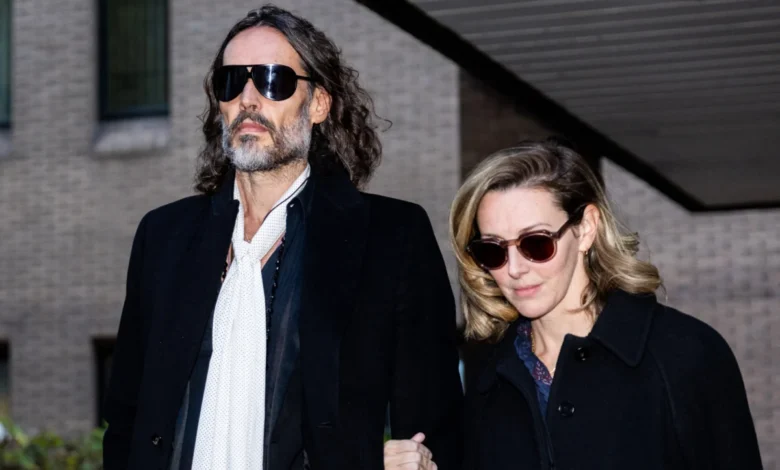
Laura Gallacher, wife of British comedian and actor Russell Brand, has publicly addressed her husband’s sentencing following his high-profile criminal trial in London. Brand was recently convicted of multiple charges, including rape and sexual assault, stemming from offenses that led to a landmark legal proceeding in the United Kingdom. Handed a prison sentence of ten years and six months, Brand’s conviction marks a dramatic turning point in the entertainer’s career, shifting his public persona from a polarizing media figure to a convicted felon.
The remarks were shared via a YouTube video posted on Sunday, featuring both Gallacher’s live commentary and a pre-recorded segment of the couple’s ongoing digital series, "Sunday Service with the Brands." The broadcast offered supporters a glimpse into how Brand’s immediate family is navigating the fallout of the judicial decision, leaning heavily into shared spiritual beliefs while acknowledging the profound personal disruption caused by the verdict.
A Family Reacts: Faith, Pain, and Absence
During the broadcast, Gallacher addressed viewers directly before transitioning into the pre-recorded content featuring her husband. Her statements underscored a reliance on faith to process the severe legal outcome.
"We trust God, and we trust His plan, and we trust everything He’s doing right now," Gallacher told viewers. "Even though it’s painful, and obviously, will take some getting used to for me to even sit here and not have my companion and my person with me. I’m speaking to Russell. He’s okay, and he’s praying, unsurprisingly."
Gallacher’s public support is consistent with her defense of Brand throughout the trial. Earlier in the legal proceedings, she took the witness stand to testify on his behalf, describing him as a "caring and kind" individual, an "amazing husband," and a "wonderful father" to their three children. During her testimony, she emphasized the transparency of their marriage, stating that she felt deeply seen by him and that their relationship had always been founded on honesty. The couple has been married since 2017.
In the pre-recorded segment of the video, which was captured while the trial was still underway, Brand offered his own perspective on the media circus surrounding the courtroom proceedings. Comparing the extensive news coverage to the trivialized nature of a sporting event, Brand criticized how mainstream outlets were handling the case.
"So obviously, as I said last week, we’re in the middle of a trial," Brand said in the video. "I mean, we don’t really look at coverage, but someone showed me some of the coverage the other day from people that were actually broadly supportive. But I know that’s not generally how it’s being covered in the mainstream media, and you can draw your own conclusions from that. Although what we’ll say is, it’s amazing to watch other people’s coverage of it because they just talk about it like it’s a football match."
Chronology of the Legal Proceedings
The conviction and subsequent sentencing of Russell Brand represent the culmination of an intensive legal investigation and judicial process that has gripped British media and international audiences alike. The timeline of events leading up to the verdict highlights the systemic pathways through which historical allegations of sexual misconduct are brought to trial within the UK legal framework.
The allegations against Brand initially surfaced publicly following joint investigative reporting by major media outlets, which detailed claims of emotional abuse, sexual assault, and rape spanning several years during the height of his mainstream media career. Following these public disclosures, multiple women came forward to police, prompting the Metropolitan Police in London to launch a formal investigation into the claims.
The investigation involved extensive evidence gathering, interviews with complainants, and the collection of historical documentation. After reviewing the case file, the Crown Prosecution Service authorized criminal charges against Brand. The trial commenced in London earlier this month, drawing massive media attention and intense public scrutiny. Throughout the trial, prosecutors presented a detailed case outlining patterns of coercive behavior and non-consensual sexual acts, while defense attorneys sought to undermine the credibility of the complainants and highlight inconsistencies in historical accounts.
Ultimately, the jury deliberated and returned a guilty verdict on charges of rape and sexual assault. Following the verdict, the presiding judge weighed aggravating and mitigating factors before handing down the sentence of ten years and six months in prison, signaling the judiciary’s firm stance on offenses of this nature, regardless of the defendant’s celebrity status or public standing.
Supporting Data and the Wider Cultural Impact
The case against Russell Brand adds to a growing body of legal and cultural reckonings involving powerful figures in the entertainment industry. Over the past decade, institutional frameworks, law enforcement agencies, and judicial systems have increasingly been forced to reevaluate how historical allegations of sexual violence are handled.
Data from justice ministries in the United Kingdom and similar Western jurisdictions indicate a persistent challenge in securing convictions for sexual offenses, often due to the historical nature of the evidence and the psychological barriers complainants face in coming forward. However, high-profile trials involving public figures have demonstrated a shift in institutional willingness to prosecute these cases through to a jury verdict.
The financial and professional implications for Brand are absolute. Once a ubiquitous presence across television, radio, film, and digital platforms—known for his rapid-fire delivery, counter-cultural persona, and later pivot to wellness and alternative commentary vlogs—Brand has seen his commercial viability evaporate. Major production companies, streaming services, and publishing houses have distanced themselves from the entertainer, terminating contracts and removing his content from mainstream distribution channels.
Public and Official Responses
Reactions to the verdict and sentencing have been sharply divided, reflecting the deeply polarized nature of Brand’s public audience. While mainstream legal advocacy groups, survivors’ networks, and public safety organizations have praised the verdict as a triumph of justice and accountability, a distinct segment of Brand’s loyal online following has expressed skepticism toward the judicial process.
Advocacy groups focusing on violence against women and girls issued statements following the sentencing, emphasizing the courage required for complainants to participate in a grueling trial process that exposes private trauma to public view. These organizations highlighted the verdict as a reminder that the law applies equally to high-profile entertainers as it does to any other citizen.
Conversely, the community surrounding Brand’s digital channels—including his alternative commentary platforms and subscription-based series—has largely rallied around the narrative presented by Gallacher and Brand himself. Supporters have frequently echoed sentiments questioning the motivations of mainstream media institutions and expressing solidarity with the family’s spiritual framing of the crisis.
Implications for Accountability in the Digital Age
The case of Russell Brand highlights several broader implications regarding the intersection of digital media, parasocial relationships, and the criminal justice system. In the modern era, public figures facing serious criminal charges possess unprecedented tools to communicate directly with their followers, bypassing traditional media filters.
Brand’s utilization of YouTube and subscription platforms to address his audience while navigating a criminal trial demonstrates a new paradigm in crisis management for disgraced celebrities. By framing legal proceedings as hostile persecution and leveraging personal relationships—such as featuring his wife’s supportive commentary—defendants can maintain insular echo chambers of support, insulating themselves from the broader consensus of the legal and societal framework.
Nevertheless, the finality of a ten-year and six-month prison sentence establishes a definitive legal boundary. Regardless of digital reach or alternative narratives, the British judicial system has enforced legal accountability for the harms proven in court. As Russell Brand begins serving his sentence, the case will likely be studied as a watershed moment in the accountability of media personalities, the evolution of historical sex crime prosecutions, and the complex dynamics of public support in the age of decentralized media.