The 2026 Rock & Roll Hall of Fame induction ceremony, held this past Saturday at the historic Peacock Theater in Los Angeles, served as a definitive declaration of the genre’s enduring resilience. While the event was marked by the expected blend of star power and long-overdue recognition, the proceedings ultimately coalesced around a singular sentiment offered by producer Rick Rubin: "You can’t kill rock ‘n’ roll." As the industry continues to evolve in the digital streaming era, the induction of a diverse class—ranging from pioneering hip-hop collectives to post-punk icons and metal legends—highlighted the fluid boundaries of what constitutes "rock" in the 21st century.
A Legacy of Rebellion and Reinvention
The ceremony, which will be broadcast on December 8 via ABC and subsequently available on Disney+ and Hulu, was a sprawling affair that bridged the gap between legacy artists and modern successors. The Rock & Roll Hall of Fame has often faced criticism for its selection process, yet the 2026 cohort—a group spanning multiple continents and decades—demonstrated a concerted effort to broaden the institution’s scope.

The inclusion of artists such as Celia Cruz, the first inductee to perform primarily in Spanish, and Fela Kuti, the first African-born artist to be honored in the performer category, underscores a shift toward a more globalized perspective. These additions, alongside country-rock pioneer Gram Parsons and industry architect Ed Sullivan, signal that the Hall is moving toward a more holistic view of musical influence, moving beyond traditional definitions of American rock.
The Rubin Influence and the Chili Peppers’ Tribute
Rick Rubin, recipient of the Musical Excellence Award, provided the evening’s most understated yet profound moment. Inducted by Neil Young, Rubin appeared in his trademark shorts and sandals, delivering a three-word acceptance speech that effectively framed the night’s proceedings.
The levity of the evening was anchored by the Red Hot Chili Peppers, who offered a surreal, tongue-in-cheek tribute to their longtime collaborator. Donning elaborate prosthetics, including white beards and balding wigs to mimic Rubin’s aesthetic, the band performed "Give It Away." The performance was a testament to the enduring camaraderie of the group, proving that their capacity for self-aware humor remains as sharp as their musical precision. The sight of the band—who famously performed in nothing but strategically placed socks during their early years—adopting the guise of their mentor served as a reminder that the spirit of rock remains inherently tied to the performance art of the genre.

The Politics of Presence: No-Shows and Industry Standards
A hallmark of the Rock Hall remains the inevitable absence of certain inductees, a phenomenon that has become part of the event’s internal mythology. Both Oasis and Iron Maiden were notably absent from the stage, yet their influence was palpable through the tributes organized in their stead.
Bob Odenkirk’s induction speech for Oasis was a masterclass in deadpan humor, noting that the band’s decision to stay home was not only expected but entirely on-brand for the notoriously volatile brothers Gallagher. Stephen Wilson Jr.’s rendition of "Wonderwall" stripped the Britpop anthem of its original stadium-rock polish, replacing it with a grit that highlighted the song’s fundamental songwriting quality.
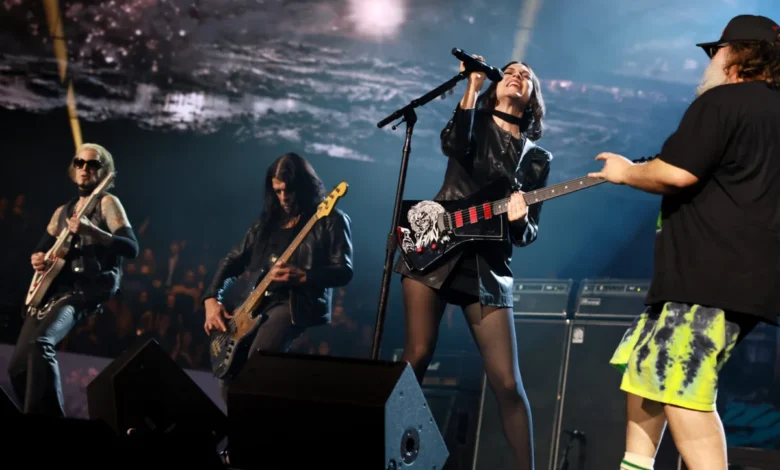
Similarly, Jack Black took the stage for Iron Maiden, offering a boisterous defense of the metal giants who were currently touring in Australia. The ensuing performance of "The Trooper," featuring a supergroup of metal and art-rock heavyweights including St. Vincent, Kirk Hammett, and Robert Trujillo, was a sonic tour-de-force. By utilizing an art-rock pioneer like St. Vincent to tackle a metal classic, the producers of the ceremony demonstrated the cross-genre pollination that has become essential to modern musical appreciation.

The Emotional Core: Resilience and Survival
While the event featured high-octane performances, the evening’s emotional anchor was the return of Phil Collins. Having struggled with significant health issues that forced his retirement from active touring, Collins’ appearance on stage with the aid of canes drew a sustained, standing ovation from the audience.
Travis Barker, who introduced the legend, provided a poignant look at the technical impact of Collins’ work, specifically highlighting the "In the Air Tonight" drum fill as a foundational moment for generations of musicians. The performance that followed, featuring Cynthia Erivo and Barker, served as a cathartic moment for the audience. Collins’ own brief speech, in which he credited his assistant Lindsay Evans for his physical recovery, offered a candid look at the fragility of life for artists who have spent half a century on the road.
Hip-Hop at the Helm: Wu-Tang Clan and Queen Latifah
The induction of the Wu-Tang Clan and Queen Latifah represented a major milestone for hip-hop within the Hall. Chris Rock’s tribute to the Wu-Tang Clan was deeply personal, grounding the group’s success in the socio-economic realities of 1990s Staten Island. He correctly identified the group’s revolutionary business model—which allowed individual members to pursue solo careers while maintaining the collective identity—as a blueprint for modern music entrepreneurship.

Queen Latifah’s induction, led by Megan Thee Stallion, shifted the focus to the necessity of female agency within the hip-hop landscape. Latifah’s speech served as a historical correction, emphasizing the collaborative nature of the genre’s early years and the importance of mentorship. The duet between Latifah and MC Lyte served as a powerful visual representation of the "sisterhood" that has sustained female artists in a historically male-dominated industry.
The Philosophical Foundations of Punk
The final act of the night, Billy Idol, served as a thematic bookend to the ceremony. Gwen Stefani’s introduction—detailing a teacher’s dismissal of a young William Broad as "idle"—highlighted the transformative power of the punk ethos. Idol’s own speech, which characterized punk not as a nihilistic movement but as a "tremendously positive" philosophy of personal freedom, resonated with the broader themes of the night.
By the time Idol concluded with a performance of "Rebel Yell" and an invitation to join the Wu-Tang Clan for the afterparty, the message was clear: the barriers between subcultures are increasingly porous.

Implications for the Future of the Hall
The 2026 ceremony suggests that the Rock & Roll Hall of Fame is shifting toward a model that prioritizes cultural impact over stylistic purity. By honoring producers, songwriters, and international artists alongside commercial titans, the institution is expanding its historical narrative to include those who built the "machine" from the inside.
Data regarding the Hall’s recent inductees indicates a distinct trend: the time between an artist’s eligibility (25 years after their first recording) and their induction is decreasing for artists who represent cultural shifts rather than just record sales. This evolution is necessary to maintain the relevance of the institution in an age where digital archives and algorithmic discovery have fundamentally changed how music history is consumed.
As the lights dimmed on the Peacock Theater, the legacy of the evening remained in the performances of those who bridged the gap between the past and the present. From the haunting synth-pop of New Order to the gritty storytelling of the Wu-Tang Clan, the 2026 induction ceremony proved that rock and roll is less a rigid musical genre and more a volatile, living archive of human expression. As Rick Rubin noted, the genre remains unkillable—not because of its adherence to tradition, but because of its infinite capacity to absorb, adapt, and innovate.