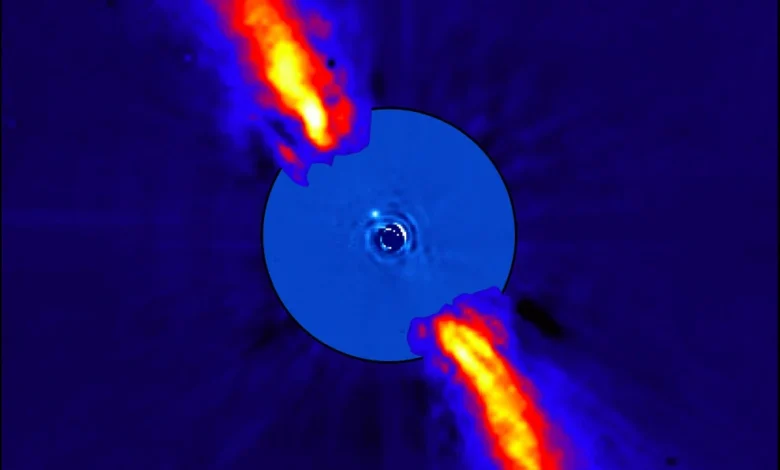
Astronomers peering into the dynamic, dust-shrouded planetary system known as Beta Pictoris have uncovered a compelling cosmic mystery that reaches back to the very origins of our galactic neighborhood. Located approximately 64 light-years away from Earth in the constellation Pictor, Beta Pictoris has long served as a premier laboratory for studying planet formation in real-time. Recent spectroscopic observations of the system’s expansive debris disk have revealed that the water ice residing within it is overwhelmingly amorphous—a disordered, glass-like solid that forms only under extreme conditions of rapid freezing in frigid environments.
This unexpected discovery challenges foundational models of circumstellar disk evolution. Standard astrophysical theories have long maintained that water ice exposed to the thermal radiation and stellar winds of a young, active star should quickly transition into an orderly crystalline structure. Instead, researchers analyzing data from the system found that less than 7 percent of the water ice in the Beta Pictoris disk is crystalline. This finding strongly implies that the raw ingredients fueling the system’s volatile inventory may have been forged in the cold, dark expanses of the interstellar medium long before the star and its nascent planets began to coalesce.
The implications of this study, published in the journal Science, extend far beyond the borders of a single planetary system. By demonstrating that primordial, interstellar ice can survive the turbulent birth phases of a star system and become widely distributed across a debris disk, scientists are gaining unprecedented insight into the universal availability of the essential building blocks for water-rich, potentially habitable worlds.
A Young Laboratory: Background Context of the Beta Pictoris System
To fully appreciate the significance of the recent findings at Beta Pictoris, one must examine the unique status of the star itself within the astronomical community. Discovered decades ago, Beta Pictoris is a relatively young A-type main-sequence star, aged at a mere 20 to 26 million years. By cosmic standards, this makes the system an infant—an ideal snapshot of an epoch that our own solar system experienced over four and a half billion years ago.
Surrounding the star is a massive, highly structured circumstellar disk composed of gas, planetesimals, and copious amounts of dust. Because the system is viewed nearly edge-on from Earth, astronomers have an unobstructed line of sight to study the vertical and radial stratification of the disk. Over the years, high-resolution imaging has revealed warps, asymmetries, and at least two gas giant planets—Beta Pictoris b and c—orbiting within the disk. These planets continuously sculpt the surrounding debris through gravitational interactions, kicking up dust and driving frequent collisions among leftover planetesimals.
Despite decades of intensive study, however, the precise chemical composition and physical state of the volatile materials residing in the outer reaches of the disk have remained subjects of intense debate. Previous infrared and submillimeter observations confirmed the presence of water ice and carbon monoxide gas, but the crystalline state of that ice and its thermal history had eluded definitive categorization until now.
Cracking the Code: The Spectrum of Amorphous Ice
The breakthrough came when a research team, led by scientists investigating the spectral signatures of the disk, focused their instruments on the specific wavelengths emitted and absorbed by water molecules. When water freezes under moderate, stable temperatures—such as those found closer to terrestrial planets or in well-insulated environments—its molecules settle into a precise, orderly crystal lattice. When exposed to infrared spectroscopy, crystalline ice produces a sharp, unmistakable peak in the spectrum just above the 3-micrometer mark.
To the surprise of the observation team, that critical peak was virtually absent in the Beta Pictoris data. Instead, the spectral profile matched that of amorphous solid water. Amorphous ice is a disordered substance that forms when water vapor or liquid condenses so rapidly and at such low temperatures that the molecules freeze in place before they can arrange themselves into a regular lattice structure.
Astrophysical models predict that any ice entering a debris disk should quickly crystallize due to ambient thermal heating. For amorphous ice to retain its glass-like structure over astronomical timescales, it must either remain perpetually colder than approximately 100 Kelvin (minus 173 degrees Celsius) or be subjected to continuous disruptive forces—such as high-energy ultraviolet radiation, cosmic rays, or energetic particle streams from the central star—that constantly break down newly formed crystal structures.
Faced with these physical constraints, the research team concluded that the vast majority of the ice currently observed in the Beta Pictoris disk did not originate locally during the formation of the star’s planets. Rather, it is likely primordial interstellar ice, captured intact from the molecular cloud from which Beta Pictoris was born tens of millions of years ago.
The Mechanics of Distribution: Constant Collisions in the Disk
Identifying the interstellar origins of the ice was only half the puzzle; researchers also had to account for how these fragile icy grains managed to spread so uniformly across the vast expanse of the debris disk rather than being vaporized or structurally altered by stellar radiation.
The research team argues that this even distribution is maintained through a continuous cycle of collisions among planetesimals orbiting within the disk. In a mature or evolving planetary system, rocky and icy bodies ranging from asteroids to dwarf planets frequently collide at high velocities. Each impact shatters the parent bodies, releasing fresh, pristine dust from the interior—including pockets of ice that had been buried deep beneath the surface and safely shielded from the harsh stellar environment.
This collisional replenishment acts as a perpetual recycling mechanism, continuously casting fresh amorphous ice into the disk faster than stellar ultraviolet light and solar winds can destroy it. Supporting this hypothesis is prior observational evidence gathered from the system. Earlier infrared images revealed a distinct, curved, and lopsided streak of dust residing within the southwestern arm of the disk. Astronomers believe this prominent feature is the direct debris signature of a massive, violent collision that occurred approximately halfway out from the star, confirming that high-energy pulverization is an active and ongoing process in Beta Pictoris.
Furthermore, the team’s findings offer a neat solution to a longstanding chemical conundrum within the system: the origin of the observed carbon monoxide gas. The data strongly support the model that carbon monoxide is continuously liberated from these colliding icy bodies, tying together multiple disparate observations into a coherent narrative of disk dynamics.
Limitations and Analytical Boundaries
While the study provides robust conclusions regarding the state and origin of the ice, the researchers acknowledge certain analytical limitations inherent to remote spectroscopic observations of distant stellar environments.
Specifically, the team was unable to quantify with absolute precision the exact ratio of crystalline to amorphous ice hidden within the densest regions of the disk, nor could they completely rule out the presence of other complex molecules or clathrates hiding within the icy mixture. The estimated threshold of less than 7 percent crystalline ice represents a robust upper limit based on current spectral models, but finer compositional details will require the next generation of space- and ground-based observatories with enhanced sensitivity in the mid-to-far infrared spectrum.
Broader Impact and Implications for Astrobiology
The discovery that a young planetary system 64 light-years away shares the same fundamental icy ingredients as our own primordial solar system carries profound implications for the search for life in the universe. It suggests that pristine, interstellar ice may not be an anomalous feature unique to the birth of our sun, but rather a common, standardized ingredient delivered to planetary systems across the Milky Way.
If raw materials like water-rich interstellar ice are standard components during the formation of circumstellar disks, then the chemical building blocks necessary for the emergence of water-rich, potentially habitable worlds are likely widespread throughout the galaxy. As astronomers continue to probe the nurseries of young star systems, findings from Beta Pictoris provide a vital conceptual bridge connecting the chemistry of interstellar molecular clouds to the eventual formation of oceans on distant, rocky planets.