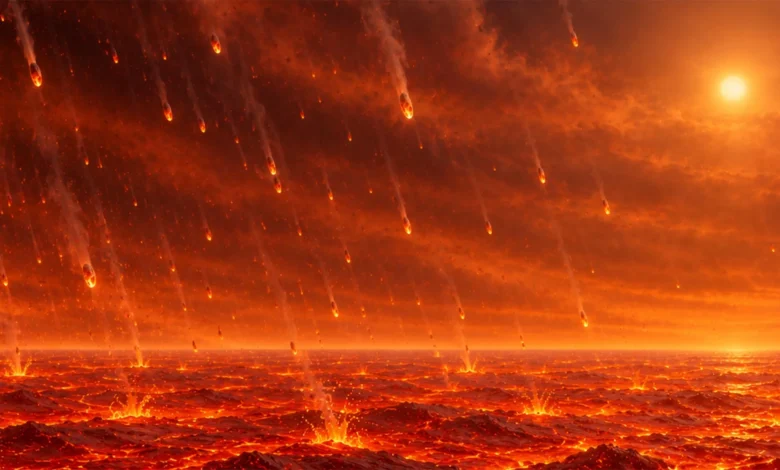
The fundamental origin of Earth’s vast oceans has long remained one of planetary science’s most compelling enigmas. Traditional scientific consensus has predominantly pointed outward, attributing the planet’s life-sustaining hydration to exogenous deliveries via comets, asteroids, and water-rich meteorites bombarding the nascent globe billions of years ago. However, groundbreaking research published in the journal Nature Geoscience has fundamentally challenged this paradigm. A team of scientists at The University of New Mexico has demonstrated that Earth may have manufactured a substantial portion of its own water internally. Through intense chemical interactions between falling rocky material and a primordial, hydrogen-dense atmosphere, the young planet could have autonomously forged massive quantities of water vapor, rewriting the timeline and mechanisms of planetary habitability.
The study, spearheaded by graduate student Susmita Garai alongside Professor and Director of Earth and Planetary Sciences Zachary Sharp and Professor Peter Olson, investigates a novel planetary birth mechanism known as pebble accretion. By simulating the extreme pressures and temperatures of the Hadean Earth—the tumultuous geological eon spanning from 4.6 to 4.0 billion years ago—the researchers discovered that water is not merely a passive gift from the outer solar system, but an active chemical byproduct of planetary construction. This revelation suggests that water generation could be an intrinsic phase of rocky planet formation throughout the cosmos, profoundly altering how astrophysicists and astrobiologists evaluate the potential abundance of habitable worlds.
Reconstructing the Hadean Laboratory: Chronology and Experimental Design
To test their audacious hypothesis, the research team at The University of New Mexico set out to recreate the hostile, high-energy environment that characterized Earth’s infancy approximately 4.5 billion years ago. During this epoch, countless small fragments of primordial rock—collectively referred to as pebbles—accreted via gravitational attraction to build the growing terrestrial body. As the proto-Earth accumulated mass, it simultaneously captured a dense, primordial envelope composed largely of hydrogen gas, creating thermal and barometric extremes far beyond modern planetary parameters.
Dr. Susmita Garai engineered a series of rigorous high-temperature experiments designed to observe what happens when iron-bearing silicate rocks descend through such a hydrogen-rich atmosphere. In the laboratory, silicate rock samples were subjected to searing temperatures ranging from 1,200 to 1,400 degrees Celsius (approximately 2,192 to 2,552 degrees Fahrenheit). These extreme thermal conditions were maintained while flowing hydrogen gas was introduced over the rock samples. To ensure scientific rigor and isolate the chemical reactions, the team conducted control experiments utilizing inert helium gas in place of hydrogen. Each experimental run lasted between 15 minutes and three hours, mirroring the dynamic, fast-paced physical processes occurring in a
collapsing protoplanetary nebula.
The results of these high-temperature trials were both immediate and profound. Within minutes of exposure to the hydrogen environment, the chemical composition of the silicate rocks transformed dramatically. Approximately 80 percent of the iron oxide contained within the rock samples was reduced, converting into metallic iron. Crucially, this reduction reaction directly yielded substantial quantities of water vapor. Conversely, the control tests utilizing helium gas produced no such chemical shift or water generation, confirming unequivocally that atmospheric hydrogen played an indispensable catalytic and reactive role in the synthesis of the water.
Challenging Decades of Planetary Dogma: The Interstellar Delivery Model Versus Internal Genesis
For the past several decades, the prevailing framework governing planetary science has relied heavily on the exogenous delivery model to explain Earth’s hydrosphere. According to this long-standing theory, the inner terrestrial planets—Mercury, Venus, Earth, and Mars—formed in regions of the solar system that were too hot for volatile compounds like water to condense and remain as liquids or ices. Consequently, Earth was thought to have formed as a dry, rocky body, only to be subsequently bombarded by icy planetesimals, comets, and carbonaceous chondrite meteorites originating from the distant, colder outer reaches of the solar system, well beyond the asteroid belt.
While this impact-delivery theory successfully accounts for the presence of certain volatile elements, it has consistently struggled to resolve complex geochemical puzzles. Chief among these issues is the sheer logistical difficulty of transporting enough material inward from the outer solar system to account for Earth’s deep-mantle water reserves and surface oceans. Furthermore, isotopic signatures—specifically the ratio of deuterium to ordinary hydrogen (D/H ratio) found in terrestrial water compared to cometary ice—have frequently presented discrepancies that do not neatly align with a purely cometary origin.
The new findings from the University of New Mexico introduce an elegant and geochemically sound alternative. Rather than depending on a complex transport mechanism from the distant solar system, Earth’s water could have been synthesized in situ. As the planet grew through the accretion of rocky pebbles raining down through a thick, primordial hydrogen atmosphere, the thermodynamic conditions naturally favored the chemical reduction of iron oxides. This internal manufacturing process bypasses the necessity of long-range delivery systems, proposing instead that the very recipe for water was baked into the fundamental building blocks of the planet itself.
Quantitative Analysis: Hundreds of Oceans Forged in Hellish Conditions
The scale of water production uncovered by Garai and Sharp’s experiments exceeded even the researchers’ initial expectations. While the team theorized that reduction reactions would yield iron metal and water vapor, the velocity and volume of the output caught them by surprise. When the experimental data were mathematically extrapolated to reflect the planetary scale and atmospheric volume of the early Earth, the calculations yielded staggering figures.
According to the study’s quantitative models, this atmospheric-rock interaction mechanism could easily have generated hundreds of oceans’ worth of water during the planet’s primary accretion phase. Professor Zachary Sharp reflected on the cognitive dissonance of visualizing modern, tranquil bodies of water against the backdrop of Earth’s violent, hellish genesis. Looking out over a vast sea or ocean today, it requires a profound shift in perspective to comprehend that the liquid sustaining life might have been forged 4.5 billion years ago in a blistering, highly reductive atmosphere characterized by temperatures hot enough to melt rock.
This massive output implies that Earth may have possessed significant amounts of water almost from the moment of its completion, rather than waiting hundreds of millions of years for a lucky string of cometary impacts. The implications of this continuous internal generation suggest that terrestrial planets could be born "wet," possessing intrinsic hydration that primes them for geological activity, plate tectonics, and chemical evolution early in their life cycles.
Implications for Astrobiology and Exoplanet Habitability
The ramifications of this research extend far beyond our own solar system, offering a potentially paradigm-shifting lens through which astronomers can assess exoplanetary habitability. In recent years, the scientific understanding of planet formation has been revolutionized by the concept of pebble accretion—a theory developed over the past decade that explains how planetary embryos rapidly sweep up millimeter-to-centimeter-sized dust and pebble-sized rocks from protoplanetary disks.
Professor Sharp noted that while pebble accretion has successfully resolved numerous longstanding anomalies regarding how gas giants and terrestrial planets assemble so rapidly, its intersection with atmospheric chemistry provides a missing link for habitability. If the reduction reaction between falling rocky pebbles and hydrogen atmospheres is a universal thermodynamic law, then virtually any Earth-sized rocky planet that forms under similar stellar conditions should inherently manufacture its own water.
This realization fundamentally alters the Drake Equation and statistical models concerning the distribution of life in the universe. Previously, astrobiologists calculated the habitability of an exoplanet by assessing its location within the circumstellar "Goldilocks zone" and factoring in the statistical probability that it had received random, life-enabling impacts from water-bearing comets. If water production is instead an intrinsic byproduct of the standard planet-building process, the galactic abundance of water-rich rocky worlds may be exponentially higher than previously estimated. Planets do not necessarily need to win a cosmic lottery of asteroid impacts to become ocean-bearing; they simply need to form according to standard astrophysical mechanics.
Future Research Directions and Unresolved Scientific Questions
Despite the monumental nature of the findings, the researchers emphasize that this study represents a foundational step rather than the final word on terrestrial water origins. Several critical uncertainties remain to be investigated by the broader planetary science community.
Chief among these is the exact apportionment of Earth’s current water inventory. While laboratory experiments have proven that the hydrogen-silicate rock reaction is chemically viable and wildly productive under Hadean conditions, determining precisely what percentage of modern Earth’s water stems from this internal atmospheric synthesis versus external cometary and meteoritic bombardment remains a complex geochemical challenge. Advanced isotopic tracing and refined modeling of early solar system dynamics will be required to untangle these overlapping contributions.
Furthermore, researchers must model how different stellar types, varying protoplanetary disk compositions, and distinct atmospheric loss rates—such as solar wind stripping during a planet’s youth—might influence the retention or destruction of this internally generated water. As observational astronomy continues to characterize the atmospheres of rocky exoplanets using advanced instruments like the James Webb Space Telescope (JWST), empirical testing of these theoretical models in distant star systems will soon become possible.
Conclusion: A Rewritten Narrative for Earth and Beyond
The discovery by Susmita Garai, Zachary Sharp, and Peter Olson at The University of New Mexico marks a transformative chapter in planetary geoscience. By demonstrating that Earth could have manufactured hundreds of oceans’ worth of water through the straightforward interaction of rocky pebbles and a hydrogen-rich atmosphere, the research bridges a major gap in our understanding of planetary evolution.
It transitions the narrative of water from an external, accidental acquisition to an internal, deterministic chemical inevitability. As science continues to probe the origins of our world and gaze outward toward distant star systems, these findings offer a compelling takeaway: the universe may be fundamentally predisposed to making wet, rocky worlds, thereby multiplying the cosmic opportunities for the emergence of life.