
Spring4Shell Vulnerability: Understanding and Patching the Critical Remote Code Execution Flaw
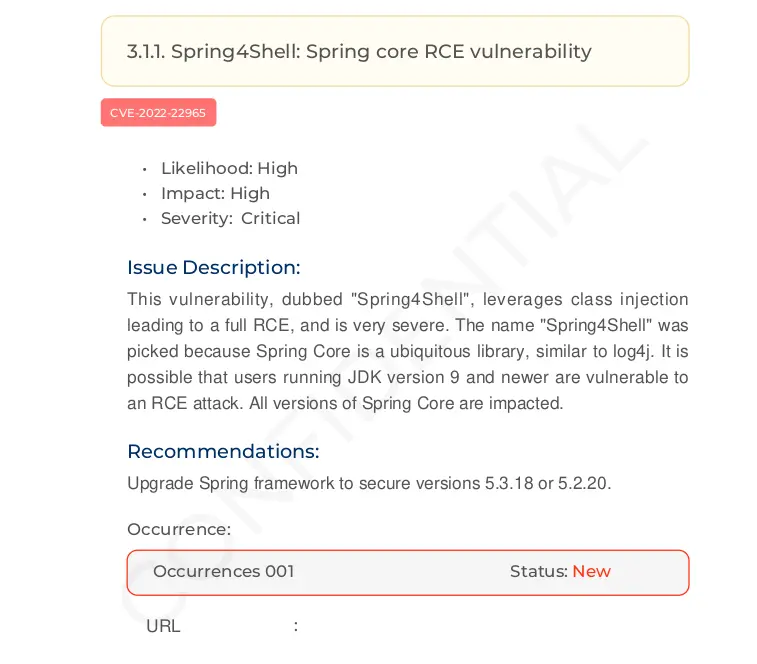
The Spring4Shell vulnerability, officially designated CVE-2022-22965, is a critical remote code execution (RCE) flaw affecting specific versions of the widely used Spring Framework. Discovered in late March 2022, this vulnerability allows unauthenticated attackers to execute arbitrary code on a vulnerable server, leading to complete system compromise. Understanding the technical intricacies of Spring4Shell, its exploitability, and the imperative need for timely patching is paramount for organizations utilizing Spring-based applications. This article delves into the core mechanics of the vulnerability, outlines the conditions for exploitation, and provides a comprehensive guide to effective mitigation strategies, emphasizing the urgency of patching.
At its heart, Spring4Shell exploits a weakness in how the Spring Framework handles file uploads in conjunction with Apache Tomcat. Specifically, the vulnerability leverages the DefaultDataBinder class within Spring MVC. When an application uses Spring MVC to handle file uploads, the DefaultDataBinder is responsible for binding request parameters to Java objects. The flaw arises from an incorrect sanitization of the filename attribute within the MultipartFile object, which represents an uploaded file. When Tomcat is configured with certain settings, particularly concerning the LocalServerPort variable, and the application itself is running within a Tomcat server, an attacker can craft a malicious request that manipulates the filename attribute. This manipulation, when passed through Spring’s data binding process, results in the creation of a malicious file within the web application’s directory.
The exploitation path typically involves sending a specially crafted POST request to an endpoint that accepts file uploads and is configured with Spring MVC. This request includes a malicious filename parameter. The filename parameter, when processed by the DefaultDataBinder, is used to construct a file path. Crucially, the vulnerability allows for directory traversal attacks within this filename parameter. For instance, an attacker might include ../../../../../../etc/tomcat/conf/catalina.properties or a similar path to write a malicious payload to a critical configuration file or even directly to the web application’s root directory. The effectiveness of this directory traversal is dependent on how Tomcat is configured and how Spring handles relative path resolution.
A key condition for exploitation is the presence of a vulnerable version of Spring Framework (specifically Spring MVC) running on top of Apache Tomcat. Furthermore, the application must be configured to allow file uploads and use Spring MVC’s data binding for these uploads. It’s also important to note that the vulnerability is not present in all Spring applications; it requires a specific confluence of configurations. However, given the widespread adoption of Spring and Tomcat, the potential attack surface is vast. The vulnerability can lead to the creation of a Web Shell, a piece of code that allows an attacker to remotely execute commands on the server, effectively giving them full control. This Web Shell can then be used to download further malicious software, exfiltrate sensitive data, or pivot to other systems within the network.
The technical details of the exploit involve manipulating the filename property of the MultipartFile object. When a MultipartFile is processed, Spring attempts to extract the filename and potentially its extension. The vulnerability allows an attacker to inject characters and path traversal sequences into the filename that, when processed by Spring’s DefaultDataBinder, are not properly escaped or validated. This leads to the filename being interpreted as a path relative to a specific working directory, allowing the attacker to write a file to an arbitrary location on the server. The LocalServerPort variable, when exposed and used within the application’s logic or by Spring, can also be a vector for attackers to determine the context of the application and craft precise path traversal payloads.
The impact of a successful Spring4Shell exploit is severe. An attacker gaining RCE can compromise the confidentiality, integrity, and availability of the affected application and its underlying infrastructure. This can translate to significant financial losses, reputational damage, and legal ramifications. Data breaches, ransomware attacks, and service disruptions are all plausible consequences of an unpatched Spring4Shell vulnerability. Security researchers have demonstrated various exploit chains, including creating JNDI lookup payloads that can lead to further RCE through deserialization vulnerabilities, or simply deploying a basic Web Shell for immediate command execution. The simplicity of some exploit methods further amplifies the risk.
Identifying if your applications are vulnerable requires a thorough inventory of your software stack. First, determine if your applications are built using the Spring Framework, specifically Spring MVC. Then, check the specific versions of Spring Framework being used. Versions of Spring Framework from 5.0.0 to 5.3.17, and Spring Boot versions from 2.0.0 to 2.6.4 are known to be affected. However, it’s crucial to verify the exact versions. The presence of Apache Tomcat as the application server is also a prerequisite for the most commonly demonstrated exploitation vectors. Finally, examine your application’s code to ascertain if it handles file uploads and utilizes Spring MVC’s data binding capabilities for these uploads.
The primary and most effective mitigation for the Spring4Shell vulnerability is to patch your systems immediately. This involves updating vulnerable Spring Framework and Spring Boot versions to patched releases. For Spring Framework, versions 5.3.18 and later, and 5.2.20 and later, address this vulnerability. For Spring Boot, versions 2.6.5 and later, and 2.5.12 and later, contain the necessary fixes. It is highly recommended to update to the latest stable versions of both Spring Framework and Spring Boot to benefit from ongoing security improvements.
In addition to direct patching, several temporary workarounds can be implemented if immediate patching is not feasible. However, these are considered interim solutions and should not replace the imperative of updating your dependencies. One such workaround involves disabling the MultipartFile data binding feature in Spring MVC. This can be achieved by configuring Spring MVC to not bind MultipartFile parameters automatically. Another temporary measure is to restrict the file upload functionality to only trusted file types and sizes, although this is less effective against sophisticated attacks.
A more robust workaround, especially for older Spring versions where direct patching might be complex, is to explicitly bind to MultipartFile rather than relying on the auto-binding mechanism. This can involve using @ModelAttribute with a specific MultipartFile parameter, which bypasses the vulnerable DefaultDataBinder processing in certain scenarios. For example, instead of:
@PostMapping("/upload")
public String handleFileUpload(@RequestParam("file") MultipartFile file) {
    // ...
    return "redirect:/";
}
Consider:
@PostMapping("/upload")
public String handleFileUpload(@ModelAttribute UploadForm form) {
    MultipartFile file = form.getFile();
    // ...
    return "redirect:/";
}
Where UploadForm is a POJO with a MultipartFile field.
Organizations should also review their Tomcat configurations. While Spring4Shell’s exploitation primarily hinges on Spring’s handling of file uploads, certain Tomcat configurations might exacerbate the vulnerability or be leveraged in more complex exploit chains. Ensuring Tomcat is updated to the latest stable versions is always a good security practice. Furthermore, implementing Web Application Firewalls (WAFs) with up-to-date rulesets can help detect and block malicious HTTP requests, including those attempting to exploit Spring4Shell. However, WAFs should not be relied upon as the sole defense mechanism.
A comprehensive security audit is crucial to identify all instances of vulnerable Spring versions across your organization. This includes not only custom-built applications but also third-party software that may incorporate Spring components. Dependency scanning tools can be invaluable in this process, automatically identifying vulnerable libraries and providing actionable recommendations for remediation. Prioritize patching critical applications and those exposed to the internet.
The long-term strategy for preventing similar vulnerabilities involves adopting secure coding practices, regularly updating dependencies, and maintaining a robust vulnerability management program. Developers should be educated on common security pitfalls, and thorough code reviews should be conducted. Utilizing security linters and static analysis tools can help catch potential vulnerabilities early in the development lifecycle. Furthermore, staying informed about emerging threats and security advisories from vendors and security researchers is essential.
The Spring4Shell vulnerability serves as a stark reminder of the interconnectedness of modern software development and the potential for widespread impact from even seemingly niche flaws. The ease with which this RCE vulnerability can be exploited, coupled with the ubiquity of the Spring Framework, makes it a high-priority threat. Organizations that fail to patch promptly expose themselves to significant risks. The technical details of the exploit, while specific, highlight the importance of understanding how frameworks handle user input, especially in the context of file operations and data binding.
In conclusion, the Spring4Shell vulnerability (CVE-2022-22965) is a critical RCE flaw that demands immediate attention. The primary and most effective remediation is to patch vulnerable Spring Framework and Spring Boot versions. While temporary workarounds exist, they should not be considered a substitute for updating your dependencies to secure releases. A proactive approach to security, including regular audits, dependency management, and adherence to secure coding practices, is essential to protect against current and future threats like Spring4Shell. The cost of inaction far outweighs the effort required to implement the necessary patches and security measures.

