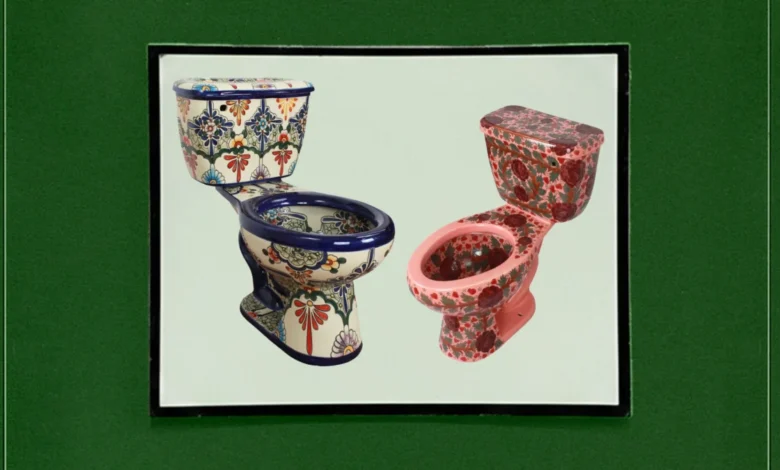
The standard for domestic bathroom aesthetics has long been defined by a clinical, utilitarian minimalism, prioritizing hygiene and unobtrusiveness over decorative expression. For decades, the prevailing architectural philosophy suggested that the toilet, as a functional necessity associated with biological waste, should remain as inconspicuous as possible. This resulted in a near-universal reliance on white porcelain, a material choice that emphasizes cleanliness through its starkness. However, a significant shift in interior design trends—moving away from the "millennial gray" era toward a philosophy known as maximalism—has begun to challenge the toilet’s status as a purely functional object. Central to this transformation is the rising popularity of the Talavera toilet, a hand-painted, highly ornate ceramic fixture that draws on centuries of Mexican and Spanish history to redefine the boundaries of bathroom decor.
The Evolution of Bathroom Aesthetics: From Utility to Statement Piece
The history of the modern bathroom is a relatively short one in the context of human architecture. Until the mid-19th century, the "closet" was often a separate, purely functional space. As indoor plumbing became a standard feature of urban development, the aesthetic of the bathroom was modeled after laboratories and hospitals to reassure homeowners of the safety and sanitation of the new technology. This established the "white porcelain" precedent that has dominated the industry for over a century.
While other household items—such as kitchen faucets, laundry hampers, and soap dispensers—have undergone various stylistic evolutions, the toilet remained largely resistant to change. In the mid-20th century, American culture saw a brief and often criticized foray into "fuzzy" toilet seat covers and carpeted bathroom floors, an attempt to soften the coldness of the room that is now largely viewed with aesthetic regret. Subsequent decades focused on technological rather than visual upgrades, most notably through the rise of Japanese bidet systems like the Toto Washlet, which offer heated seats and advanced cleansing features while maintaining the traditional white silhouette.
The current movement toward the Talavera style represents a fundamental reclassification of the toilet. Rather than viewing the fixture as an embarrassing necessity to be hidden, designers and homeowners are increasingly treating it as a canvas for folk art. This shift aligns with a broader trend in interior design known as "dopamine decor," where bright colors, intricate patterns, and artisanal craftsmanship are used to create spaces that evoke joy and personal expression.
The Artistic Heritage of Talavera Pottery
The Talavera toilets gaining traction in the luxury market are not merely painted fixtures; they are the contemporary descendants of a complex historical synthesis. The term "Talavera" refers to a specific style of majolica pottery—a process where colorful mineral-based pigments are applied over a milky-white lead or tin glaze.
The technique originated in Talavera de la Reina, Spain, which served as the majolica capital of the world for centuries. During the 16th century, Spanish colonialists brought these techniques to the city of Puebla in what was then New Spain (modern-day Mexico). However, the aesthetic of Mexican Talavera was further transformed by the Manila Galleon trade. Trading ships carrying fine Chinese porcelain traveled from the Philippines to Acapulco, introducing Mexican artisans to the blue-and-white color palettes of the Ming Dynasty.
Pueblan potters reinterpreted these Asian influences, blending them with Spanish techniques and indigenous Mexican floral and geometric motifs. This created a unique cultural hybrid that was eventually protected by a "Denominación de Origen" (Denomination of Origin), ensuring that authentic Talavera can only be produced in specific regions using traditional methods. The toilets currently appearing in high-end design portfolios, such as those sourced from Guanajuato, Mexico, utilize these labor-intensive methods, with designs often extending into the interior of the tank and the bowl itself.
Market Dynamics and the Role of Artisanal E-commerce
The sourcing of these ornate fixtures has been revolutionized by global e-commerce platforms. Historically, acquiring a hand-painted Mexican toilet would have required a physical trip to Central Mexico or a specialized import broker. Today, the market is dominated by independent artisans and workshops that sell directly to international consumers through platforms like Etsy.
One notable figure in this niche market is Salvador, the proprietor of Casa Castillo Art based in Guanajuato. His digital storefront has become a primary hub for Talavera sanitary ware, offering hundreds of unique toilet designs alongside matching sinks, mirrors, and floor tiles. The pricing for these items typically ranges from $1,100 to $1,500 USD, positioning them as a luxury alternative to high-end functional toilets.
Industry data suggests that the "home spa" and luxury bathroom segment is one of the fastest-growing areas in the renovation market. According to recent reports on the global sanitary ware market, consumers are increasingly willing to invest in "statement pieces" for secondary bathrooms and powder rooms—spaces where guests are likely to encounter the decor. The Talavera toilet fits perfectly into this "powder room prestige" trend, where the small footprint of the room allows for bold, high-impact design choices that might be overwhelming in a larger living space.
Celebrity Influence and the Mainstreaming of Maximalism
The transition of the Talavera toilet from a niche folk art item to a high-fashion interior design staple can be traced, in part, to celebrity endorsements and media coverage. In 2021, Architectural Digest featured the Los Angeles home of supermodel and actress Cara Delevingne. The residence, designed by architect Nicolo Bini, was described as a "delightfully dizzying" blend of styles, including a jungle-themed bathroom.
Central to this bathroom’s design was a Talavera toilet from Casa Castillo Art, placed against a backdrop of vibrant banana-leaf wallpaper. The visibility of such a unique fixture in a high-profile celebrity home served as a catalyst for a broader discussion on bathroom maximalism. It challenged the notion that luxury must be synonymous with the sleek, cold surfaces of modern minimalism, suggesting instead that luxury could be found in the "sickly desperation for beauty"—a phrase used by design enthusiasts to describe the need for every object in a home to possess artistic value.
Public Perception and the Functional Conundrum
Despite the growing popularity of artistic toilets, the trend remains a point of contention among traditionalists. Online forums and design communities, such as those on Reddit, frequently debate the practicality of highly decorated sanitary ware. Critics often raise concerns regarding the "visual cleanliness" of a patterned bowl, arguing that the intricate designs may make it difficult to discern whether the fixture is truly sanitized.
Proponents, however, argue that this is a psychological barrier rather than a functional one. Modern Talavera glazes are fired at high temperatures (typically between 850°C and 1,000°C), creating a non-porous, durable surface that is as easy to clean as standard white porcelain. The debate highlights a lingering cultural discomfort with the toilet’s primary function; by turning the object into a "work of art," proponents are effectively attempting to de-stigmatize the bathroom and integrate it more fully into the home’s overall aesthetic narrative.
Chronology of the Artistic Toilet Trend
- 16th Century: Spanish majolica techniques are introduced to Mexico, specifically in Puebla.
- 17th–18th Century: The influence of Chinese porcelain via trade routes establishes the classic blue-and-white Talavera palette.
- 1920s–1950s: The "Colonial Revival" in the United States sparks a brief interest in Mexican tilework for kitchens and bathrooms.
- 2005–2015: The rise of minimalist "spa" bathrooms reinforces the dominance of all-white porcelain fixtures.
- 2018: The "Maximalism" movement begins to gain traction on social media platforms like Instagram and Pinterest, encouraging bold colors and patterns.
- 2021: High-profile celebrity home tours (e.g., Cara Delevingne) bring the Talavera toilet into the mainstream design conversation.
- 2023–Present: E-commerce data shows a surge in sales for artisanal Mexican sanitary ware, with workshops in Guanajuato and Puebla expanding their digital presence to meet international demand.
Broader Impact and Future Outlook
The rise of the Talavera toilet is more than a fleeting decor trend; it is indicative of a broader shift in how consumers view their living environments. As the "work from home" era has increased the amount of time people spend in their personal spaces, there has been a corresponding rise in the desire for "total environment" design—where no corner of the home is left unconsidered.
From a manufacturing perspective, this trend may encourage larger sanitary ware companies to experiment with more than just shape and technology. While giants like Kohler and Toto have experimented with different colors of porcelain (such as black, gray, or biscuit), they have yet to embrace complex, hand-painted patterns on a mass scale. The success of independent artisans like those at Casa Castillo Art proves there is a viable market for "biological necessities" that double as decorative objects.
Ultimately, the Talavera toilet represents a bridge between history and modern lifestyle. It takes a craft that was nearly lost to industrialization and applies it to the most modern of domestic inventions. As interior design continues to prioritize personality and cultural storytelling, the bathroom is likely to move further away from its clinical roots, embracing a future where even the most humble objects are treated with the reverence of art.