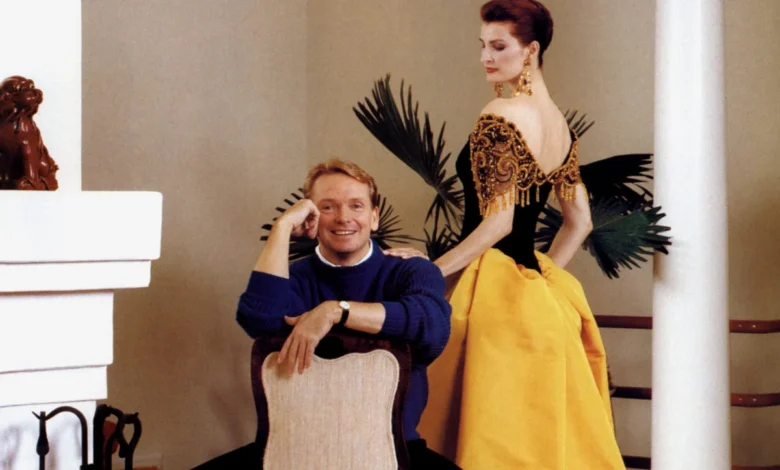
The global fashion industry is mourning the loss of a true visionary following the death of Bob Mackie at the age of 87. An unparalleled force in costume design, Mackie earned his reputation as the "Guru of Glitter," a moniker earned through decades of defining the aesthetic of American entertainment. His work, which garnered nine Emmy Awards and a Tony Award, bridged the gap between high-fashion couture and the theatrical demands of stage and screen. While the world remembers him for the shimmering, gravity-defying ensembles he crafted for icons like Cher, Carol Burnett, and Diana Ross, a look back at his private life reveals a stark, refreshing contrast to the high-octane glamour that defined his professional career.
A Career Defined by Showstopping Artistry
Bob Mackie’s influence on pop culture is difficult to overstate. Born in 1939, Mackie began his career in the early 1960s, quickly establishing himself as a designer who understood the transformative power of a garment. His collaborative relationship with Cher, in particular, remains one of the most significant partnerships in fashion history. Throughout the 1970s and 1980s, Mackie’s designs for The Sonny & Cher Comedy Hour pushed the boundaries of television censorship and fashion design, utilizing beads, feathers, and illusion netting to create outfits that were as much about performance as they were about clothing.
His portfolio was remarkably diverse, extending well beyond television. He designed costumes for Broadway productions, including the musical Moon Over Buffalo, and created iconic looks for performers ranging from Barbra Streisand to Tina Turner. By the time he transitioned into his own ready-to-wear empire, Mackie had already cemented his status as a legendary figure who understood that clothing was not just functional—it was a narrative tool.

Chronology of an Icon
- 1939: Robert Gordon Mackie is born in Monterey Park, California.
- 1960s: Begins his career as a sketch artist for designers like Edith Head and Jean Louis.
- 1967: Gains widespread recognition for his work on The Carol Burnett Show, a collaboration that would last for over a decade.
- 1970s–1980s: Becomes synonymous with "glitz" through his work with Cher, creating outfits for the Academy Awards and various variety shows that remain cultural touchstones today.
- 1989: Architectural Digest tours his Beverly Hills home, offering the public a rare glimpse into his private aesthetic.
- 1999: Receives a Tony Award for his costume design for Contact.
- 2019: Wins the Tony Award for Best Costume Design in a Musical for The Cher Show, marking a career-defining late-stage achievement.
- 2024: Passes away at the age of 87, leaving behind a legacy that continues to influence modern red-carpet fashion.
The Dual Identity: Public Glamour vs. Private Comfort
Despite a professional life that thrived on the excessive, the nocturnal, and the spectacular, Mackie’s private life was anchored in a profound desire for serenity. His Beverly Hills residence, which served as his sanctuary during the height of his career, functioned as a deliberate antidote to the chaos of the entertainment industry.
While outsiders often assumed that the man behind the sequins lived in a home filled with chrome, leopard print, and mirrors, the reality was entirely different. Mackie favored a space defined by light, clean lines, and comfort. He famously noted that he never felt the need for his personal lifestyle to reflect the glitzy garments he designed for the stage. Instead, he treated his home as a place for intellectual and sensory rest.
Interior Philosophy: A Curated Calm
Mackie’s home decor mirrored his approach to life: intentional and personal. Rather than filling his rooms with show-business memorabilia—of which he had plenty—he chose to surround himself with objects that brought him joy on a human level. His dining room was graced by Baccarat crystal and Staffordshire statuettes, while his bedroom featured an eclectic mix of Balinese wood carvings and Oaxacan animal figures.
"I’ve never liked a lifestyle that reflects the clothes I design," Mackie once remarked. "It doesn’t appeal to me. I bought the house for the light and the privacy." This philosophy extended to his minimal approach to "decorating." He famously avoided buying new furniture, preferring to live with pieces that had history and character. He was particularly fond of what he called his "toys"—idiosyncratic objects, such as a striped wooden tiger from Paris or antique mannequins, that lent the home a sense of personality without descending into "the cutes."

The Business of Creativity
Mackie’s career was marked by a relentless work ethic. As his brand expanded into ready-to-wear—encompassing everything from furs and belts to bridal wear and swimwear—his schedule became increasingly demanding. This expansion, which he candidly described as a response to a "mid-life crisis," was driven by a fear of untapped potential. He recognized early on that his time was finite, and he channeled that urgency into every facet of his business.
The shift toward a ready-to-wear empire required Mackie to split his time between Los Angeles and New York. Despite the cross-country travel and the pressures of managing a global brand, he remained committed to the sanctity of his California home. It was a space where he could cook, read the Sunday paper, and detach from the expectations of the industry.
Impact and Industry Analysis
The death of Bob Mackie signals the end of a specific era in American costume design. Mackie was part of a generation of designers who treated the human body as a canvas for high-stakes performance art. His work fundamentally changed how audiences perceived the Academy Awards; he turned the red carpet into a runway, proving that a costume could be a news story in its own right.
From a design analysis perspective, Mackie’s genius lay in his understanding of the "silhouette." He knew how to manipulate fabric to accentuate the female form while ensuring that the wearer could still move, dance, and perform. His use of materials was revolutionary, utilizing synthetic fabrics and intricate beading techniques that were previously reserved for couture houses.

Industry analysts often point to Mackie as the bridge between old-school Hollywood costume design—exemplified by figures like Edith Head—and the modern era of celebrity styling. By embracing the theatrical, he paved the way for modern stylists to take risks with their clients.
Official Responses and Lasting Impressions
Following the news of his passing, the fashion world has responded with an outpouring of tributes. Peers, former clients, and museum curators have all highlighted his humility, his work ethic, and his kindness. While he will be remembered for the feathers and the beads, those who knew him best recall a man of quiet intelligence who found as much beauty in a piece of Balinese folk art as he did in a rhinestone-encrusted gown.
As the industry reflects on his contributions, it is clear that Bob Mackie’s impact will endure through the archives of his work and the generations of designers he inspired. He leaves behind a blueprint for how to balance the demands of a high-pressure, public-facing career with the essential human need for a quiet, personal refuge. Whether on the stage or in the simple, sun-drenched rooms of his home, Bob Mackie lived a life defined by the pursuit of beauty—a pursuit he masterfully balanced between the bright lights of the stage and the comforting shadows of his private world.