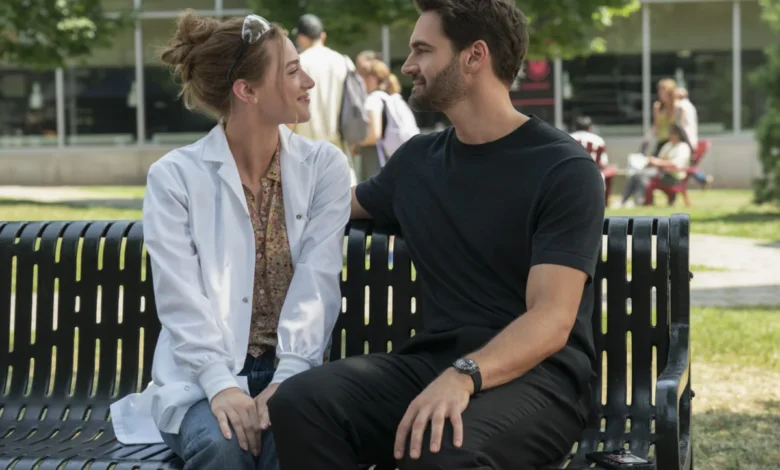
The film adaptation of Ali Hazelwood’s New York Times bestselling novel, The Love Hypothesis, which is now available on Prime Video, has ignited significant discourse regarding its portrayal of power dynamics within elite academic institutions. At its core, the narrative follows Olive Smith, a doctoral candidate at Stanford University portrayed by Lili Reinhart, whose decision to engage in a "fake dating" arrangement with a stern, notoriously difficult professor named Adam Carlsen—played by Adam Bateman—spirals into an exploration of vulnerability, consent, and the professional hazards inherent in STEM fields.
The Foundation of the Narrative: Friendship and Academic Pressure
The narrative catalyst for the film is a deceptively simple premise: Olive, hoping to alleviate the social pressure exerted by her friend Anh (Rachel Marsh), constructs a facade of a romantic life. However, the film quickly pivots from a lighthearted romantic comedy into a more serious investigation of systemic abuse. The "harebrained" scheme, as described by author Ali Hazelwood, serves as a backdrop to the more harrowing reality of Dr. Tom Benton (Arty Froushan), a colleague of Carlsen’s at Harvard.
Benton’s character represents a critical shift in the film’s tone. By leveraging his position of power to sexually harass Olive, Benton provides the central conflict that forces the protagonist to confront the realities of her environment. This segment of the film serves as a sobering reminder of the #MeToo era’s influence on storytelling, particularly within insular communities like academia, where professional advancement is often tethered to the approval of those in positions of authority.
Chronology of the Conflict
The tension in the third act of the film is not merely romantic; it is professional and existential. The timeline of these events begins with Olive’s pursuit of research opportunities in Boston.
- The Proposal: Tom Benton offers Olive a prestigious spot in his lab, contingent upon her compliance with his sexual advances. This occurs under the false pretense of professional mentorship.
- The Manipulation: Benton utilizes a hotel room encounter to further intimidate Olive, effectively weaponizing his status against her.
- The Public Confrontation: In an act of defiance, Dr. Adam Carlsen confronts Benton after learning of his behavior. The incident, which is captured on social media, serves as the public exposure necessary to break the cycle of silence.
- The Resolution: Following the viral exposure of Benton’s actions, the film reaches its climax, where the emotional barrier between Olive and Adam dissolves, leading to their mutual confession of feelings.
Analytical Perspectives on Power Dynamics
In discussions surrounding the film’s production, both Lili Reinhart and Adam Bateman emphasized the necessity of addressing abuse of power with gravity. Reinhart noted that for a character like Olive, who lacks a traditional family support system, the friendship with Anh functions as her only true safe space. The cathartic scene in which Olive reveals her assault to Anh is framed not just as a plot point, but as an essential moment of character liberation.
"When an abuse of power takes place, there’s no such thing as a winner," Adam Bateman stated regarding his character’s decision to intervene. "These things operate in the shadows. The only way that behavior like that is stopped is by bringing it into the light, despite the personal and professional risks involved."
From a critical standpoint, the film succeeds by utilizing the "science-themed" dialogue of the characters as a coping mechanism. By framing their confession of love through the language of "Type 1" and "Type 2" errors—scientific terms for false positives and false negatives—the characters maintain a sense of intellectual identity while navigating profound emotional vulnerability. This stylistic choice, while unconventional, serves to underscore the characters’ backgrounds as researchers who feel more comfortable analyzing their emotions through data than experiencing them through traditional romantic expression.
Industry Context and Market Impact
The adaptation of The Love Hypothesis arrives at a time when literary adaptations in the romance genre are seeing a significant surge in demand. According to industry data, the "BookTok" phenomenon—the community of readers on TikTok—has been a major driver for the acquisition of literary properties by streaming services. Ali Hazelwood’s work, known for its focus on women in STEM, fits into a growing trend of "niche" romances that prioritize professional ambition alongside personal growth.

The decision to diverge from the book in certain sequences, particularly the climactic lecture hall interruption, highlights the challenges of translating prose to the screen. Director and screenwriters had to navigate the "canon" expectations of a dedicated fanbase while ensuring that the cinematic experience provided the necessary tension for an audience that might not be familiar with the original source material.
Sociological Implications of the Plot
The portrayal of Dr. Tom Benton is indicative of a broader trend in contemporary cinema: the deconstruction of the "academic mentor" archetype. By highlighting how such figures can exploit the precarious nature of graduate student life—where students are often reliant on advisors for funding, references, and career placement—the film provides a poignant, albeit dramatized, look at the systemic issues present in higher education.
The use of social media as a plot device to expose misconduct is also a modern touchpoint. In the film, the digital footprint of the confrontation is what forces the institutional reality to catch up with the perpetrator. This reflects a real-world shift where public opinion and digital visibility often act as a faster mechanism for accountability than internal university grievance processes.
Critical Reception and Audience Engagement
The film has been praised for its refusal to treat the sexual harassment subplot as a mere "obstacle" to be brushed aside in favor of the romance. Instead, the narrative treats the trauma as a permanent shift in the protagonist’s outlook. The subsequent romantic reconciliation is earned, rather than granted, because it follows a moment of genuine, high-stakes personal risk.
Reinhart’s performance has been highlighted for its balance of professional anxiety and emotional growth. In interviews, she noted the difficulty of filming the final scenes, which were "massaged" and refined up until the day of production to ensure the dialogue remained true to the characters’ analytical nature.
Future Adaptations and the Hazelwood Universe
The success of this adaptation marks a significant milestone in the ongoing effort to bring Ali Hazelwood’s catalog to the screen. With other projects like Deep End in development, the industry is closely watching how these stories translate across platforms. The reliance on scientific metaphors, a hallmark of Hazelwood’s writing, provides a unique aesthetic signature that sets these films apart from the traditional "meet-cute" structure of standard romantic comedies.
As the film continues to reach a global audience on Prime Video, it serves as a case study in how genre fiction can effectively integrate social commentary without sacrificing the escapist qualities that audiences demand. By grounding the "fake dating" trope in the harsh realities of professional misconduct, The Love Hypothesis manages to elevate its source material into a contemporary commentary on what it means to find genuine connection in an environment that often demands total emotional detachment.
The film stands as a testament to the idea that the "experiment" of love, much like scientific research, is often subject to variables that cannot be controlled, predicted, or fully understood until the final, often messy, results are in. For Olive and Adam, the conclusion is not just that they have found each other, but that they have navigated the toxicity of their environment to arrive at a place of mutual respect and, ultimately, love.