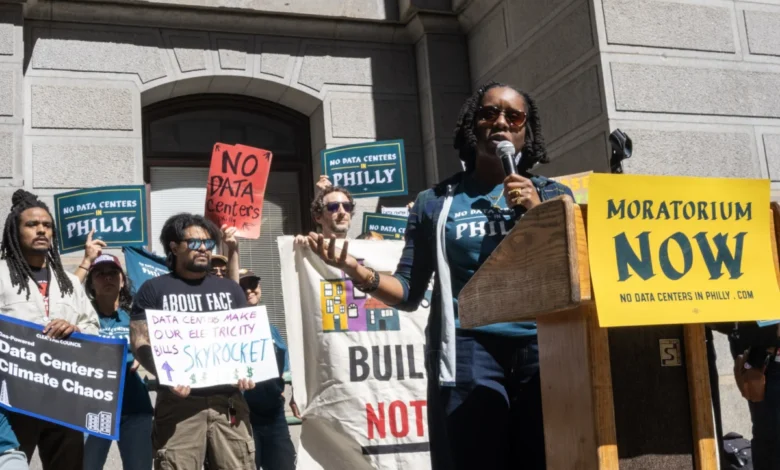
Across the United States, a growing tension is emerging between the rapid, power-intensive development of artificial intelligence infrastructure and the health, environmental, and resource concerns of local communities. As tech giants scramble to secure land and energy for massive AI data centers, a significant shift in public sentiment has taken hold. Recent polling data from Gallup indicates that a majority of Americans now oppose the construction of these facilities in their own neighborhoods, citing fears of environmental degradation, noise pollution, and the strain on local power grids. While proponents of the industry promise significant economic growth and job creation, this narrative is increasingly failing to resonate with residents who have historically borne the brunt of industrial expansion.
The Grays Ferry Experience and the Legacy of Industrialization
For Shawmar Pitts, a lifelong resident of the Grays Ferry neighborhood in Southwest Philadelphia, the debate over data centers is not an abstract exercise in technological progress; it is a matter of personal and community survival. Pitts grew up in the shadow of what was once the largest oil refinery on the East Coast. The facility, Philadelphia Energy Solutions, was a constant fixture in the lives of locals until a massive explosion in 2019 shuttered its operations for good.

For years, the community struggled with a high prevalence of chronic health conditions, yet the connection between their environment and their health remained obscured until 2018. It was then that the environmental justice organization Philly Thrive began conducting outreach in the neighborhood, presenting data that linked the refinery’s emissions to specific respiratory and chronic illnesses. For Pitts, the experience was a revelation. “I read the information they had on the table about how living near the refinery affects you, and I’m looking at all the sicknesses on this paper, and I’m like, ‘My mother has this, my sister has that, my next-door neighbor suffers from this’—every house, someone has something on that list,” Pitts recalled. This realization propelled him into a life of activism. Now serving as the managing co-director of Philly Thrive, Pitts is at the forefront of a campaign to prevent the encroachment of data centers in his city.
The Geography of Opposition: From Philadelphia to the Nation
While Philadelphia has not yet formally approved any data center construction, city planners have identified two potential locations for development: one in the northeast section of the city and another in the historically burdened Grays Ferry area. This has catalyzed a swift, organized response from residents who are wary of trading one form of industrial impact for another.
The opposition in Philadelphia is part of a much broader national trend. From Denver and Indianapolis to Asheville and Reno, city councils have been forced to implement moratoriums on new data center permits. These pauses, often lasting from several months to a year, are designed to allow local governments to conduct independent impact assessments, examine zoning laws, and address public anxiety regarding water usage and electricity demand. In New York, the movement reached the state level when Governor Kathy Hochul signed an executive order placing a temporary halt on new data center permits, emphasizing that progress should not come at the expense of local utility stability or environmental health.

The Energy Crisis: AI’s Voracious Appetite
The primary driver of this friction is the unprecedented energy requirement of the current AI boom. Data centers are not merely office buildings filled with servers; they are industrial-scale consumers of electricity and, in many cases, water for cooling. According to projections from BloombergNEF, the scale of this expansion is staggering: by 2035, U.S. data centers could consume more natural gas than the total combined consumption of Germany and Japan. This estimate, revised upward significantly in the last nine months, highlights the speed at which the industry is scaling.
The environmental implications of this growth are twofold. First, there is the immediate carbon footprint. While natural gas is often marketed as a "bridge fuel" that burns cleaner than coal or oil, its combustion still releases significant quantities of carbon dioxide. Estimates suggest that the added demand for data center power could lead to an increase in greenhouse gas emissions by an additional 1 million metric tons per day.
Second, there is the issue of grid reliability and emergency backup. As Annie Fox, an attorney for the Clean Air Council, noted during a recent rally in Philadelphia, many proposed data centers include hundreds of diesel generators. While these are ostensibly for emergency use, regulatory precedents suggest they may be tapped during peak load times to prevent grid failure. "We can expect that to get more frequent," Fox said. "Fossil fuel-hungry data centers will worsen climate change, making those heatwaves more frequent and severe."

The Human Cost: A Community’s Demand for Accountability
The personal stories emerging from these communities provide a stark counterpoint to the optimistic economic projections provided by developers. Sonya Sanders, president of the board at Philly Thrive, lost her husband to a rare form of bone cancer in 2020. Having lived in the vicinity of the refinery for decades, she attributes his illness directly to the chronic exposure to industrial pollutants. Her testimony at a recent rally outside Philadelphia’s City Hall underscored the sense of betrayal felt by residents who believe their health has been sacrificed for corporate profit. "The pollution killed him," she said. "I believe he would be here today if he wasn’t silently murdered, because it was the pursuit of profit that killed him."
This sentiment is echoed by residents like Donna Greenberg, who expressed concerns that extend beyond air quality to issues of privacy and resource allocation. "I’m worried about pollution," Greenberg stated. "I’m worried about surveillance and the fact that they’re going to have access to information they have no business knowing, and I’m concerned that they’re going to be using water and electricity that takes away from the people and the neighborhoods who need it."
Looking Ahead: The Path Toward Regulatory Reform
The "No Data Centers in Philly" campaign, which drew over 100 participants to its kick-off rally, serves as a bellwether for how cities across the country may handle similar proposals in the coming decade. The central argument of the activists is not necessarily that technology is inherently evil, but that the current model of rapid, unregulated expansion ignores the fundamental rights of local residents to clean air, stable power, and transparent land-use policies.

Analysts suggest that the next phase of this conflict will likely involve more rigorous environmental impact statements (EIS) and a push for legislative requirements that mandate data centers utilize renewable energy sources exclusively. However, transitioning the industry to green energy at the scale required to satisfy current AI projections remains a monumental challenge.
As city officials in Philadelphia and elsewhere weigh the economic incentives—such as tax revenue and potential high-tech employment—against the vocal opposition of their constituents, the debate continues to intensify. For now, the momentum lies with the grassroots movements, which are successfully forcing a pause in a sector that had previously expected a frictionless path to expansion. Whether these moratoriums lead to a fundamental change in how data centers are integrated into urban environments or merely delay the inevitable remains to be seen. What is clear, however, is that the era of "invisible" industrial expansion is coming to an end. Communities are increasingly informed, organized, and willing to challenge the industrial giants on their own terms.