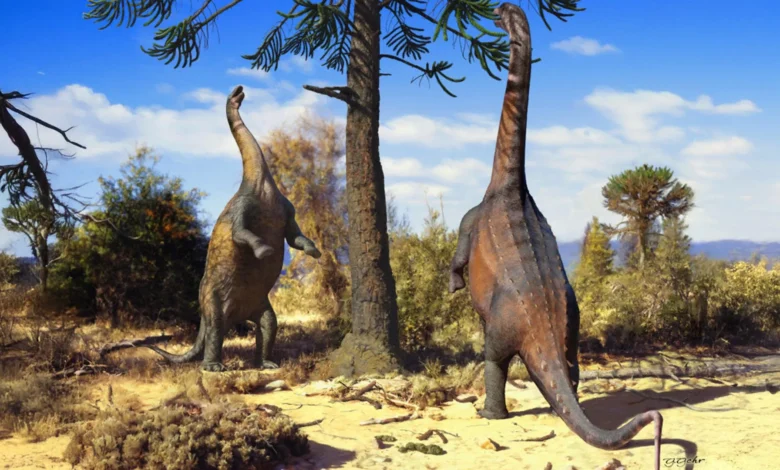
Sixty-six million years ago, during the twilight of the dinosaur era, two South American sauropods possessed an unexpected ability: the capacity to stand upright on their hind legs for extended periods. This revelation, unearthed through cutting-edge biomechanical simulations, challenges the conventional image of these long-necked herbivores as perpetually grounded behemoths. The study, focusing on Uberabatitan from Brazil and Neuquensaurus from Argentina, suggests that this bipedal stance was not merely a fleeting pose but a functional adaptation with significant evolutionary advantages, particularly for younger individuals.
Unveiling the Bipedal Potential of Mid-Sized Sauropods
The research, supported by the São Paulo Research Foundation (FAPESP) and published in the esteemed journal Palaeontology, utilized sophisticated engineering principles to analyze the skeletal structure of these ancient creatures. Unlike their colossal cousins, Uberabatitan and Neuquensaurus were of a more modest stature, comparable in size to modern elephants. However, even these "smaller" sauropods presented a formidable presence. Adult Uberabatitans, for instance, are estimated to have reached lengths of up to 26 meters, making them the largest known dinosaurs unearthed in Brazil, a testament to the rich paleontological heritage of South America.
The core of the investigation centered on understanding the biomechanical forces exerted on the femur, or thigh bone, when these dinosaurs shifted their weight onto their hind limbs. By employing computational methods akin to those used in civil engineering to test the structural integrity of bridges and buildings, scientists aimed to quantify the stress placed upon these crucial bones.
Dr. Julian Silva Júnior, a postdoctoral researcher at the School of Engineering of São Paulo State University (FEIS-UNESP) and the study’s lead author, elaborated on the findings. "Smaller sauropods like these had a bone and muscle structure that allowed them to stand more easily and for longer on their two hind legs," he stated. "Larger ones were probably also able to stand, but for a shorter time and with less comfort, since the position caused a lot of stress on the femur." This suggests a clear trade-off between size and bipedal endurance, with younger and less massive individuals enjoying a distinct advantage.
Engineering Ancient Skeletons: The Finite Element Analysis Approach
The research team meticulously reconstructed digital models of the femurs of seven distinct sauropod species. This selection represented a diverse range of evolutionary lineages, body sizes, and anatomical characteristics, drawing from fossil specimens housed in natural history museums across the globe. The chosen methodology, Finite Element Analysis (FEA), is a powerful tool in engineering that divides a complex structure into a multitude of smaller, interconnected elements. Each element’s response to various forces – such as pressure, weight, or heat – is then calculated, allowing for a comprehensive understanding of the overall structural behavior.
In this paleontological application, two primary simulation scenarios were devised. The first, an "extrinsic scenario," simulated the forces acting upon the femur from external factors, predominantly gravity and the dinosaur’s own body weight when it adopted a bipedal stance. The second, an "intrinsic scenario," analyzed the internal forces generated by muscle contractions acting upon the femur. By integrating the results of both simulations, the researchers were able to estimate the cumulative stress experienced by the femur in each sauropod species.
The most striking results emerged from the analysis of the two South American sauropods: a juvenile Uberabatitan ribeiroi and Neuquensaurus australis. These individuals, who roamed the Earth approximately 66 million years ago during the Late Cretaceous period, exhibited the lowest stress levels on their femurs when standing on their hind legs. This was attributed to their particularly robust femurs, characterized by thicker and sturdier bone structures capable of more effectively distributing the immense forces involved in bipedal locomotion.
The Evolutionary Advantages of Standing Tall
The ability to stand on two legs, even for limited durations, would have conferred significant evolutionary benefits upon these herbivores.
Reaching New Heights: Accessing Higher Vegetation
As obligate herbivores, sauropods relied on a constant supply of plant matter. Standing upright would have dramatically expanded their foraging range, allowing them to access nutrient-rich leaves and foliage high in the canopy that were inaccessible to their shorter quadrupedal counterparts. This dietary flexibility could have been crucial for survival, particularly during periods of resource scarcity.
A Display of Strength: Reproduction and Defense
The bipedal posture could also have played a vital role in reproductive strategies. For males, the ability to stand tall might have facilitated mounting females for mating or served as a visual display to attract potential mates, showcasing their physical prowess and fitness. Furthermore, in the face of predation, an upright stance would have made these animals appear significantly larger and more imposing, potentially deterring threats. By elevating the front of their bodies, they could project an image of greater size and dominance, a powerful defensive mechanism in a dangerous world.
When combined with the support of their tails, these sauropods could adopt a tripodal stance, utilizing three points of contact for enhanced stability. This tripartite support system would have been crucial for maintaining balance while standing tall, especially for larger individuals.
The Gradual Decline of Bipedalism with Age
A key finding of the study highlights a significant correlation between age and bipedal capability. The simulations indicated that younger individuals of Uberabatitan and Neuquensaurus were far more adept at supporting their weight on their hind legs. As these animals matured and their body mass increased, the biomechanical strain on their femurs would have escalated dramatically.
"The bigger ones had very large muscles and even giant femurs, but not enough to support their weight," explained the paleontologist. "That doesn’t mean they couldn’t stand up, but they probably chose the best time to do so, because it must have been an uncomfortable position." This suggests that while the physical capacity for bipedalism might have persisted in adult sauropods, the energetic cost and discomfort associated with maintaining such a pose would have limited its frequency and duration. It is plausible that adult Uberabatitan individuals, despite their robust skeletal structure, would have experienced stress levels comparable to other giant sauropods when attempting to stand upright for extended periods.
Contextualizing the Discovery: A Broader Paleontological Landscape
The discovery of bipedal capabilities in these South American sauropods adds a fascinating new dimension to our understanding of dinosaurian locomotion and behavior. For decades, the prevailing image of sauropods has been that of slow-moving, quadrupedal giants, their immense weight necessitating a constant four-legged gait. While this has largely held true for the truly colossal sauropods, such as Argentinosaurus or Brachiosaurus, this new research suggests a greater degree of postural flexibility within the sauropod family tree.
The Late Cretaceous period, the era in which these dinosaurs lived, was a time of significant ecological change. The rise of angiosperms (flowering plants) altered vegetation patterns, and competition for resources may have driven the evolution of diverse feeding strategies. The ability to reach higher food sources or to present a more intimidating profile to predators could have been critical adaptations in this dynamic environment.
The fossil record of Uberabatitan and Neuquensaurus provides valuable insights into the fauna of Gondwana, the supercontinent that comprised South America, Africa, Antarctica, Australia, and India during the Mesozoic Era. These findings contribute to a growing body of evidence that points to unique evolutionary pathways and adaptations developing on these isolated landmasses.
Limitations and Future Directions
The researchers acknowledge certain limitations inherent in their modeling approach. The simulations did not explicitly account for the role of cartilage, the flexible connective tissue that cushions joints and absorbs shock. The cushioning effect of cartilage could have further mitigated stress on the femur, potentially enhancing bipedal capacity. Similarly, the precise contribution of the tail as a stabilizing element in a tripodal stance was not fully modeled.
"Because cartilage was not analyzed in any of the seven specimens, the researchers assumed that it played a similar role across the species," the study notes. This assumption, while necessary for comparative analysis, means the findings are best interpreted as relative rather than absolute measures of bipedal capability for each individual animal.
Despite these limitations, the FEA methodology remains a powerful tool for comparative biomechanical studies. "The tool we use is very efficient for comparisons, even if the answer isn’t exact for each one," Dr. Silva Júnior concluded. "By comparing representatives from different lineages, we can get a fairly accurate picture of how these animals behaved millions of years ago."
The implications of this research extend beyond the specific species studied. It opens avenues for re-evaluating the locomotion and behavior of other medium-sized sauropods and encourages further investigation into the biomechanics of dinosaurian posture. Future research could incorporate more sophisticated modeling that includes soft tissues like cartilage and muscles, providing an even more nuanced understanding of these ancient giants and their remarkable adaptations. The ongoing quest to unravel the mysteries of prehistoric life continues to yield surprising insights, reminding us that the narrative of dinosaur evolution is far from complete.