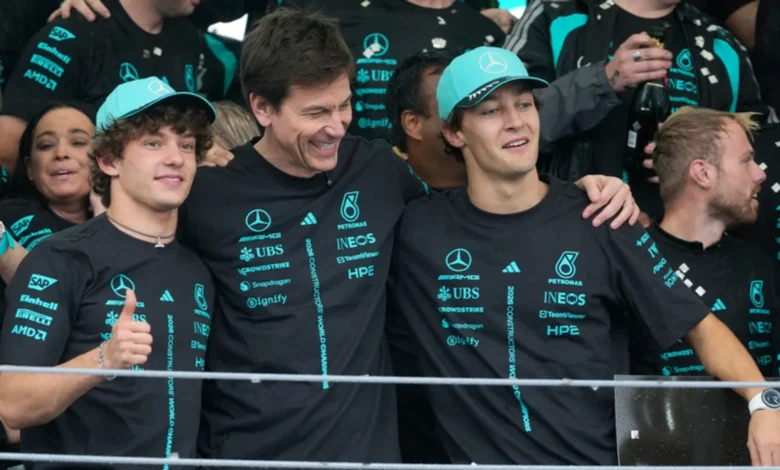
Mercedes has officially reclaimed its throne at the pinnacle of motorsport, securing the 2026 Formula 1 Constructors Championship at the Sao Paulo Grand Prix. The triumph marks the team’s ninth constructors’ crown, drawing them level with Williams in the sport’s historic hierarchy and bringing an emphatic end to a turbulent four-year rebuilding period. For Team Principal Toto Wolff, the milestone is not merely a technical achievement, but a testament to profound organizational resilience following the seismic regulation changes of 2022 that initially derailed the Brackley and Brixworth squads.
The journey back to the summit required navigating years of competitive obscurity, fluctuating technical understandings, and the departure of legendary figures. Yet, with a masterclass in adaptation to the new 2026 aerodynamic and power unit regulations, Mercedes has completed a remarkable sporting resurrection. Having already locked up the Drivers Championship earlier in the month with rising star Kimi Antonelli, the Silver Arrows have successfully reasserted their dominance across both primary Formula 1 championships.
The Anatomy of a Modern Motorsport Resurgence
The roots of Mercedes’ current triumph stretch back to the tectonic regulatory shift of 2022, which introduced ground-effect aerodynamics to Formula 1. For an organization accustomed to an unprecedented streak of eight consecutive constructors’ championships between 2014 and 2021, the new era began as a nightmare. The team’s initial concept, notably characterized by the "zeropod" design philosophy introduced in 2022, fundamentally failed to unlock the expected performance window. Porpoising, unstable rear platforms, and a persistent lack of correlation between factory wind tunnel data and on-track behavior plagued the W13 and its successors.
During the lean years from 2022 through 2025, Mercedes slipped from dominant front-runners to regular contenders for podiums and occasional race victories. While drivers Lewis Hamilton and George Russell managed to extract seven Grand Prix victories out of the struggling machinery during this period, the sheer numbers masked deep internal struggles. Finishing second, third, and fourth in the constructors’ standings represented a steep fall from grace for a team built on winning culture.
Reflecting on the psychological and operational toll of these years, Toto Wolff emphasized that the turnaround was forged in adversity. The team was forced to unlearn old habits, discard cherished engineering philosophies, and completely restructure its aerodynamic departments. The transition required grueling self-assessment, with engineers and aerodynamicists oscillating between false breakthroughs and stark realizations that fundamental assumptions about the car were flawed.
The Sao Paulo Grand Prix: Securing the Crown in Chaos
The coronation at Interlagos was far from a straightforward procession. The Sao Paulo Grand Prix delivered classic Brazilian weather dynamics, plunging the field into treacherous mixed-grip conditions that favored adaptability over raw pace. Lando Norris capitalized expertly on the shifting track states to dominate the race for McLaren, neutralizing any potential celebrations from the front of the podium.
For Mercedes, Sunday afternoon proved to be a nervous exercise in damage limitation rather than a celebratory victory lap. Both George Russell and rookie sensation Kimi Antonelli suffered costly spins during the Grand Prix as they wrestled with the unpredictable asphalt and spray. Nevertheless, defensive driving and relentless execution ensured that Russell crossed the line in fourth place, closely followed by Antonelli in fifth.
The points haul proved sufficient to mathematically seal the constructors’ title with races to spare, cementing an extraordinary campaign. Speaking to the media after the race, Russell admitted that the team would have preferred to clinch the championship with a commanding 1-2 finish on the podium, but acknowledged the profound significance of the broader achievement. Having joined the squad at the onset of their difficult transition in 2022, Russell noted that navigating the arduous journey back to the top made the ultimate victory all the sweeter.
A Tribute to the 2,500 Superstars Behind the Scenes
While modern Formula 1 broadcasting naturally focuses heavily on the drivers and the prominent team principals standing on the pit wall, Wolff was quick to redirect the spotlight toward the vast workforce operating behind the scenes. He frequently stresses that modern Formula 1 is an engineering war fought by thousands of dedicated specialists rather than an isolated battle between elite drivers.
Mercedes operates across two primary, highly integrated UK facilities: the chassis and aerodynamic hub in Brackley and the high-performance powertrain division in Brixworth. Together, these campuses house approximately 2,500 employees whose relentless efforts underpin every lap turned on the world stage. Wolff noted that while drivers and team bosses absorb the immediate glare of television cameras, the true architects of a championship are the fabricators, simulation engineers, software developers, and mechanics who worked tirelessly through the bleakest moments of the ground-effect era.
This sentiment was echoed by Kimi Antonelli, who secured the 2026 Drivers Championship earlier in November. The young Italian phenom, thrust into the pressure cooker of a top-tier Mercedes seat, praised the unyielding commitment of the engineering teams. Antonelli emphasized that the immense daily pressure faced by the factories to deliver performance upgrades ultimately created the winning platform that allowed both him and Russell to fight for victories throughout the 2026 season.
Historical Context and Elite Company
By claiming its ninth constructors’ championship, Mercedes has cemented its status as one of the most successful dynasties in the history of Formula 1. The team now stands alongside Williams on nine titles, trailing only McLaren, which holds 10 constructors’ championships, and the undisputed historical leader, Scuderia Ferrari, with 16 titles.
What sets the latest Mercedes triumph apart, however, is the velocity of the recovery. Historically, dominant sports dynasties that suffer a prolonged slump often require a decade or a complete corporate overhaul to return to winning ways. Teams that fall behind the technological curve in Formula 1 frequently become trapped in a downward spiral of lost personnel, reduced sponsorship revenue, and compounding aerodynamic disadvantages under aerodynamic testing restriction (ATR) sliding scales.
By bucking this trend and bouncing back within a single major regulatory cycle—transitioning from the ground-effect era difficulties to mastering the new 2026 technical regulations—Mercedes has entered an exclusive club of sporting organizations capable of immediate self-correction. Wolff noted that very few teams across any global sport have managed to sustain a multi-year championship dynasty, endure a severe competitive trough, and successfully rebuild a championship-winning machine in such a short window.
Strategic Implications and Future Outlook
The immediate impact of the 2026 double championship extends far beyond the gleaming trophies deposited in the Brackley cabinet. Winning the first season of a completely new technical regulation set provides immense momentum as Formula 1 enters a stable development phase. The 2026 regulations fundamentally restructured power unit architectures—introducing a 50-50 power split between internal combustion engines and advanced electrical energy deployment—alongside active aerodynamic elements.
Mercedes’ powertrain division in Brixworth successfully navigated the complex challenge of balancing electrification demands with sustainable fuels, setting the benchmark for rival manufacturers such as Ferrari, Red Bull Ford, and Audi. This technical superiority on the power unit side, combined with a rectified aerodynamic understanding, ensures that the Silver Arrows enter the subsequent development cycles from a position of profound strength.
Furthermore, securing both world championships stabilizes the team’s commercial ecosystem, solidifying key partnerships and ensuring maximum financial distributions under the Concorde Agreement framework. With Antonelli maturing rapidly into a formidable championship-winning leader on track, and Russell providing veteran consistency and speed, Mercedes possesses a formidable driver lineup engineered for the long term.
As the Formula 1 paddock packs its equipment and departs South America, the circus immediately sets its sights on the next high-stakes spectacle. The championship trail heads across the globe to the neon-lit expanse of the Las Vegas Strip for the Las Vegas Grand Prix, scheduled from November 20-22. While the championship battles for both constructors and drivers have found their definitive resolutions, the final rounds of the 2026 season promise intense battles for remaining positions down the constructor standings, all broadcast live on Sky Sports F1.