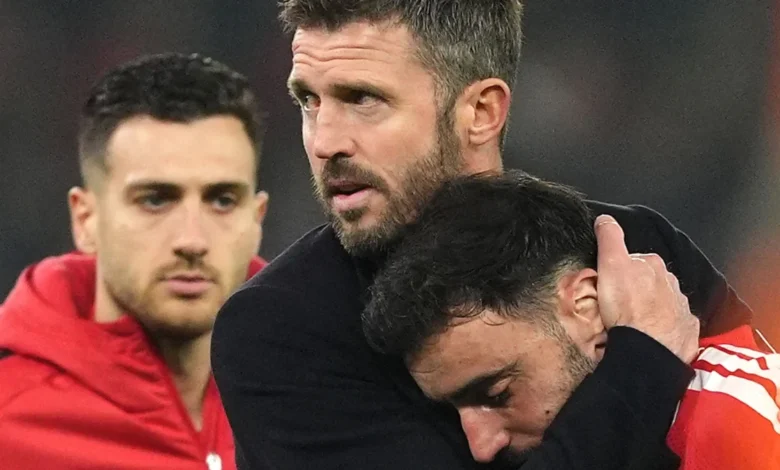
Manchester United find themselves engulfed in a profound and unprecedented sporting crisis following a chaotic 4-4 draw against Aston Villa at Old Trafford, a result that plunges the 20-time English champions into the Premier League relegation zone. Under-fire manager Michael Carrick has insisted that he fully expects to retain his position despite an alarming run of form that has left the club sitting third-bottom of the table after ten matches.
The dramatic encounter saw United rescue an unlikely point courtesy of two goals in stoppage time, but the defensive frailties and tactical disarray on display overshadowed the late heroics. With only ten games played in the 2025/26 Premier League campaign, United have accumulated a meager haul of points that leaves them one point adrift of safety. The club’s 18th-place position marks their worst start to a top-flight season since the 1986/87 campaign, when they languished in 20th place prior to the appointment of Sir Alex Ferguson. Furthermore, the stalemate against Aston Villa extends Manchester United’s winless run in the league to eight matches, setting an unwanted club record in the Premier League era and raising serious questions about the direction of the institution heading into the November international break.
The Chronology of a Collapse
The descent into the relegation zone has been gradual yet agonizing for the Old Trafford faithful, characterized by a staggering inability to close out matches, porous defensive structures, and a complete loss of tactical identity. Carrick, who stepped into the managerial hotseat amidst high expectations of stabilizing the club, has overseen a catastrophic tailspin that began in late August.
Following a mixed opening to the season, United’s campaign completely unraveled during a grueling autumn fixture list. Successive defeats against mid-table opponents exposed deep-seated vulnerabilities in transition, while heavy losses to traditional rivals further eroded player confidence. The defensive unit, once the bedrock of the club’s historic successes, has disintegrated into a liability, conceding goals at an alarming rate.
The match against Aston Villa served as a microcosm of United’s entire season. Dominant in patches and creating numerous opportunities through enterprising attacking play, the team repeatedly surrendered their advantage due to elementary defensive errors and a lack of game management. Trailing late in the game, the home side showed admirable resilience to salvage a 4-4 draw through two frantic injury-time strikes, sparking chaotic scenes of relief and disbelief across the stands. However, the emotional celebrations at the final whistle could not mask the grim reality of the club’s league standing. While sections of the fanbase offered supportive applause to Carrick as he walked off the pitch, the overarching sentiment among analysts and former players is that a draw against Villa at home—while thrilling as a spectacle—highlights a catastrophic regression for a club of Manchester United’s stature.
A Tetchy Exchange and Defiant Stance
In the immediate aftermath of the match, Carrick found himself locked in a confrontational and tetchy television interview with Sky Sports broadcaster Patrick Davison. When pressed on whether he anticipated losing his job during the forthcoming two-week international break, the Manchester United manager offered a defiant and dismissive response.
When Davison suggested that conversations regarding his future were inevitable given the circumstances, Carrick pushed back sharply, questioning the premise of the inquiry. Refusing to entertain the notion of resignation or dismissal, Carrick maintained that his primary focus remains on correcting the team’s glaring defensive mistakes while building upon the positive aspects of their attacking display against Villa.
Addressing the media in his formal post-match press conference, Carrick doubled down on his belief in the squad’s capability to reverse their fortunes. "One hundred per cent," Carrick replied when asked if he believed the current group of players had enough quality to climb out of the relegation zone. "I think there’s more than enough. Goals change games and we’ve got to deal with it and it’s something we have to improve on drastically. But there’s more than enough, we’re just making it too difficult for ourselves at the moment in certain times."
Carrick emphasized that the fundamental issue lies within both penalty boxes, arguing that his side’s overall performance merited a victory had it not been for "totally avoidable goals." Despite the mounting pressure and the unprecedented statistical reality of United’s league position, the manager insisted he remains clear-eyed about the required trajectory of the football club, though he acknowledged that the ultimate currency of the profession is simply winning matches.
Scathing Assessments from Club Icons
Carrick’s defiant stance and cautious optimism have done little to appease the club’s legends and external pundits, who have launched scathing critiques not only of the coaching staff and players, but fundamentally of the ownership and executive leadership.
Speaking as a pundit for NBC, former Manchester United captain Gary Neville delivered a blistering assessment of the club’s institutional rot, arguing that the constant revolving door of managers has masked deeper structural failures. Neville pointed out that the current crisis transcends Carrick’s tenure, noting that the club has cycled through eight permanent and interim managers over the past twelve years—including world-class tacticians and club legends—without finding a sustainable solution.
"You can keep changing the manager and thinking that’s going to be the answer," Neville stated. "But this has been proven now over eight managers in 12 years—that’s not the answer. Michael could leave, Michael might stay, we don’t know. The ownership don’t have a clue what to do. It’s rinse and repeat. Ruben Amorim, Erik ten Hag, Ole Gunnar Solskjaer, Carrick, Jose Mourinho, Louis van Gaal, David Moyes, Ralf Rangnick… None of it has worked because if you recruit badly, if you’ve got a poor performance department, a poor recruitment department, you’ve not got leadership that is strong right through the spine of the football club, you will fail."
Neville argued that organizational failure is inevitable when leadership lacks alignment from the board level down to the players on the pitch, highlighting a dangerous trend of employing inexperienced personnel in crucial senior operational roles.
Echoing Neville’s concerns, fellow Sky Sports pundit Roy Keane launched a blistering critique of Carrick’s demeanor and the psychological softness embedded within the current United dressing room. Keane likened Carrick’s diplomatic media persona to that of a politician, expressing disbelief at the manager’s casual approach to a historic crisis.
"It’s obviously difficult for the manager, under pressure, no doubt. He talks a lot but doesn’t say much. I don’t know if that’s a tactic. Like a politician," Keane remarked. "He keeps saying we need to tighten up and there’s things we need to work on, but they better get moving on that. It’s the worst start in how many years? All these stats aren’t very good. If you keep giving up goals and chances, it’s just going to continue."
Keane contrasted Carrick’s measured, calm public persona with the ferocious standards of leadership required to rescue a sinking ship, questioning whether the current squad possesses the requisite mental fortitude to navigate the brutal fixtures ahead. Pointing toward an impending match against Liverpool following the international break, Keane warned that United’s defensive fragility would be ruthlessly exposed by higher-caliber opposition, noting a glaring absence of on-field leaders willing to demand accountability from one another.
Broader Impact and Strategic Implications
The implications of Manchester United’s current predicament extend far beyond sporting embarrassment; they threaten the club’s financial stability, commercial appeal, and long-term strategic planning. A prolonged battle against relegation would drastically alter the club’s revenue streams, impacting broadcasting income, commercial partnerships, and matchday revenues while severely hindering their ability to attract elite global talent in future transfer windows.
The stark reality of sitting 18th in the Premier League table after ten matches forces the club hierarchy into a delicate and consequential dilemma during the November international break. Retaining Carrick offers continuity but risks alienating a fanbase that is growing increasingly hostile toward the club’s administrative direction, whereas dismissing another manager deepens the perception of institutional instability.
As the squad disperses for international duty, the Old Trafford leadership faces an intense period of internal reflection. Whether the club chooses to double down on Carrick’s project or execute yet another managerial upheaval, the fundamental diagnosis offered by club legends rings loud and clear: until structural alignment, elite recruitment, and rigorous accountability are established from the very top of the organization down to the pitch, Manchester United will remain trapped in a recurring cycle of underachievement.