Walmart Cancels Inventory Tracking Robots: A Strategic Shift or a Costly Misstep?
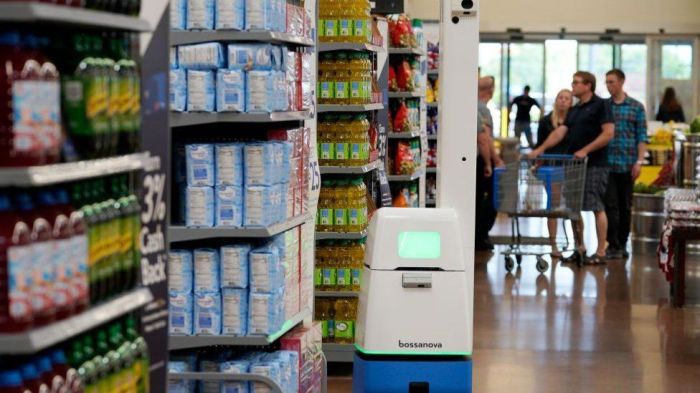
Walmart’s decision to scale back its ambitious deployment of inventory tracking robots, primarily the Bossa Nova Robotics-developed autonomous mobile robots (AMRs), marks a significant pivot in the retail giant’s technology strategy. This move, signaled by the cessation of robot deployment in all but a few pilot locations and reports of the robots being repossessed by the vendor, has sparked considerable debate within the retail and technology sectors. Is this a pragmatic recalibration of resources, a concession to the limitations of current AI and robotics in a complex retail environment, or a potentially missed opportunity to leverage cutting-edge technology for improved operational efficiency and customer satisfaction? Understanding the nuances of this decision requires an examination of the robots’ purported benefits, the challenges encountered during their implementation, and Walmart’s broader strategic objectives.
The allure of inventory tracking robots stemmed from their promise to revolutionize retail operations, particularly in a high-volume, high-SKU environment like Walmart. Bossa Nova’s robots were designed to autonomously navigate store aisles, scanning shelves to identify misplaced items, out-of-stock products, and discrepancies between the physical inventory and the digital record. The theoretical advantages were substantial. Real-time inventory data is the bedrock of efficient retail. Inaccurate stock counts lead to a cascade of problems, including lost sales due to empty shelves, increased labor costs associated with manual inventory checks, and diminished customer trust when promised items are unavailable. Robots, in theory, could address these issues with unparalleled speed and accuracy, freeing up human associates to focus on customer-facing tasks, such as assisting shoppers, stocking shelves, and managing online order fulfillment.
The core functionality of these robots revolved around computer vision and artificial intelligence. Equipped with a suite of cameras and sensors, they were programmed to recognize product barcodes, compare shelf facings to expected layouts, and identify anomalies. The data collected was then fed into Walmart’s inventory management systems, theoretically providing a constantly updated and highly accurate picture of what was on the shelves. This real-time visibility was expected to enable proactive restocking, reduce the need for disruptive full-store inventory counts, and ultimately improve the shopping experience by ensuring product availability. Furthermore, the robots were envisioned as a way to gather valuable data on shopper behavior and store layout, informing future merchandising and operational decisions.
However, the path from pilot program to widespread deployment proved to be fraught with challenges, many of which are endemic to the complexities of large-scale retail environments and the current state of AI and robotics. One of the primary hurdles was the sheer messiness of a typical Walmart store. Unlike controlled laboratory settings, store aisles are dynamic and unpredictable. Shelves are often overstocked or understocked, items can be out of place due to customer browsing or employee stocking, and the sheer variety of products, packaging, and display methods presents a significant challenge for even advanced computer vision systems. The robots struggled with identifying damaged products, distinguishing between similar items with subtle packaging differences, and navigating cluttered aisles, especially during peak shopping hours.
Another significant factor was the cost-effectiveness and return on investment (ROI). While the initial promise of labor savings and increased sales was compelling, the actual cost of procuring, deploying, maintaining, and integrating a fleet of thousands of robots across a vast retail network likely proved to be substantial. The return on that investment, in terms of measurable improvements in inventory accuracy and associated cost reductions, may not have materialized as quickly or as significantly as anticipated. The cost of developing and refining the AI models to handle the diverse and dynamic retail environment also represented a considerable ongoing expense. Moreover, the integration of robot-generated data into existing, often legacy, inventory management systems presented technical complexities and required significant IT investment and personnel.
The human element also played a crucial role. While the robots were intended to augment human labor, their presence also required adaptation and training for store associates. There were concerns about the impact on jobs, although Walmart consistently maintained that the robots were designed to free up associates for more value-added tasks. However, the practical implementation of this vision requires careful management of change, effective communication, and seamless collaboration between humans and machines. It’s possible that the integration of robots into the daily workflow of store associates was not as smooth as envisioned, leading to inefficiencies or resistance.
Walmart’s decision to pull back on Bossa Nova robots can also be seen as a reflection of its evolving strategic priorities. The retail landscape is in constant flux, and Walmart is a company that has historically been adept at adapting to change. The surge in e-commerce, the increasing demand for same-day delivery and curbside pickup, and the need for more agile and responsive supply chains have likely shifted the focus of its technological investments. Resources that might have been allocated to extensive robot deployment could now be redirected towards areas perceived as having a more immediate and impactful return, such as enhancing its e-commerce fulfillment capabilities, optimizing its supply chain logistics, or developing new customer-facing technologies.
The ongoing investment in other automation technologies and strategies at Walmart suggests that this is not a wholesale rejection of robotics or AI, but rather a strategic pruning. Walmart continues to explore and implement automation in its distribution centers, where the environment is more controlled and the benefits of robotics for tasks like sorting and picking are more readily apparent. The company has also invested in in-store automation for other purposes, such as shelf-scanning devices and automated cleaning machines, indicating a continued belief in the potential of technology to improve operations. Therefore, the cancellation of the Bossa Nova inventory robots might be best understood as a reassessment of which specific technologies offer the most compelling value proposition within the complex and ever-changing ecosystem of a brick-and-mortar retail giant.
Furthermore, the retail industry is undergoing a significant transformation driven by data analytics. The ability to collect, analyze, and act upon vast amounts of data is becoming increasingly critical. While the robots were intended to generate data, it’s possible that Walmart found more efficient or effective ways to gather similar or even more comprehensive inventory-related data through other means, such as advanced RFID technology, improved point-of-sale systems, or sophisticated demand forecasting algorithms. The ability to leverage AI and machine learning for predictive analytics, rather than purely for real-time scanning, might be seen as a more strategic long-term investment.
The market for retail robotics is still relatively nascent and evolving rapidly. Companies like Bossa Nova, while pioneering, may have faced challenges in scaling their technology to meet the demands of a retailer the size of Walmart. The cost of developing AI that can reliably distinguish between thousands of unique SKUs in a dynamic environment is immense, and the economic viability of such solutions for widespread retail deployment is still being proven. Walmart’s decision could also be a signal to the broader robotics industry that the current generation of inventory-tracking robots, at least as implemented, did not meet the rigorous performance and economic benchmarks required for such a massive rollout.
Looking ahead, Walmart’s decision does not signal the end of automation in retail. Instead, it highlights the critical importance of carefully evaluating the specific use case, the maturity of the technology, and the potential ROI before committing to large-scale deployments. The focus may shift from broad-stroke inventory scanning to more targeted applications of robotics and AI that address specific pain points with a clearer path to profitability. This could include robots for specialized tasks within distribution centers or for highly controlled environments within stores, such as automated click-and-collect order picking or advanced sorting mechanisms.
The lessons learned from Walmart’s experience with Bossa Nova are valuable for the entire retail sector. It underscores the need for robust pilot programs that accurately simulate real-world conditions, thorough cost-benefit analyses, and a deep understanding of how new technologies will integrate with existing operational processes and human workforces. The pursuit of technological innovation in retail must be balanced with pragmatism, ensuring that investments deliver tangible improvements in efficiency, customer experience, and profitability. The future of retail automation will likely involve a more nuanced and strategic approach, focusing on solutions that are proven, scalable, and demonstrably capable of driving value in the complex and dynamic world of commerce. Walmart’s strategic recalibration, while potentially disappointing for proponents of autonomous inventory tracking, is a pragmatic response to the evolving realities of the retail industry and a testament to the company’s ongoing commitment to leveraging technology to optimize its vast operations.

