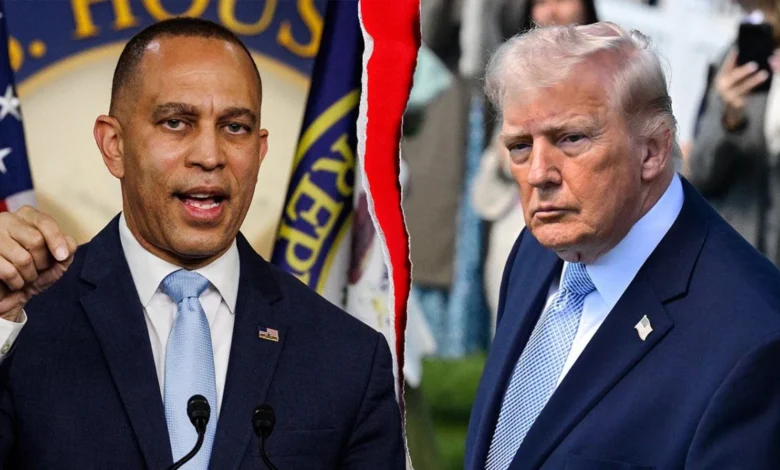
In a high-stakes legislative maneuver that underscored the deepening ideological fissures within the Democratic Party, Rep. Al Green, D-Texas, forced a floor vote on Tuesday aimed at impeaching President Donald Trump. The resolution, centered on the controversial deaths of two U.S. citizens at the hands of federal immigration officials earlier this year, sparked a procedural showdown that saw dozens of House Democrats join Republicans to effectively quash the measure.
The House of Representatives voted 232 to 147 to table the resolution, a strategic parliamentary device used to dispose of a motion without requiring members to cast an up-or-down vote on the substance of the impeachment articles themselves. The tally revealed a splintered caucus: 18 Democrats voted alongside the Republican majority to kill the motion, while 46 members, including House Minority Leader Hakeem Jeffries, opted to vote "present." Nearly 150 Democrats supported a direct path to an impeachment vote, highlighting the persistent tension between the party’s progressive base and its institutional leadership.
A Chronology of Confrontation
This latest push by Rep. Green marks the second time in recent months that the Texas congressman has bypassed party leadership to force the chamber’s hand. In June 2025, Green introduced a similar resolution that met a similar fate, with 128 Democrats siding with Republicans to table the measure.
For Green, who was recently unseated in a primary election amid a broader shift in the Democratic electorate, the resolution represents a final legislative crusade. Throughout his tenure, Green has argued that the constitutional duty to hold the executive branch accountable transcends political expediency. However, for the broader House Democratic caucus, the move is viewed as a distraction that threatens to derail their electoral strategy heading into the November midterms.
The timeline of these efforts suggests a persistent, albeit minority, sentiment within the party that the traditional, committee-led impeachment process is too slow or too susceptible to partisan obstruction. By forcing a vote on the floor, proponents like Green aim to compel members to place their names on the record regarding the President’s fitness for office.
The Political Tightrope
The procedural vote on Tuesday presented a significant dilemma for Democratic lawmakers, who are currently navigating a challenging political landscape. Party leadership, spearheaded by Hakeem Jeffries, has maintained that the path to reclaiming the House majority requires a laser-like focus on economic concerns—specifically the rising cost of living, healthcare affordability, and domestic stability.
By engaging in a floor fight over impeachment, the party risks alienating moderate and independent voters who may perceive the effort as a continuation of political theater. Conversely, failing to address the demands of the progressive wing risks suppressing voter turnout in key urban districts where the demand for impeachment remains high.
"Impeachment is a profound constitutional remedy that traditionally requires a comprehensive investigative process," Jeffries stated in a formal release following the vote. "It demands the collection and review of thousands of documents, an exacting scrutiny of the facts, the examination of dozens of key witnesses, and the marshaling of the forces of democracy to build a broad national consensus."
Jeffries and his deputies argued that the current resolution lacked the necessary foundation for such a momentous action, framing the Republican majority as a body "focused solely on rubber-stamping Donald Trump’s extreme agenda." They reaffirmed their commitment to utilizing more traditional oversight tools once the legislative session pivots toward more substantive investigations.
Data and Legislative Precedent
The vote count itself provides a window into the current state of congressional politics. The 147 votes in favor of proceeding with an impeachment debate reflect a significant base of support that persists despite the lack of institutional backing. However, the 18 Democrats who joined the Republican "table" motion represent a critical bloc of moderate members who are acutely aware of the electoral risks associated with aggressive impeachment efforts in a swing-district environment.
Historical precedent for impeachment remains a contentious point of discussion. The U.S. Constitution provides for impeachment in cases of "Treason, Bribery, or other high Crimes and Misdemeanors." While proponents argue the executive actions regarding immigration policies fall under this mandate, opponents—and even skeptical constitutional scholars—argue that such actions, however controversial, fall within the scope of executive branch discretion and are better adjudicated through the court system or at the ballot box.
The Internal Democratic Rebellion
The friction between Rep. Green and the House leadership is emblematic of a broader "rebellion" that has surfaced within the Democratic ranks. As the party grapples with its post-2025 identity, the influence of legacy establishment figures is being challenged by a more assertive, grassroots-oriented faction.
During his comments to reporters, Green expressed profound frustration with the "wait and see" approach adopted by his colleagues. "The Constitution doesn’t have a wait clause in it," Green asserted. "I believe that there are some Republicans and Democrats who are considering voting to protect the president. If they’re not considering protecting him, that will be the effect of what they will do when they vote to either table or they vote to send this to a committee for further investigation."
This rhetoric has resonated with segments of the base that feel the party has become too risk-averse. However, it has also provided fuel for Republican critics, who have consistently characterized these attempts as evidence of a party driven by ideological extremes rather than governance.
Broader Implications and Future Outlook
The defeat of the resolution is unlikely to be the end of the conversation regarding presidential accountability. As the November midterms approach, both parties are refining their messaging strategies. For Republicans, the impeachment attempts serve as a potent mobilization tool, allowing them to frame the Democratic caucus as obsessed with "political revenge" rather than "everyday issues."
For Democrats, the challenge remains to strike a balance between their core constituents’ demands for accountability and the moderate voters’ need for economic relief. The "present" vote, while a convenient procedural exit, may prove to be a liability if the issue continues to resurface.
Analysts suggest that the frequent forced votes are a symptom of a legislative body in transition. With the departure of vocal figures like Rep. Green, the dynamic of the House may shift, yet the underlying causes of these clashes—fundamental disagreements over the limits of executive power and the proper use of the impeachment mechanism—remain unresolved.
As the 2026 election cycle intensifies, the House will likely continue to face these internal pressures. The question for the electorate will be whether they view these attempts at impeachment as a necessary check on executive authority or as a misuse of the constitutional process. For now, the status quo holds, but the fractures exposed by Tuesday’s vote indicate that the path to November will be defined by more than just economic policy; it will be a contest over the soul and the process of American governance.
In the immediate term, the House is expected to return to its scheduled agenda, though the echoes of Tuesday’s floor drama will surely color the tone of debates in the coming weeks. Whether this latest effort by Rep. Green will be viewed as a principled stand or a tactical error remains a subject of intense debate, but the impact on the unity of the Democratic caucus is already clear: the path to the midterms is far from a settled road.