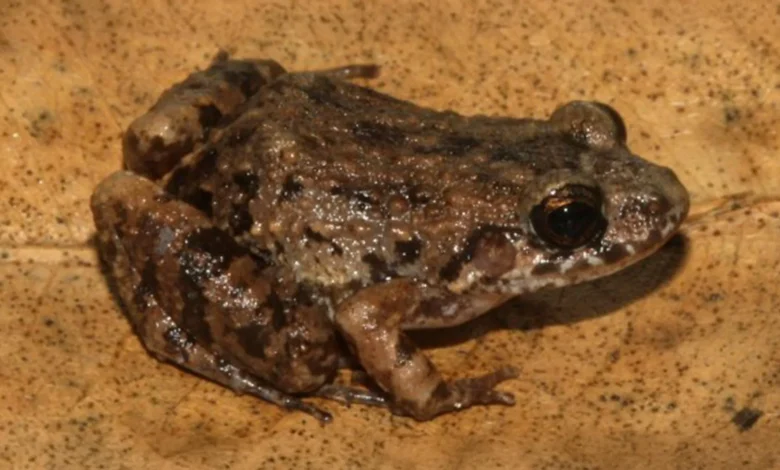
Deep within the seasonally inundated forests of the western Amazon basin, scientists have officially documented a previously unknown amphibian species, Adenomera varcena. Published in the peer-reviewed journal Ichthyology & Herpetology, this discovery adds a vital puzzle piece to the broader understanding of Neotropical biodiversity. The newly identified frog was discovered through a rigorous combination of integrative taxonomy—utilizing DNA barcoding, acoustic monitoring of distinct mating calls, high-resolution morphological comparisons, and museum collections.
The research was spearheaded by an international collaborative team, prominently featuring Célio F. B. Haddad, a professor at São Paulo State University (UNESP), and Thiago R. Carvalho, a professor at the Federal University of Minas Gerais (UFMG). Both scientists are affiliated with the Center for Research on Biodiversity Dynamics and Climate Change (CBioClima), a Research, Innovation, and Dissemination Center (RIDC) financially supported by FAPESP. The broader project also integrated researchers from the University of São Paulo (USP), the Federal University of Uberlândia (UFU), and the Pontifical Catholic University of Ecuador (PUCE-Quito).
This breakthrough underscores a growing phenomenon in contemporary biology known as cryptic diversity. In such cases, distinct evolutionary lineages maintain nearly identical outward appearances, making them virtually indistinguishable to the naked eye. By peeling back layers of genetic and acoustic data, the research team has not only introduced a new taxon to science but also revealed critical insights into how Amazonian fauna adapt to extreme environmental niches.
Chronology of the Discovery: From the Upper Juruá to the Laboratory
The journey to identifying Adenomera varcena spans several years of rigorous field expeditions and laboratory analysis. The primary geographical focal point for the discovery lies in the Upper Juruá River region of western Acre, Brazil. During targeted herpetological surveys, researchers scoured remote forest fragments near the Moa and Crôa rivers, situated close to the municipality of Cruzeiro do Sul.
Historically, discovering a new vertebrate species required primarily morphological evaluation—measuring bone structures, examining skin textures, and counting scale or tubercle patterns. However, the scientific framework deployed for Adenomera varcena reflects modern standards of integrative taxonomy.
Following the initial collection of field specimens, the chronology of the discovery advanced into the laboratory phase. Researchers extracted DNA to sequence mitochondrial and nuclear markers, enabling phylogenetic comparisons against known relatives within the genus Adenomera. Simultaneously, acoustic engineers and biologists analyzed audio recordings of the male mating calls captured in the wild. By cross-referencing these acoustic signatures with morphological metrics, habitat data, and historical museum archives, the team confirmed that the specimens represented a distinct, undescribed species.
The species epithet varcena was purposefully chosen to honor the unique ecosystem the frog inhabits. Derived from the Portuguese term várzea, it refers specifically to Amazonian floodplain forests that undergo regular seasonal inundation.
Expanding the Ecological Boundaries of the Genus Adenomera
The habitat of Adenomera varcena represents one of the most compelling aspects of the discovery. Until now, amphibians belonging to the genus Adenomera were predominantly documented in terra firme or dryland forests—ecosystems that remain well above the high-water marks of seasonal river flooding.
Finding a member of this diverse genus thriving in seasonally flooded forests upends conventional ecological assumptions regarding the adaptability and historical distribution of Adenomera. Seasonally flooded forests present harsh environmental filters. During the high-water season, vast tracts of forest floor are submerged for months at a time, forcing terrestrial organisms to either adapt amphibious strategies, seek elevated refuges, or restrict their life-history cycles to predictable hydrological windows.
The presence of Adenomera varcena in the várzea ecosystems of Acre suggests that the evolutionary history of the genus is more ecologically diverse than previously recognized. It indicates that certain lineages have successfully colonized and adapted to dynamic, water-stressed environments, expanding their ecological niche well beyond the confines of stable dryland forests.
Morphological and Acoustic Distinction: The Hidden Markers
Because Adenomera varcena is a product of cryptic diversity, telling it apart from sibling species requires careful attention to minute physical and acoustic details. Outwardly, the frog shares a general body plan, coloration, and size profile with several closely related taxa distributed throughout South America.
However, detailed morphological examination revealed key diagnostic differences. Most notably, Adenomera varcena lacks a distinct dark spot on the underside of its forearm—a common pigmentation marker found in several kindred species.
Beyond visual morphology, the acoustic profile of the frog provided an airtight case for its distinct taxonomic status. Amphibian mating calls are driven by sexual selection and serve as natural reproductive barriers between species. The male Adenomera varcena produces a specialized vocalization characterized by a short sound emitted at a notably slow rhythm. These precise acoustic parameters, when paired with genetic divergence data, established beyond a doubt that the lineage has evolved independently from its dryland counterparts.
Official Responses and Scientific Implications
The formal description of Adenomera varcena arrives at a critical juncture for tropical conservation biology. As human pressures, agricultural expansion, and infrastructure projects accelerate across South America, taxonomists find themselves racing against time to catalog species before they are altered or erased by environmental degradation.
Professor Thiago R. Carvalho emphasizes the complex challenges researchers face when evaluating the vulnerability of newly discovered organisms. "Since we don’t yet know in detail the species’ ecological requirements and its natural history—such as its reproductive period and mode—it’s difficult to predict the impacts of climate change," Carvalho explains.
He notes that global climate anomalies are already altering the seasonal flooding patterns of floodplain forest ecosystems throughout the Amazon basin. Because Adenomera varcena exhibits a specialized preference for this specific hydrological zone, shifts in the timing, duration, or height of seasonal floods could profoundly disrupt its reproductive behavior.
"In a scenario of accelerated loss of natural areas, the formal description of a new species underscores how much more effort we still need to make to advance studies on our biodiversity," Carvalho adds. "Species may become locally extinct even before they’re formally recognized as species through their naming and description."
Echoing these concerns, Professor Célio F. B. Haddad highlights the urgent practical consequences of taxonomic research for legal protections and conservation policies. "Currently, the pace of ecosystem destruction outpaces the capacity of taxonomic studies to keep up," Haddad states.
When an animal remains scientifically undescribed, it effectively remains invisible to conservation law. Such species are omitted from official threatened fauna lists, environmental impact assessments, and government protection frameworks, leaving them legally vulnerable to habitat destruction.
"Consequently, species that haven’t yet been described are omitted from lists of threatened fauna and remain legally and environmentally vulnerable," Haddad emphasizes. "Thus, describing new species serves as a tool that aids in their protection. Furthermore, deepening our knowledge of actual biodiversity expands our understanding of the evolution of organisms, consolidating an essential pillar for both pure science and conservation strategies."
Broader Context and Future Research Directions
The identification of Adenomera varcena highlights a broader truth about Neotropical herpetology: the Amazon basin harbors an immense repository of hidden life that conventional surveys routinely underestimate. As genetic sequencing techniques become more accessible and refined, herpetologists expect to uncover numerous additional cryptic lineages across the Amazonian lowlands.
The research team points out that several other candidate lineages within the genus Adenomera await formal taxonomic evaluation. Unraveling these relationships will require continued fieldwork in remote regions, expanded museum sequencing initiatives, and long-term ecological monitoring programs.
Understanding the baseline biology of Adenomera varcena is now an urgent priority. Future studies must determine its exact geographic range beyond the Upper Juruá region, assess population densities across different floodplain sectors, and map out its precise reproductive ecology—including egg-laying sites and tadpole development stages.
Ultimately, the discovery of Adenomera varcena serves as both a celebration of Amazonian complexity and a sobering reminder of the conservation challenges ahead. By transforming an anonymous forest dweller into a formally recognized species, scientists have equipped conservationists with a new instrument for advocacy, ensuring that the unique floodplain forests of western Acre and the life they sustain receive the scientific attention and legal protection they require.