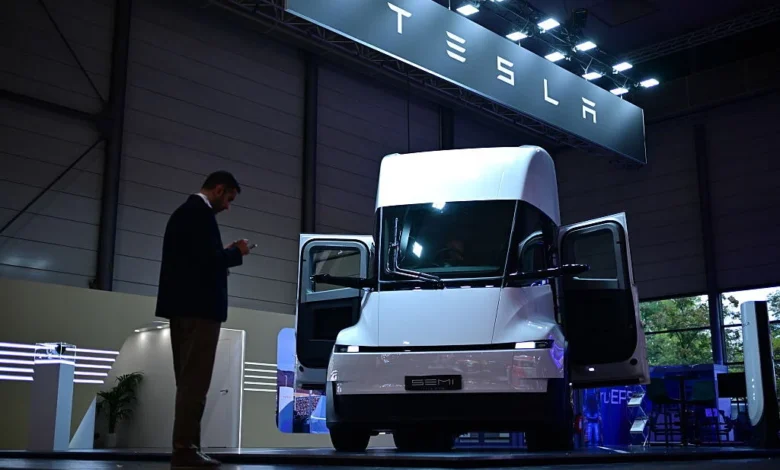
The landscape of American commercial freight is undergoing a profound and unexpected transformation, caught in the crosshairs of shifting political priorities, geopolitical instability, and extreme volatility in global energy markets. In a development that underscores the complex economic realities facing the logistics sector, a major coalition of corporate shippers has finalized a record-breaking procurement agreement for 2,500 Tesla Semi trucks. This massive order arrives paradoxically at a time when the federal government has dismantled key financial pillars supporting the electric vehicle industry, yet soaring fuel costs driven by international conflict have rendered electric propulsion an undeniable financial imperative for commercial fleets.
The blockbuster order, coordinated by a consortium of major corporate stakeholders including technology giant Microsoft and consumer goods conglomerate PepsiCo, represents a watershed moment for heavy-duty electrification. Scheduled for delivery beginning immediately and rolling out over the subsequent 18 months, the deployment of these 2,500 class-8 electric semi-trucks is poised to fundamentally alter the composition of American freight transportation. Industry analysts note that if these vehicles successfully reach their operational destinations on schedule, they will nearly double the total volume of heavy-duty electric trucks currently navigating United States roadways, marking a massive leap forward for commercial zero-emission transportation infrastructure.
Shifting Political Landscapes and Federal Policy Rollbacks
The timing of this historic commercial vehicle acquisition is particularly striking given the recent, dramatic shifts in federal policy regarding sustainable transportation. Over the past year, the political coalition that returned the Trump administration to the White House—a political machine bolstered significantly by substantial financial contributions from Tesla Chief Executive Officer Elon Musk—has systematically dismantled billions of dollars in federal subsidies, tax credits, and financial support designated for electric vehicles and clean energy infrastructure.
Concurrently, federal regulatory agencies have actively moved to relax fuel economy standards for heavy-duty truck engines. Previous regulatory frameworks had established aggressive emissions reduction targets designed to steer manufacturers toward sustainable technologies, addressing a critical environmental sector where heavy-duty commercial trucks account for roughly 7 percent of total United States greenhouse gas emissions. The deliberate rollback of these standards, alongside the evaporation of federal purchase incentives, was widely predicted by industry experts to severely dampen corporate appetite for fleet electrification.
Instead, free-market economic pressures have rapidly superseded legislative reversals. The unexpected catalyst has emerged from the global oil markets, where ongoing military conflict involving Iran has severely disrupted crude oil production, refining capacity, and maritime shipping lanes throughout the Middle East. The resulting supply shock has sent diesel prices skyrocketing to unprecedented heights. Within the span of a single month, benchmark diesel prices in the United States reached historic records, soaring to nearly double the rates observed during the corresponding period in the previous year.
Addressing these dramatic macroeconomic developments in a pre-taped industry address, Musk highlighted the inescapable mathematics driving corporate purchasing decisions. The commercial truck sector, he noted, is pivoting toward electrification because the operational economics have become overwhelmingly favorable. Despite the loss of federal subsidies, the cost differential between traditional diesel fuel and electricity has widened dramatically, making electric semis an exceptionally sound investment for logistics operations navigating a deeply unstable energy landscape. The irony of this economic lifeline was not lost on industry observers, as these market conditions stem directly from geopolitical tensions involving the very presidential administration Musk previously advised through the Department of Government Efficiency.
Inside the Record-Setting Procurement Deal
The logistics coalition behind the massive Tesla Semi order arrived at their decision following a rigorous evaluation process. According to Meena Bibra, a spokesperson for the nonprofit Smart Freight Centre, which provided strategic guidance and facilitation for the transaction, the procurement group conducted comprehensive assessments comparing multiple heavy-duty electric vehicle platforms. The selection criteria focused heavily on upfront pricing, operational performance, manufacturing capacity, and the reliability of post-sale service and support infrastructure.
While Tesla emerged as the primary beneficiary of this specific multi-carrier purchasing pool, the broader collaborative strategy was designed to leverage collective bargaining power. By pooling the purchasing demand of numerous commercial carriers, the alliance successfully negotiated volume pricing structures that significantly lowered the per-unit cost of the new trucks, overcoming one of the primary historical barriers to commercial fleet electrification.
Nevertheless, market diversity remains a cornerstone of the broader freight transition. Industry analysts emphasize that while Tesla secured this landmark win, commercial carriers retain diverse operational requirements. Fleets accustomed to legacy vehicle architectures, or those requiring specialized configurations, continue to evaluate and procure electric heavy-duty alternatives from established commercial manufacturers such as Kenworth, Ride, and Volvo. The ability of multiple manufacturers to secure market share indicates a maturing commercial EV ecosystem that extends well beyond any single corporate entity.
Technological Roadmap and Autonomous Aspirations
Despite the enthusiasm surrounding the physical deployment of the Tesla Semi, questions remain regarding the integration of advanced technological features promised during the vehicle’s long development cycle. Notably, Tesla’s proprietary driver assistance software, marketed as Full Self-Driving (Supervised), was notably absent from the specifications of the vehicles currently slated for delivery.
The integration of advanced automation into heavy commercial vehicles represents both a massive potential efficiency gain and a significant regulatory hurdle. During his address, Musk indicated that the driver-assistance technology would eventually debut on the Semi platform in "the very near future." However, this projection evokes memories of the vehicle’s initial unveiling in 2017, when early iterations of the technology—then termed Enhanced Autopilot—were heavily emphasized as core selling points for long-haul fleet operators. Fleet managers and safety advocates alike continue to monitor how autonomous and semi-autonomous systems will be certified and integrated into heavy commercial transport, where safety margins carry immense public consequence.
Economic Implications and the Future of Freight
The convergence of record-high diesel costs and this historic fleet acquisition signals a critical inflection point for the American logistics and transportation sectors. For years, the commercial adoption of electric heavy-duty trucks faced intense skepticism regarding battery range, charging infrastructure availability, payload capacity, and total cost of ownership. While federal policy shifts initially threatened to stall momentum, soaring liquid fuel expenses have fundamentally rewritten the financial equation for fleet operators.
Corporations operating massive logistics networks, such as Microsoft and PepsiCo, are increasingly viewing fleet electrification not merely as a corporate sustainability initiative, but as a vital risk-management strategy against the extreme volatility of fossil fuel markets. By securing predictable electrical energy costs, these enterprises can better insulate their supply chains from external geopolitical shocks.
As the first wave of these 2,500 Tesla Semis rolls out over the next year and a half, industry analysts will closely monitor their real-world performance, charging reliability, and maintenance costs. The success or failure of this deployment will likely serve as the definitive benchmark for the rest of the commercial trucking industry, determining whether heavy-duty freight can successfully sever its historic dependence on petroleum, regardless of the shifting tides of federal policy and political administration.