
Conquering Decision Fatigue: Strategies for Sharper Choices and a More Productive Life
Decision fatigue, a phenomenon where the quality of decisions deteriorates after a long session of decision-making, is an insidious drain on mental resources. It’s the feeling of being overwhelmed by choices, leading to impulsivity, avoidance, or simply making the easiest, rather than the best, option. This article provides actionable, SEO-optimized strategies to combat decision fatigue and reclaim your cognitive power for more effective decision-making, enhanced productivity, and a generally less draining daily existence. Understanding the underlying mechanisms of decision fatigue is the first step to mitigating its impact. Each decision, regardless of its perceived importance, draws from a finite pool of mental energy. This energy is responsible for executive functions like impulse control, complex problem-solving, and rational judgment. As this pool depletes, our ability to engage these functions weakens. Consequently, we become more susceptible to making poor choices, deferring important tasks, or resorting to default options that may not align with our long-term goals. Recognizing the symptoms – increased irritability, procrastination, difficulty concentrating, and a tendency to make impulsive or suboptimal choices – is crucial for identifying when decision fatigue is taking hold.
The Science Behind Decision Fatigue: Depleting Your Willpower
The concept of decision fatigue is deeply rooted in the theory of ego depletion, famously proposed by Roy Baumeister. This theory posits that willpower, often thought of as a boundless resource, is in fact a limited commodity that can be exhausted through use. Every act requiring self-control, whether it’s resisting a tempting dessert, suppressing an emotional outburst, or making a difficult choice, draws upon this same limited pool. When this pool is depleted, our ability to exert self-control in subsequent situations is compromised. This has profound implications for decision-making. Imagine a day filled with myriad choices, from what to wear to what to eat for breakfast, to the complex strategic decisions at work. Each of these, however minor, contributes to this depletion. As the day progresses, the cognitive load increases, and the capacity for making sound, well-considered decisions diminishes. This leads to a cascade of negative effects. For instance, faced with a complex work project requiring multiple strategic decisions, a fatigued mind might opt for the path of least resistance, a superficial solution that offers immediate relief but lacks long-term efficacy. Similarly, personal choices can suffer, leading to unhealthy eating habits, impulsive purchases, or neglecting important personal responsibilities. Understanding this physiological and psychological basis is paramount for developing effective counter-strategies. It’s not about being lazy or lacking in willpower; it’s about managing a finite resource.
Identifying the Symptoms: When Your Brain Says "Enough"
Recognizing the early warning signs of decision fatigue is paramount to proactively addressing it. These symptoms often manifest subtly, gradually impacting your cognitive abilities and behavioral patterns. One of the most prevalent indicators is a noticeable decrease in the quality of your decisions. You might find yourself making rash choices, opting for the easiest or most immediate solution without proper deliberation, or experiencing buyer’s remorse more frequently. This can extend to both minor decisions, like choosing what to order at a restaurant, and major ones, like making a significant career move. Beyond decision quality, you may experience a general decline in mental clarity and focus. Concentration becomes a struggle, tasks that were once straightforward now feel arduous, and you might find your mind wandering frequently. This cognitive fog can significantly hinder productivity and efficiency.
Another common symptom is increased irritability and emotional volatility. As your mental resources dwindle, your ability to regulate emotions and maintain patience erodes. Minor annoyances can escalate into significant frustrations, and you might find yourself snapping at colleagues or loved ones more readily. This can strain relationships and create a negative work or home environment. Procrastination is another tell-tale sign. Faced with yet another decision, your brain might simply shut down, opting to delay the choice altogether. This can lead to missed deadlines, mounting stress, and a feeling of being constantly behind. Finally, a general sense of apathy or overwhelm can set in. The sheer volume of choices, even seemingly trivial ones, can feel insurmountable, leading to a desire to disengage and avoid making any decisions at all. Acknowledging these symptoms allows for early intervention, preventing the cascade of negative consequences associated with prolonged decision fatigue.
Strategy 1: Simplify and Automate – Reduce the Number of Decisions
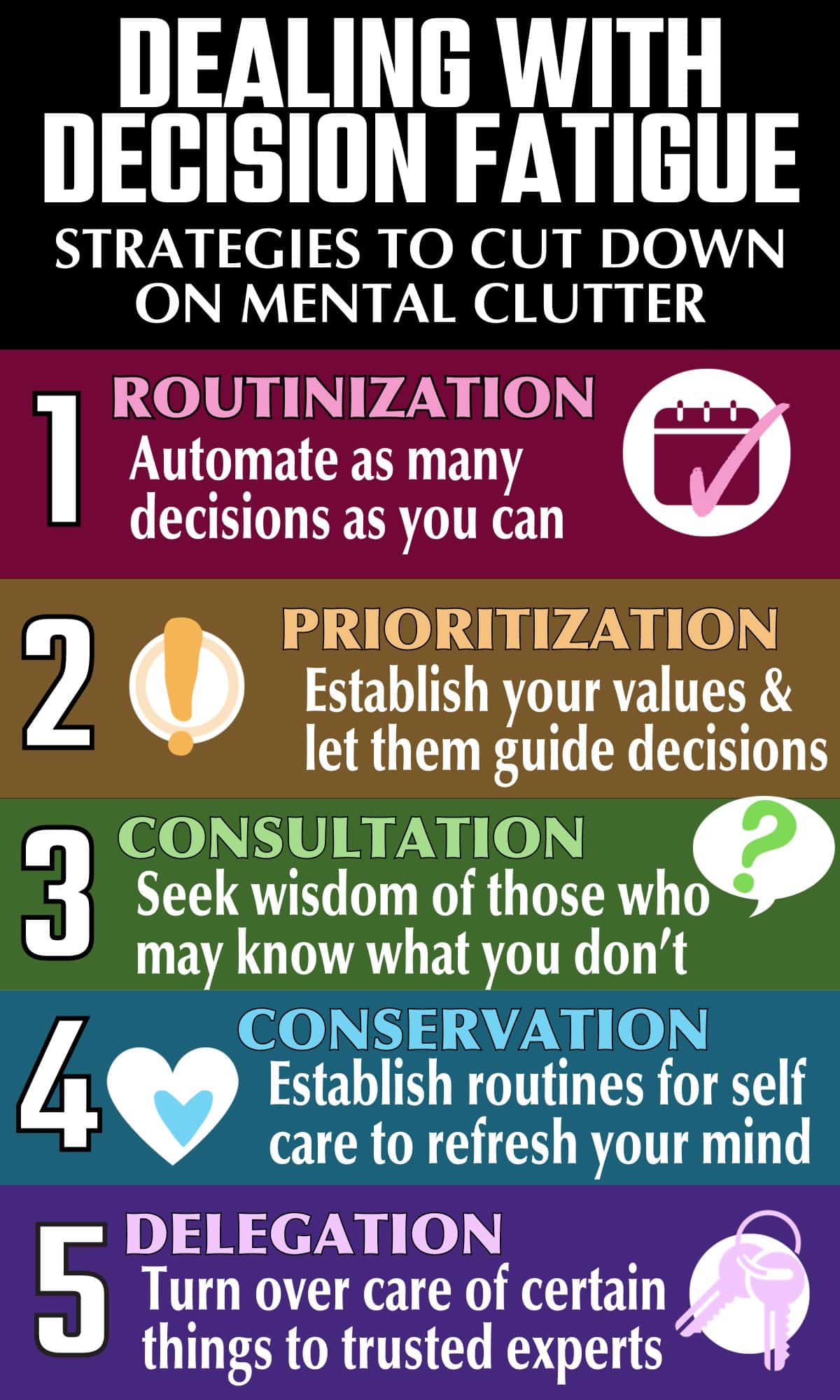
The most effective way to combat decision fatigue is to reduce the sheer number of decisions you need to make. This involves a conscious effort to simplify your routines and automate recurring choices. Consider establishing pre-set options for daily activities. For example, create a weekly meal plan to eliminate the daily question of what to cook. This can be as simple as dedicating specific days to certain types of cuisine or pre-batching meals on the weekend. Similarly, designate specific days for laundry, grocery shopping, or other recurring chores to create predictable patterns.
For clothing, consider developing a capsule wardrobe or a few go-to outfits for different occasions. This eliminates the morning indecision about what to wear. Automate as many financial decisions as possible. Set up automatic bill payments to avoid the monthly task of tracking due dates. Consider setting up automatic transfers to savings or investment accounts to streamline your financial planning. At work, identify recurring tasks or processes that can be standardized or templated. This can include email responses, project management workflows, or report generation. By creating consistent systems and relying on pre-determined choices, you conserve your mental energy for the truly critical decisions that require your full cognitive capacity. This strategic reduction in decision volume is not about being rigid; it’s about creating mental space by minimizing the everyday cognitive load.
Strategy 2: Prioritize and Delegate – Focus Your Mental Energy
Once you’ve reduced the number of decisions, the next crucial step is to prioritize what truly matters and delegate what you can. Not all decisions are created equal. Implement a system for categorizing decisions based on their importance and urgency. The Eisenhower Matrix, which categorizes tasks into four quadrants (Urgent and Important, Important but Not Urgent, Urgent but Not Important, Not Urgent and Not Important), can be a powerful tool here. Focus your depleted mental energy on the "Important" quadrants, particularly "Urgent and Important" and "Important but Not Urgent."
Delegate any decision that falls into the "Urgent but Not Important" category to someone else if possible. This could involve delegating tasks at work to team members or assigning household chores to family members. Empowering others to make these decisions frees up your cognitive resources. For decisions that are "Not Urgent and Not Important," either eliminate them entirely or defer them until your decision-making capacity is replenished. Regularly review your responsibilities and identify opportunities for delegation. This requires trust in others and effective communication of expectations. By strategically allocating your decision-making power, you ensure that your most valuable cognitive resources are dedicated to the choices that will have the greatest impact, both personally and professionally. This conscious prioritization prevents the squandering of mental energy on low-impact choices.
Strategy 3: Establish Routines and Habits – Build Cognitive Shortcuts
Routines and habits are powerful allies in the fight against decision fatigue because they transform choices into automatic behaviors. They create cognitive shortcuts, allowing your brain to bypass conscious deliberation for recurring tasks. Think of brushing your teeth or driving a familiar route; these are actions performed with minimal conscious thought because they have become ingrained habits. Apply this principle to various aspects of your life. For instance, establishing a consistent morning routine can eliminate numerous small decisions. This could include waking up at the same time, performing a set sequence of activities like stretching, meditating, or having a specific breakfast.
Similarly, a structured evening routine can prepare you for the next day, reducing morning chaos. This might involve laying out clothes, packing your lunch, or reviewing your schedule. At work, create standardized procedures for common tasks. This could involve using templates for emails, developing checklists for project phases, or establishing a consistent method for organizing your digital files. The key is to identify recurring actions and consciously work to turn them into habits. This requires discipline initially, but once established, these habits require very little mental effort. Regularly reflecting on your daily activities can help identify areas where routines can be beneficial. By building a framework of predictable behaviors, you significantly reduce the number of conscious decisions you need to make, preserving your mental energy for more complex and impactful choices.
Strategy 4: Optimize Your Environment – Reduce External Triggers
Your environment plays a significant role in triggering decisions and contributing to decision fatigue. Minimizing external stimuli that demand your attention and choice can be remarkably effective. This involves creating physical and digital spaces that support focus and reduce distractions. In your physical workspace, decluttering is paramount. A cluttered desk or office can lead to a cluttered mind, forcing you to make more decisions about where to place things or what to focus on. Organize your workspace so that frequently used items are easily accessible and everything else is stored away.
In the digital realm, this translates to managing your notifications. Constant pings from emails, social media, and messaging apps fragment your attention and force you to make split-second decisions about whether to engage. Turn off non-essential notifications and schedule specific times to check emails and social media. Create dedicated focus time by blocking out periods in your calendar where you will not be interrupted. Consider using website blockers or productivity apps that limit access to distracting websites during work hours. Even small environmental changes, such as having a designated spot for your keys or wallet, can reduce the mental effort required for these everyday decisions. By proactively managing your environment, you create a more conducive space for sustained focus and minimize the cognitive load imposed by external demands.
Strategy 5: Mindful Decision-Making and Breaks – Recharge Your Cognitive Batteries
Even with the best strategies for reduction, some decisions are unavoidable. For these, adopting a mindful approach and incorporating regular breaks is crucial. Before making a significant decision, pause and acknowledge your current mental state. Are you feeling tired, stressed, or rushed? If so, it might be wise to postpone the decision until you are more refreshed. Practicing mindfulness can help you become more aware of your cognitive limitations and emotional triggers, enabling you to make more rational choices.
Regular breaks are not a luxury; they are a necessity for replenishing your decision-making capacity. Short, frequent breaks throughout the day can be more effective than one long break. Step away from your work, engage in light physical activity, or simply close your eyes and breathe deeply. These micro-breaks allow your brain to reset and recover. Consider incorporating longer breaks, such as a lunch break away from your desk, or even a short walk in nature. These longer pauses provide a more substantial cognitive recharge. When faced with a complex decision, break it down into smaller, more manageable components. Address each part systematically rather than trying to solve the entire problem at once. By integrating mindful pauses and strategic breaks into your workflow, you ensure that you are approaching decisions with a clear and rested mind, leading to better outcomes and a more sustainable pace of work.
Conclusion: Sustainable Productivity Through Decision Management
Combating decision fatigue is not about eliminating choices entirely, but about managing them strategically. By understanding the science behind this cognitive drain, recognizing its symptoms, and implementing practical strategies for simplification, prioritization, routine building, environmental optimization, and mindful breaks, you can significantly improve your decision-making abilities. This leads to enhanced productivity, reduced stress, and a greater sense of control over your daily life. The ongoing practice of these techniques fosters sustainable productivity, enabling you to tackle challenges with clarity and confidence. Investing in managing your decision-making capacity is an investment in your overall well-being and effectiveness.

