
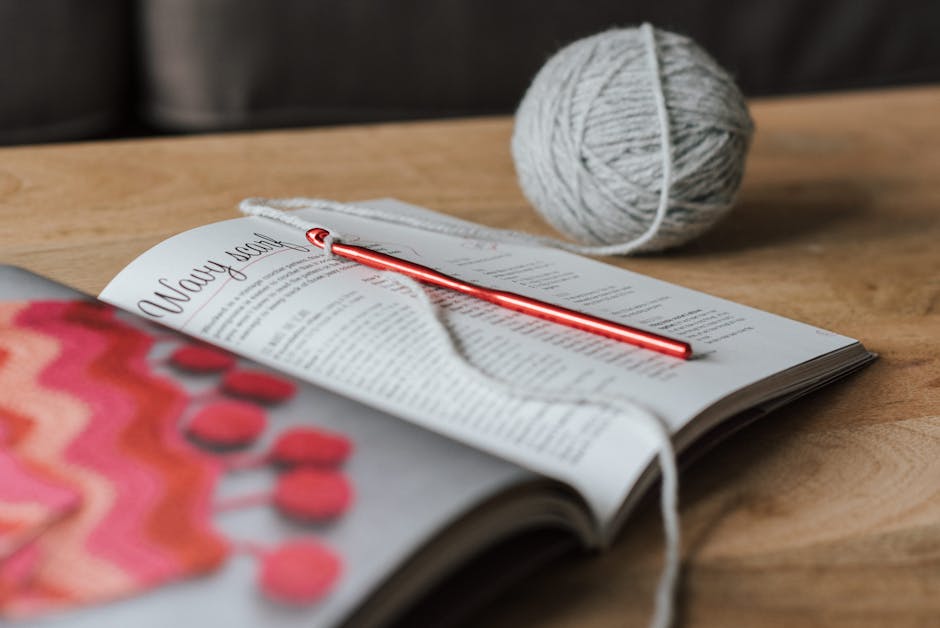
Mastering Crochet Basics: Your Essential Guide to Reading Patterns
Embarking on a crochet journey necessitates a fundamental understanding of crochet basics and, critically, the ability to decipher crochet patterns. These patterns act as blueprints, guiding crocheters through the creation of intricate stitches, shaping, and ultimately, finished projects. This guide provides a comprehensive overview of the essential crochet stitches, pattern terminology, and techniques required to confidently read and execute any crochet pattern. Understanding the anatomy of a crochet pattern is the first hurdle. Typically, patterns begin with a list of materials required, including the type and weight of yarn, the recommended hook size, and any necessary notions like stitch markers, tapestry needles, or buttons. Following this, you’ll find a gauge swatch instruction. Gauge refers to the number of stitches and rows per a specific measurement (usually 4 inches or 10 cm). Achieving the correct gauge is crucial for ensuring your finished project matches the intended size. A swatch allows you to check if your tension (how tightly or loosely you crochet) is consistent with the pattern designer’s. If your swatch has more stitches or rows than specified, your tension is too tight, and you’ll need to use a larger hook. Conversely, if it has fewer, your tension is too loose, and a smaller hook is required.
The core of any crochet pattern lies in the stitch abbreviations and special instructions. These are often presented in a dedicated section or within the pattern itself. Familiarizing yourself with these abbreviations is paramount. The most fundamental crochet stitches, and their common abbreviations, include: the chain stitch (ch), the slip stitch (sl st), the single crochet (sc), the half double crochet (hdc), the double crochet (dc), the treble crochet (tr), and the double treble crochet (dtr). Each of these stitches forms the building blocks for more complex designs. Understanding the how behind each stitch is as important as recognizing its abbreviation. For instance, the chain stitch is the foundation of most crochet projects. It’s created by looping the yarn and pulling it through a loop on the hook. The slip stitch is used to join rounds, create edges, or move yarn without adding height. Single crochet is the shortest of the basic stitches, creating a dense fabric. Half double crochet adds a bit more height and creates a slightly looser fabric than single crochet. Double crochet is a common stitch that creates more height and a looser, drapier fabric. Treble crochet and double treble crochet are even taller stitches, creating very open and lacy fabrics.
Beyond basic stitches, patterns will introduce variations and modifiers. Common modifiers include "in the front loop only" (FLO) and "in the back loop only" (BLO). Crocheting into specific loops affects the fabric’s texture and appearance. Working in the FLO creates a ribbed effect, while working in the BLO can create a similar texture or allow the unused loop to create a visible horizontal bar, often used for seaming or creating decorative edges. Patterns will also specify how to work stitches into a previous row or round. For example, "sc in next 5 stitches" means to work one single crochet into each of the next five stitches of the preceding row. Understanding "stitch count" is vital. Patterns will often tell you how many stitches you should have at the end of a row or round. If your stitch count doesn’t match, it indicates an error that needs to be identified and corrected before proceeding. "Turning chain" is another critical element. When you reach the end of a row, you’ll often work a specific number of turning chains to bring your yarn to the correct height for the next row. For instance, a turning chain of 1 is common for single crochet, while a turning chain of 2 or 3 is typical for half double crochet and double crochet, respectively. It’s important to note that sometimes the turning chain counts as a stitch, and other times it does not. The pattern will explicitly state this.
Reading a crochet pattern involves a sequential approach. Most patterns are written from right to left, following the progression of your stitches. Each row or round is typically presented as a separate line or paragraph, with stitch instructions clearly delineated. You’ll see instructions like "Row 1: ch 21. sc in 2nd ch from hook and in each ch across. Turn. (20 sc)" This means: start with a chain of 21 stitches. Then, work a single crochet into the second chain from your hook, and continue working a single crochet into each subsequent chain until you reach the end of the chain. At the end of the row, turn your work. You should have a total of 20 single crochet stitches. Understanding how to read stitch counts within parentheses at the end of each row or round is crucial for confirming your progress.
Working in the round introduces a new set of concepts. Patterns for hats, amigurumi, or blankets often begin by working in a magic ring (also called a magic circle or adjustable loop) or by chaining a few stitches and joining them to form a ring. This creates a seamless starting point for circular projects. Instructions for working in the round might look like: "Round 1: Make a magic ring. ch 1, 8 sc in ring. Pull ring tight. Join with sl st to first sc. (8 sc)" This instructs you to create a magic ring, chain 1 (which typically doesn’t count as a stitch in this context), work 8 single crochets into the magic ring, pull the ring tight to close the center hole, and then join the round by inserting your hook into the first single crochet and completing a slip stitch. Again, the stitch count at the end of the round is your confirmation.
Increasing and decreasing stitches are fundamental techniques for shaping crochet fabric. Increases add stitches, making the fabric wider, while decreases remove stitches, making it narrower. Common increase methods include working two or more stitches into the same stitch. For example, "2 sc in next stitch" or "3 hdc in next stitch." Decrease methods involve crocheting two or more stitches together as if they were one. The most common decrease for single crochet is the "single crochet two together" (sc2tog). This is typically worked by inserting your hook into the first stitch, yarning over, and pulling up a loop (two loops on hook). Then, insert your hook into the next stitch, yarn over, and pull up another loop (three loops on hook). Finally, yarn over and pull through all three loops on your hook. The pattern will specify the type of decrease (e.g., "dc2tog" for double crochet two together) and where to work it.
More advanced techniques found in patterns include: working in a specific stitch, such as "sc in the third loop of hdc," which creates a distinctive ribbed texture. "Post stitches," like front post double crochet (fpdc) and back post double crochet (bpdc), involve working around the "post" of a stitch from the previous row, creating raised, textured patterns. Working "clusters" of stitches, where multiple stitches are worked into the same stitch space and then joined together, is another common technique. "Shells" are a type of cluster where several double crochets are worked into the same stitch. Familiarizing yourself with these variations will unlock a vast array of design possibilities.
Understanding pattern conventions is equally important. Brackets [] and parentheses () are used to group instructions that are repeated. For instance, [sc in next st, 2 sc in next st] 6 times means you will work the sequence "single crochet in the next stitch, then two single crochets in the next stitch" a total of six times. Asterisks * or other symbols are sometimes used as markers to indicate a point in the pattern that will be referenced later, such as in repeat sections. Some patterns use color coding to indicate different sections or yarn changes, though this is less common in written patterns and more prevalent in charts.
Finally, don’t underestimate the power of visual aids and external resources. Many patterns include schematic diagrams or photos that illustrate specific techniques or stitch patterns. Online tutorials, videos, and crochet communities are invaluable resources for clarifying any confusing aspects of a pattern. If a written explanation of a stitch or technique remains unclear, searching for a video demonstration can often provide the necessary visual understanding. When starting out, it’s advisable to choose patterns labeled as "beginner" or "easy." These patterns typically utilize basic stitches and straightforward construction, allowing you to build confidence and familiarity with pattern reading. As your skills progress, you can gradually tackle more complex patterns. The key to mastering crochet patterns is consistent practice and a willingness to learn. With dedication and this comprehensive understanding of the basics, you’ll soon be confidently interpreting and creating beautiful crochet projects.

