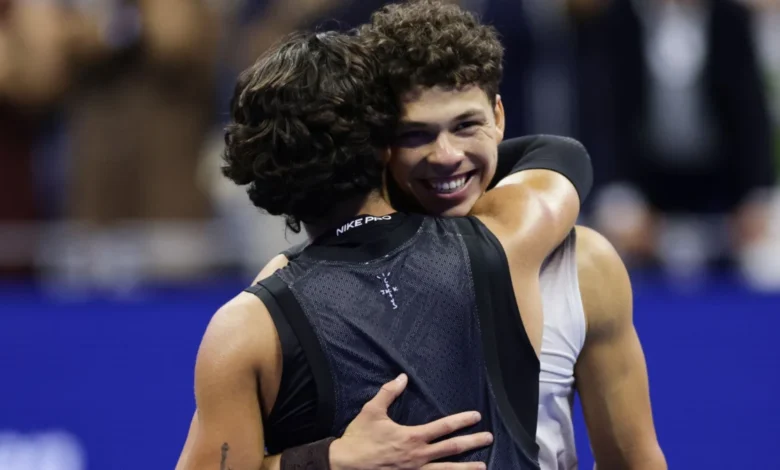
The clock struck 3:33 a.m. local time inside a buzzing Arthur Ashe Stadium when American rising star Ben Shelton struck a decisive, clean ace past Carlos Alcaraz to capture a grueling five-set victory. While the remaining thousands of spectators erupted in a delirious chorus of cheers and chants for the home favorite, the historic timestamp once again thrust the contentious issue of late-night finishes at major tennis tournaments into the global spotlight.
The quarterfinal thriller, which secured Shelton a marquee victory, did not actually commence until well past 11:00 p.m. on Tuesday evening. A succession of three exceptionally long daytime and evening matches on the tournament’s premier court created a cascading delay that pushed the marquee men’s showdown into the early hours of the morning. While tournament organizers, broadcasters, and fans frequently celebrate the electric atmosphere of nocturnal tennis, a chorus of voices from within the sport—including former world number ones, Grand Slam champions, and active competitors—are increasingly questioning the physical and logistical sustainability of these marathon sessions.
The Chronology of a Midnight Marathon
The root cause of the staggering 3:33 a.m. finish lay in the heavily congested Day Nine schedule at Flushing Meadows. Three preceding matches on Arthur Ashe Stadium proved to be arduous, highly competitive affairs that drained the allotted daytime slots and pushed the evening session further back into the night.
By the time Alcaraz and Shelton stepped onto the court, midnight was fast approaching. What followed was a physically demanding, five-set battle of attrition that pushed both athletes to their absolute physical limits. Breaks of serve were hard-fought, long rallies were standard, and the mental concentration required at that hour was extraordinary.
When the final point was finally decided, the sun was merely hours away from rising over New York City. Shelton, visibly exhausted yet exhilarated by the home crowd’s steadfast support, addressed the remaining spectators in his post-match on-court interview.
"It’s incredible," Shelton told the crowd, balancing his elation with a wry nod to the absurdity of the hour. "I always say that this is the greatest sports city in the world, I say that this is the greatest stadium in the world. I’m just hoping that my best friend and my sister over there don’t have to be at work at 6 a.m. in three hours."
The Historical Context of Extreme Tennis Finishes
Shelton’s victory over Alcaraz now sits securely in the record books as one of the latest-finishing singles matches in professional tennis history. However, it is far from an isolated incident. The sport has witnessed a steady creep of match completions occurring well past the traditional bounds of sports entertainment.
The all-time record for the latest singles finish in tennis history remains Alexander Zverev’s victory over Jenson Brooksby at the Abierto Mexicano Telcel in Acapulco in 2022, which concluded at an astonishing 4:54 a.m. Grand Slam tournaments have similarly grappled with the phenomenon. Lleyton Hewitt’s legendary, marathon win over Marcos Baghdatis at the 2008 Australian Open wrapped up at 4:34 a.m., while Andy Murray’s unforgettable five-set escape against Thanasi Kokkinakis at Melbourne Park in 2023 ended at 4:05 a.m. Daniil Medvedev’s win over Emil Ruusuvuori at the 2024 Australian Open added to the trend by finishing at 3:39 a.m., closely followed by Andreas Seppi’s 3:34 a.m. finish against Bobby Reynolds at the 2007 Australian Open. Shelton and Alcaraz’s 3:33 a.m. conclusion at the US Open now safely enshrines New York alongside Melbourne and Acapulco as cities where elite tennis routinely defies the clock.
Player Welfare and Operational Realities
The physical toll of these unprecedented schedules has sparked widespread debate among athletes, coaches, and administrators. The human body requires specific recovery protocols following high-intensity aerobic exercise, and professional tennis players operate at the absolute peak of human physiological capability.
Sleep cycles, nutritional intake, hydration routines, and physical warm-up schedules are entirely derailed when athletes are forced to compete through the night. Belarusian star Aryna Sabalenka addressed the broader systemic issue earlier in the tournament, noting the disruptive nature of erratic scheduling.
"When you finish late, the next day shifts a lot," Sabalenka explained. "Like, you still need to get your hours of sleep, so you start later. You just can really mess up your schedule."
Veterans of the sport have echoed these concerns. Former world number one Venus Williams described late-night starts as "not ideal," pointing out the unique nature of tennis compared to other major global sports.
"I just don’t know any other sport where you have to start that late," Williams said following her own late-night encounter against Sofia Kenin. "I definitely think there’s room for improvement there."
The friction is not solely limited to players. Coaches and trainers face immense difficulties in preparing athletes when recovery windows are slashed from the standard 24 hours down to twelve or fewer.
Industry Reactions and Divided Opinions
The debate has neatly divided the tennis ecosystem into two distinct camps: those prioritizing athlete welfare and competitive integrity, and those balancing commercial, broadcasting, and logistical realities.
Martina Navratilova, a winner of 18 Grand Slam singles titles, voiced her strong disapproval of the scheduling on social media. Writing on X, the former world number one argued that the status quo had crossed an acceptable threshold.
"Something has got to give – this is not OK and it is not normal – no other sport might start at 11 AM or 11 PM. In the same event," Navratilova posted.
Conversely, former US Open champion and tennis analyst Andy Roddick offered a defense of tournament organizers on his Served Podcast, highlighting the logistical hurdles of managing massive crowds at modern sports complexes.
"I know a lot of the comments are, you know, ‘How do you finish at 4 in the morning?’ and all of that," Roddick noted. "Well, every match goes to a match tie-break except for one. And you’ve got to get 25,000 people out of a stadium responsibly, and you’ve got to get 25,000 people in responsibly. So, I hear a lot of complaining. I don’t hear a lot of proposed solutions."
Tournament organizers have generally leaned into the spectacle of the late-night sessions, recognizing their immense value for television ratings and fan engagement. During the tournament, the official US Open social media channels humorously leaned into the late hour, posting a fill-in-the-blank letter template designed for exhausted fans to present to their employers to excuse their absence from work the following morning.
Potential Solutions for Future Grand Slams
As the frequency of matches stretching past midnight increases, tennis stakeholders are actively searching for viable solutions that satisfy broadcasters, ticket-holding fans, and the athletes themselves.
From a commercial perspective, late-night matches are immensely lucrative. Marion Bartoli, a former Wimbledon champion and analyst, acknowledged the economic and entertainment value of the time slot while offering a structural compromise for tournament schedulers.
"From a TV point of view it’s great because you have people on the edge of their sofa and they want to watch the match from home," Bartoli said. "But I will say, ultimately, one match a night especially when you get down to the quarter-finals and you know those matches are going to be a lot closer could potentially be the solution. I’d say in the first week you can have two matches because you know some of the matches might be one-sided, but as you move on, definitely one match."
Other proposed solutions frequently discussed within the tennis community include moving the start time of the evening session earlier—shifting from 7:00 p.m. to 6:00 p.m., for instance—or implementing strict curfew rules similar to those utilized at Wimbledon and other European venues, where matches must halt by a specific hour to protect surrounding residential communities and ensure player recovery.
As the US Open and other Grand Slam tournaments continue to navigate the competing demands of global entertainment markets and athletic endurance, the conversation sparked by Shelton and Alcaraz’s historic encounter shows no signs of abating. For now, tournament schedules remain a high-stakes balancing act between commercial imperative and human limits.